


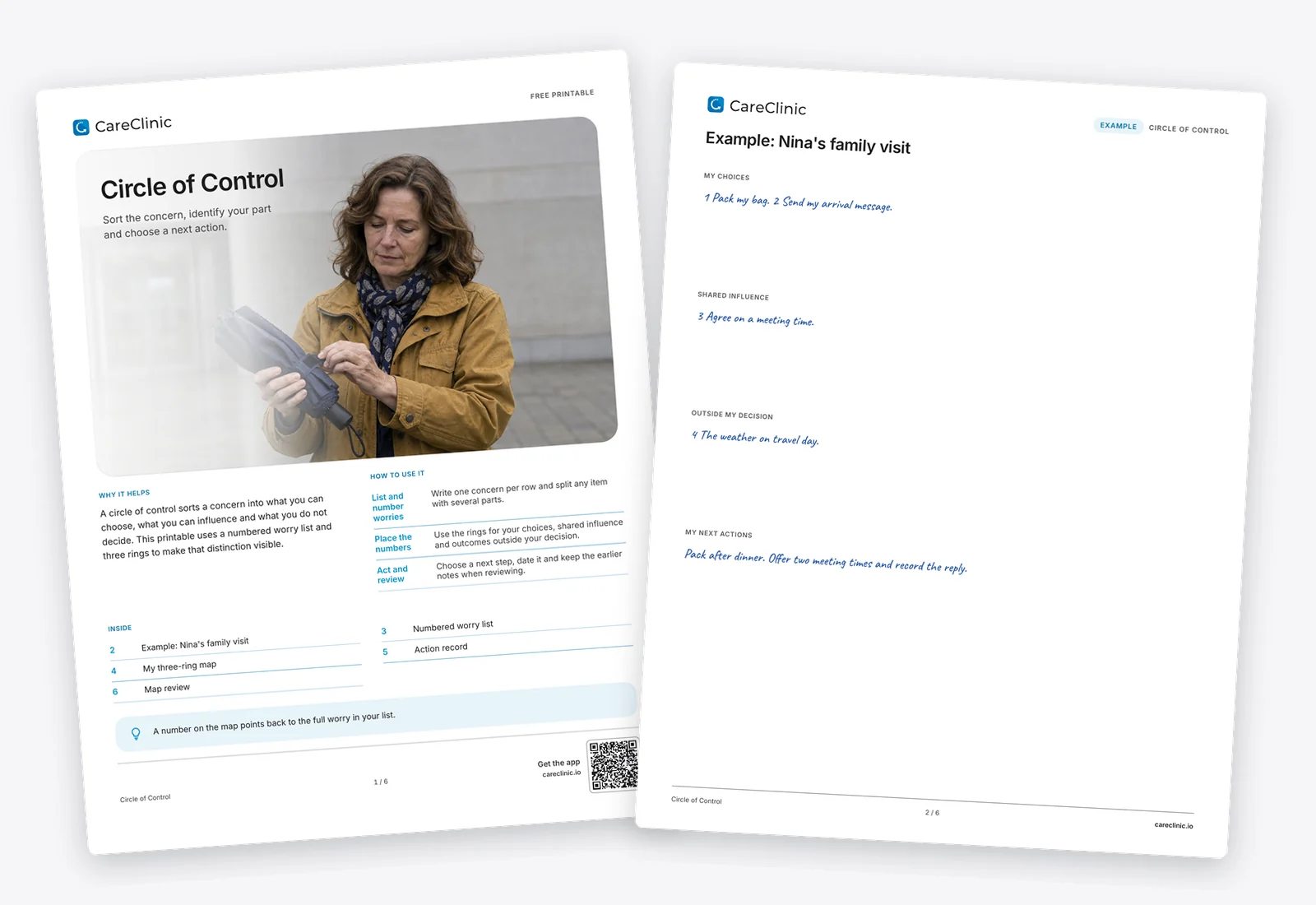
A circle of control sorts a concern into what you can choose, what you can influence and what you do not decide. This printable uses a numbered worry list and three rings to make that distinction visible. An action page then connects the choices in your reach with a next step.
Use the packet for one situation or a short collection of worries. The example follows preparations for a family visit. Blank pages let you keep the full wording in a list while putting only its number into a ring. At review, return to the list and record what you tried, what changed and what still needs a question.
Download the Circle of Control
- Fill it in on your phone or computer, or print it
- US Letter and A4
- Includes a filled example
How it helps
Separate parts of a worry
Describe the part you choose rather than treating the entire outcome as one item.
See influence clearly
Keep shared outcomes apart from actions you can decide yourself.
Choose a next step
Write a specific action and a time beside the worry number.
How to use it
- List and number worries. Write one concern per row and split any item with several parts.
- Place the numbers. Use the rings for your choices, shared influence and outcomes outside your decision.
- Act and review. Choose a next step, date it and keep the earlier notes when reviewing.
What is inside
- Page 1, Circle of ControlInstructions and contents.
- Page 2, Example: Nina's family visitA filled example to follow.
- Page 3, Numbered worry listOne concern per row.
- Page 4, My three-ring mapDate and situation. Write the worry numbers in the matching ring.
- Page 5, Action recordWhat I can choose or contribute.
- Page 6, Map reviewCount in each ring and what I notice. What I tried, what changed and what to revisit. For my next appointment.
See a filled example
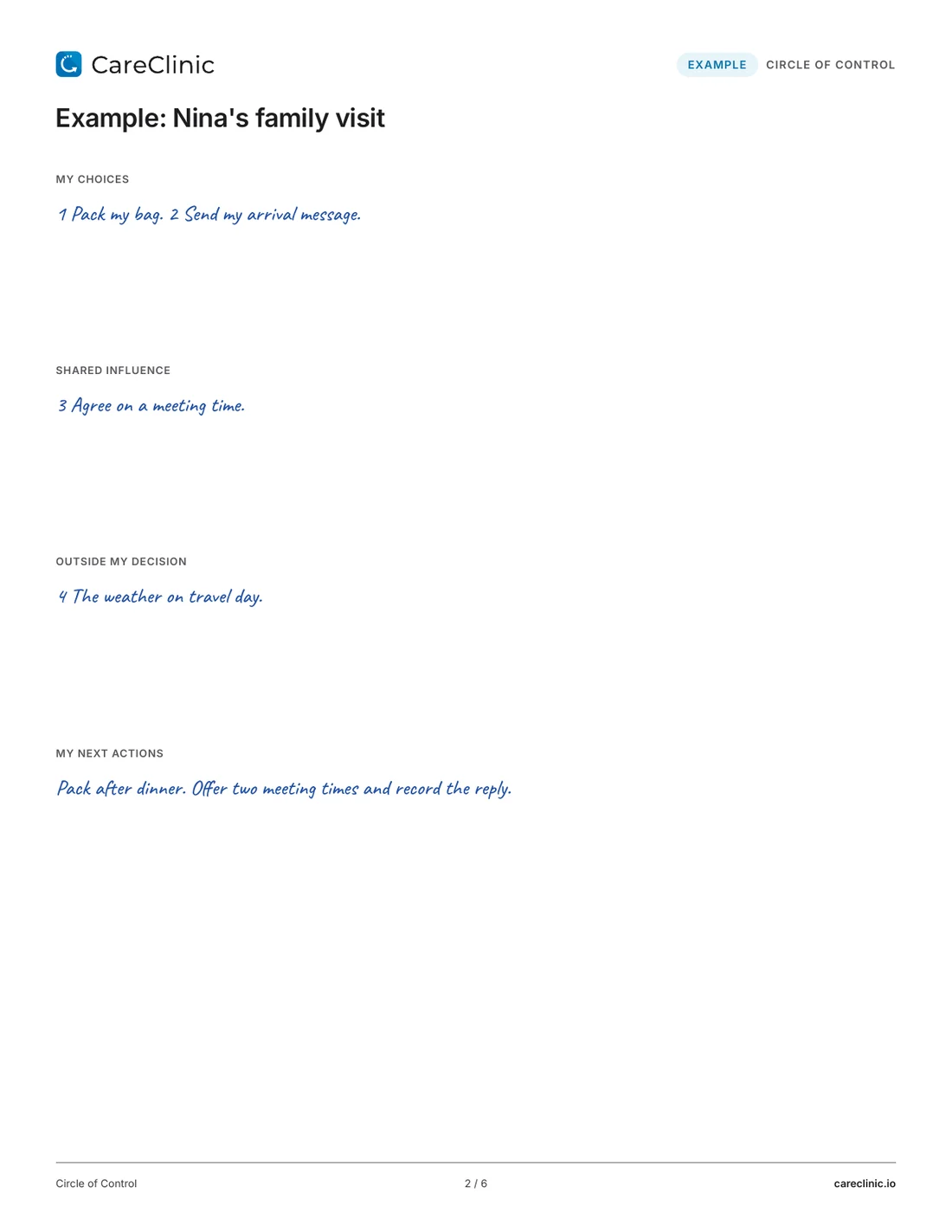
Nina's circle of control example concerns a family visit. Packing her bag and sending her arrival message are choices she can make. Choosing a shared meeting time involves other people, while the weather on the travel day is outside her decision. Her next action is to pack the bag after dinner, and her influence step is to offer two meeting times.
 Open the full PDF
Write the worry before choosing its ring
Start the circle of control list with the actual concern, not only a broad label such as family or work. A sentence about an arrival time or a conversation gives you something specific to examine. Number each row so the ring map can stay readable even when the full wording takes several lines.
One concern may contain several parts. Preparing a message is a different item from receiving the reply you hoped for. Separate those parts before deciding where they belong. The list has twelve rows, and you can use another copy if needed. Keeping the wording beside its number makes later changes easy to understand.
Distinguish choice, influence and concern
The inner ring holds actions or decisions that are yours. The middle ring holds matters where your actions contribute but do not determine the result. The outer ring holds concerns outside your decision. Cheshire East Council describes this three-circle distinction in its wellbeing guidance, including the difference between direct control and influence.
Put the item number in the ring that fits the part you wrote. Nina can decide to pack her bag, but a shared meeting time requires agreement. Weather is a different kind of concern again. A circle of control does not make the outer item unimportant. It identifies a limit on the decision you can make about it.
Keep thoughts and feelings separate from chosen actions
A feeling can arrive without your choosing it. Use the action page for what you intend to do in response rather than demanding that you stop feeling worried. You might write a message, gather information or prepare an item. The feelings wheel can help you name the feeling before deciding what action belongs beside it.
The map can change as the wording becomes clearer. If you placed a whole outcome in the center, ask which action within it is actually yours. Keep the original concern in the list and add the more specific version. You can move its number without pretending the uncertainty has disappeared.
Turn a number in the center into a next step
Choose a small action you can describe and date. Pack the bag after dinner is more specific than prepare for the visit. The action page has columns for the worry number, next step, intended time and what happened. This lets you return to the concern after trying the action.
For an influence item, record the part you will contribute and the response you are waiting for. Nina offers two meeting times, then leaves space for the reply. She can record that contribution without marking the whole shared decision as completed. The circle of control keeps her action visible beside the limit on its outcome.
Return to the map with the record beside it
At review, count items in each ring and read the list that those numbers represent. A larger outer count describes where you placed the concerns, not how well you did. Use the action record to see what you tried and what information became available afterward. One ring is not a score to maximize.
Choose what to revisit next and keep the earlier map. A mental health check-in can hold a broader reflection on the week, while this packet keeps the specific concerns and decisions together. Bring both the list and action page when discussing the pattern so the numbers on the diagram have their full meaning.
Tips that make it work
- Keep the circle of control list beside the map so every number has its wording available.
- Split preparing a request from receiving a particular answer.
- Write chosen actions rather than treating a feeling as an instruction you can switch off.
- Keep the first map when you make another one after trying an action.
Bringing it to your doctor
Bring the worry list, map and action record to an appointment when discussing a recurring pattern of concern. Use the review card for one question about the part you find difficult to sort. The dated action notes show what you tried and what remained uncertain.
Questions
What is a circle of control?
It is a diagram for sorting concerns by the decisions you can make about them. This version has a center for your choices, a middle ring for influence and an outer ring for other concerns.
What are circle of control examples?
Packing a bag is a chosen action in the example. Offering meeting times is a contribution to a shared decision. The travel day weather is outside Nina's decision.
How do I use the circle of influence?
Write the contribution you can make while keeping the shared outcome separate. Record the action you tried and the response or information that followed.
Can I move an item to another ring?
Yes. Keep its wording in the numbered list and revise the part you mean. Move the number when the new wording changes the decision you are describing.
Is this circle of control PDF free?
Yes. The circle of control worksheet is free in US Letter and A4. Both versions include the example, worry list, ring map, action record and review.
More free worksheets

References
- Circles of control. Cheshire East Council. https://www.cheshireeast.gov.uk/system_pages/information-for-staff/wellbeing/self-help/circles-of-control.aspx