


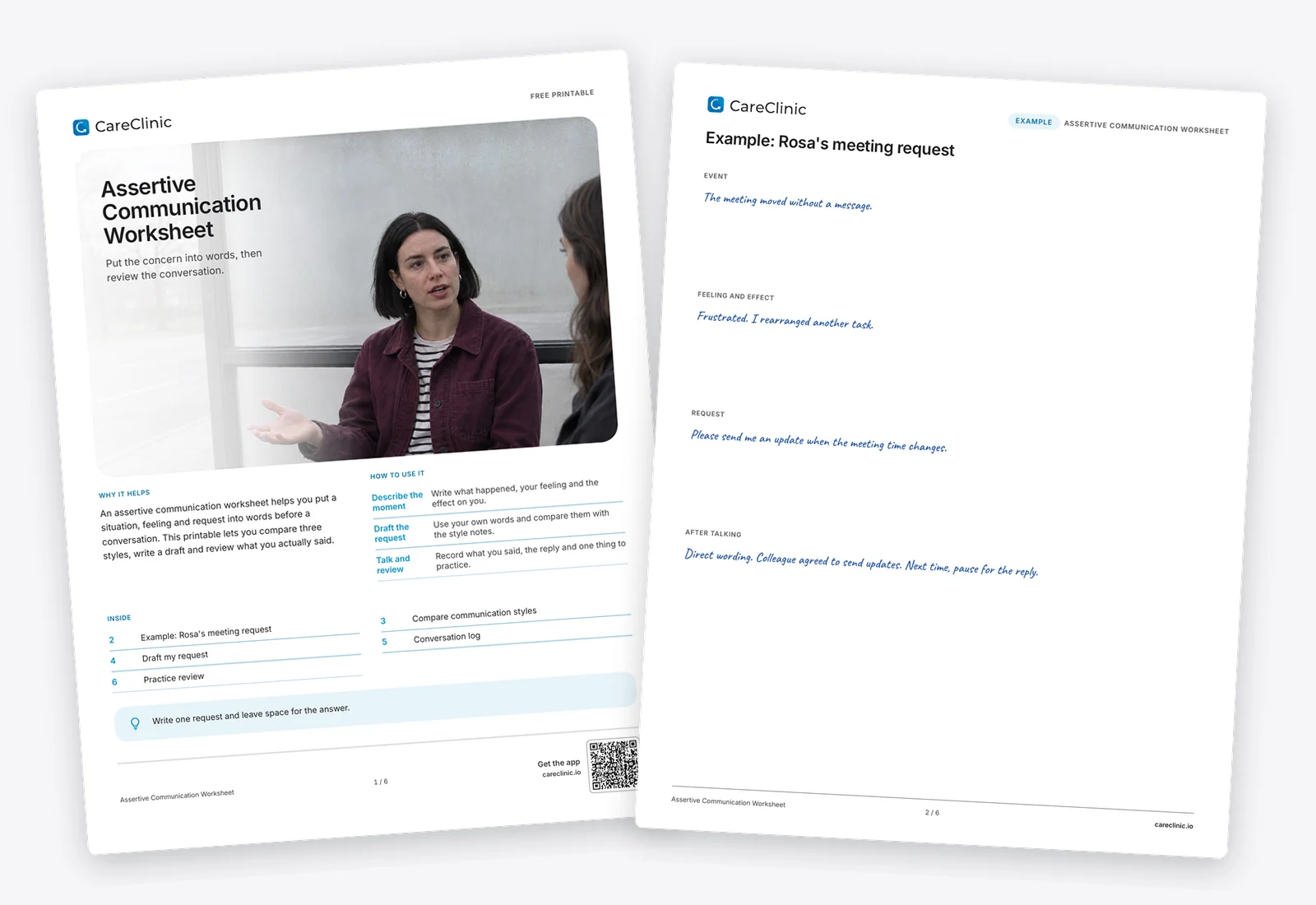
An assertive communication worksheet helps you put a situation, feeling and request into words before a conversation. This printable lets you compare three styles, write a draft and review what you actually said. It includes an example, practice pages, a talk log and a review card.
Use one situation at a time. Describe the event you want to discuss, explain its effect on you and write a request the other person can answer. Afterward, record your own communication style and what the other person said. Keep the draft beside that record to see what changed when you spoke.
Download the Assertive Communication Worksheet
- Fill it in on your phone or computer, or print it
- US Letter and A4
- Includes a filled example
How it helps
A specific situation
Describe an event without turning it into a judgment about the person.
A clear request
Name what you want and leave room for an answer.
A record after talking
Compare your intended words with the words you used.
How to use it
- Describe the moment. Write what happened, your feeling and the effect on you.
- Draft the request. Use your own words and compare them with the style notes.
- Talk and review. Record what you said, the reply and one thing to practice.
What is inside
- Page 1, Assertive Communication WorksheetInstructions and contents.
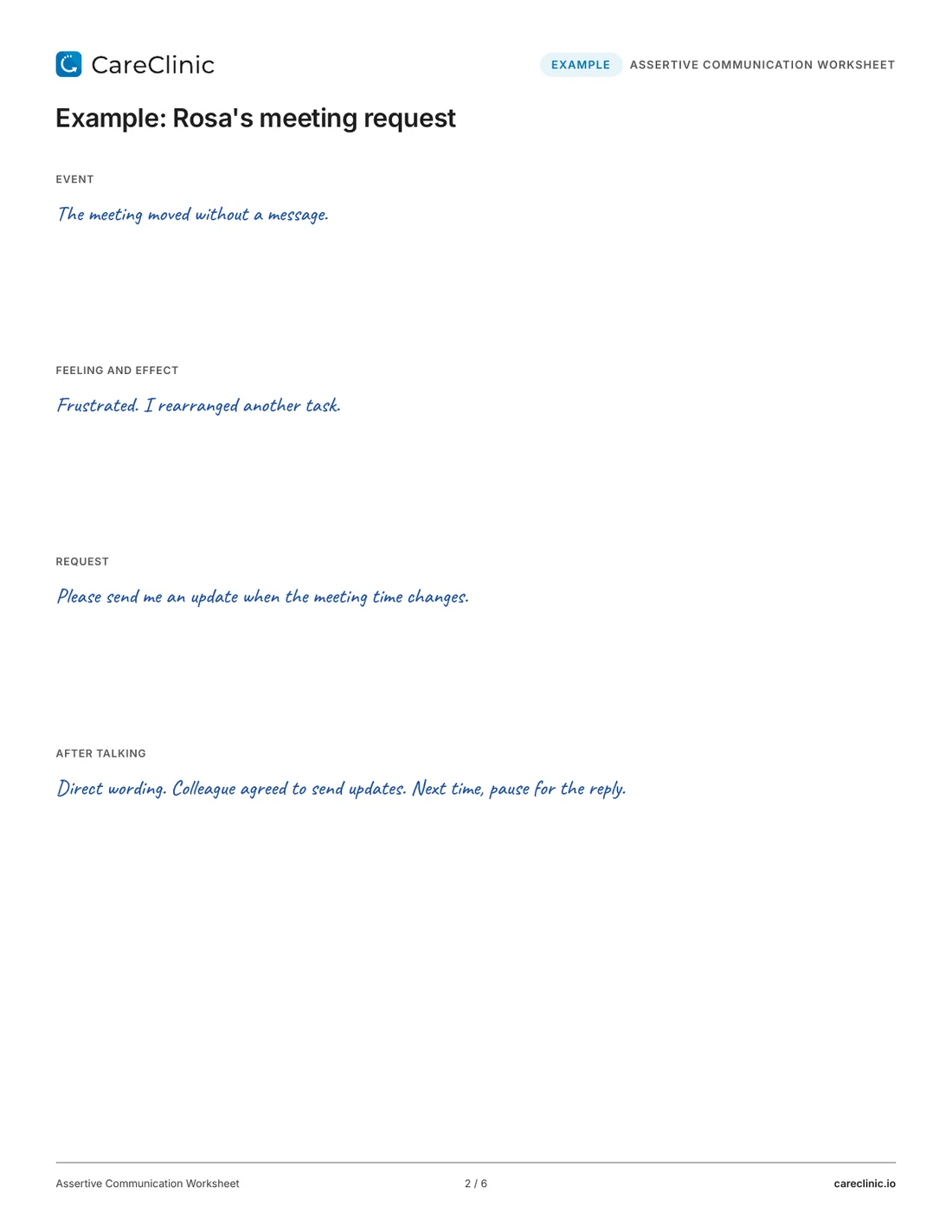
- Page 2, Example: Rosa's meeting requestA filled example to follow.
- Page 3, Compare communication stylesSituation and the point I want to express. Passive version: what stays unsaid. Aggressive version: where blame or orders appear. Assertive version: direct concern and room to reply.
- Page 4, Draft my requestEvent, feeling and effect on me. One action I want to request. My first draft. My revision in words I would say.
- Page 5, Conversation logAfter the conversation.
- Page 6, Practice reviewWhat I notice across calm and tense conversations. One part I want to rehearse and my next situation. For my next appointment.
See a filled example
Rosa's assertive communication worksheet concerns a meeting that moved without a message. She feels frustrated because she rearranged another task. Her request is, Please send me an update when the meeting time changes. After talking, she notes that she used direct wording, the colleague agreed to send updates, and next time she wants to pause for the reply.
 Open the full PDF
Separate the event from a judgment
Begin the assertive communication worksheet with one event you can describe. For example, a meeting moved to another time, a task arrived after a deadline or a plan changed without a message. Write the detail you want to discuss before deciding what it says about the other person.
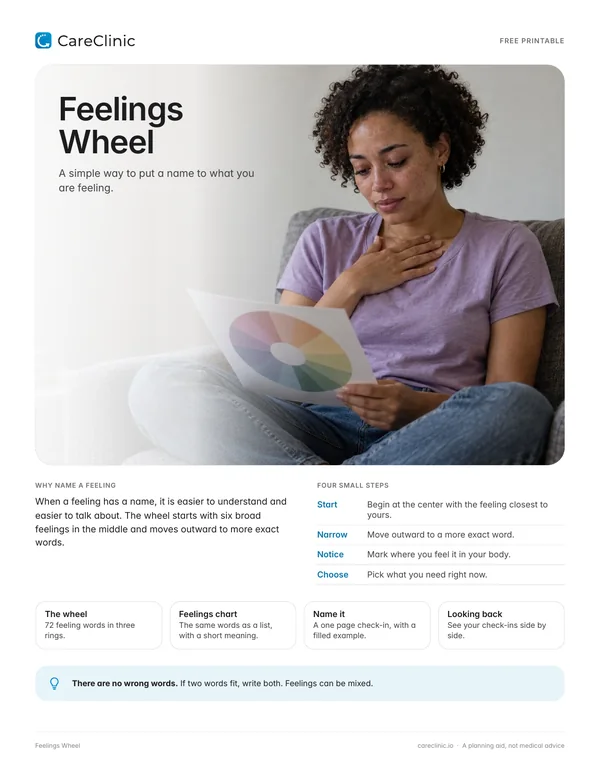
Add the feeling and the practical effect. These are different parts of the draft: frustrated names a feeling, while rearranging another task describes an effect. A feelings wheel can help you find a word when the feeling is hard to name. Keep the event brief enough that the request does not disappear inside a long account.
Compare passive, aggressive and assertive wording
The Centre for Clinical Interventions describes assertiveness as communicating directly while respecting other people. Passive wording may leave your request unstated. Aggressive wording can turn the request into blame or an order. The comparison page gives room to write the same situation in each style and notice what changes.
The point is to hear the difference in the words you chose. Read each draft aloud, then ask whether it states your concern and gives the other person room to answer. Labels such as always or never may deserve another look, but a single word does not establish the style of an entire conversation. Tone and context matter too.
Make a request someone can answer
Choose one request for this attempt. Ask for an action or arrangement that the other person can understand, such as a message when a meeting time changes. Keep it separate from an assumption about what they meant. The assertive communication worksheet has space for an initial draft and a revised version.
Read the revision for vague words, extra apologies and judgments that distract from the request. Keep an apology when you mean it, rather than deleting a word because it appears on a checklist. Write the final version in language you would actually say. A clear sentence can still receive disagreement or a different suggestion.
Record the conversation after it happens
Date the talk log and describe the situation in a few words. Note whether it felt calm, tense or heated, then record the communication style you think you used. The last columns hold the reply and your own observation about how clearly you expressed what mattered. These are reflections, not scores assigned to another person.
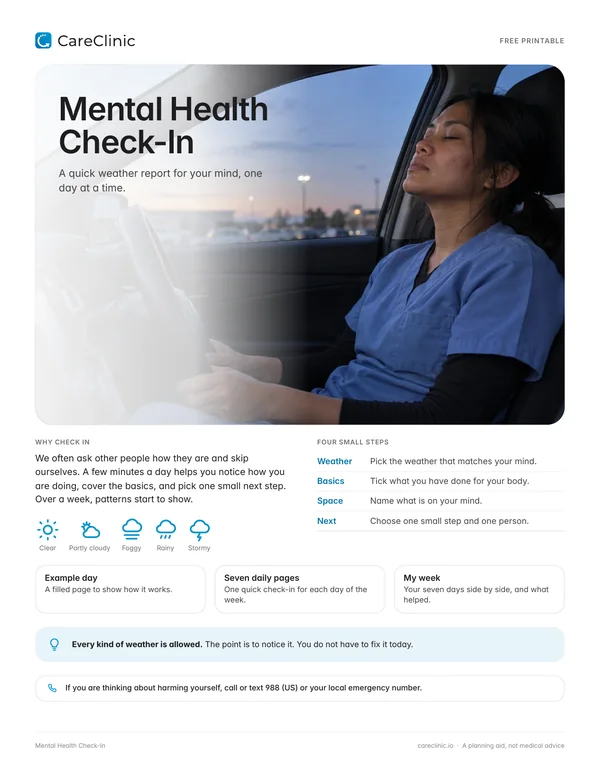
Keep the actual response in the log, including a no or an unanswered request. The outcome is useful information even when it differs from what you hoped. A mental health check-in can hold a broader reflection afterward. Use the same date when you want to connect that note with the conversation entry.
Compare practice with what came out under pressure
At review time, compare several entries instead of relying on the most memorable conversation. Notice whether your request tends to become less direct when you feel tense, or whether the words stay clear but the pace changes. Return to the draft to see which part you want to rehearse again.
Choose one change that concerns your own communication, such as describing the event more briefly or pausing after the request. Keep the earlier assertive communication worksheet as part of the record. The next practice page can use a different situation while the log shows what you have tried and how you described the result.
Tips that make it work
- Use one assertive communication worksheet for one concrete situation, then date the related talk log entry.
- Read a draft aloud to check that it sounds like words you would use.
- Keep a clear request separate from a guess about the other person's intentions.
- Write the actual reply before interpreting the outcome.
Bringing it to your doctor
Bring a draft and the relevant log entries when discussing communication practice with your doctor or care team. Use the review card to name one recurring difficulty and one question. Include the situation and your own words so a short style label has context.
Questions
What is an assertive communication worksheet?
It is a set of prompts for describing a situation and drafting a direct request. This version also compares communication styles and records how actual conversations went.
How do I practice assertive communication?
Choose one event, name its effect and draft a request in your own words. Read it aloud, revise it and record what happened after the conversation.
What is an example of assertive wording?
Please send me an update when the meeting time changes. Rosa uses that sentence in the example. It states the practical request without labeling the colleague or guessing their intention.
Does assertive communication mean being aggressive?
No. The CCI guidance distinguishes direct, respectful communication from aggression. Use the comparison page to look at the words you chose and the room left for a reply.
Is this assertive communication worksheet PDF free?
Yes. The assertive communication worksheet is free in US Letter and A4. Both sizes contain the example, draft pages, conversation log and review.
More free worksheets
References
- Assertiveness. Centre for Clinical Interventions. https://www.cci.health.wa.gov.au/Resources/Looking-After-Yourself/Assertiveness