


A 30 day challenge is a month of doing one action every day and crossing it off on a calendar. A month gives you enough days to spot a pattern, and the end date makes it easier to start. You can pick anything, but a small action tied to your health tends to give the clearest result.
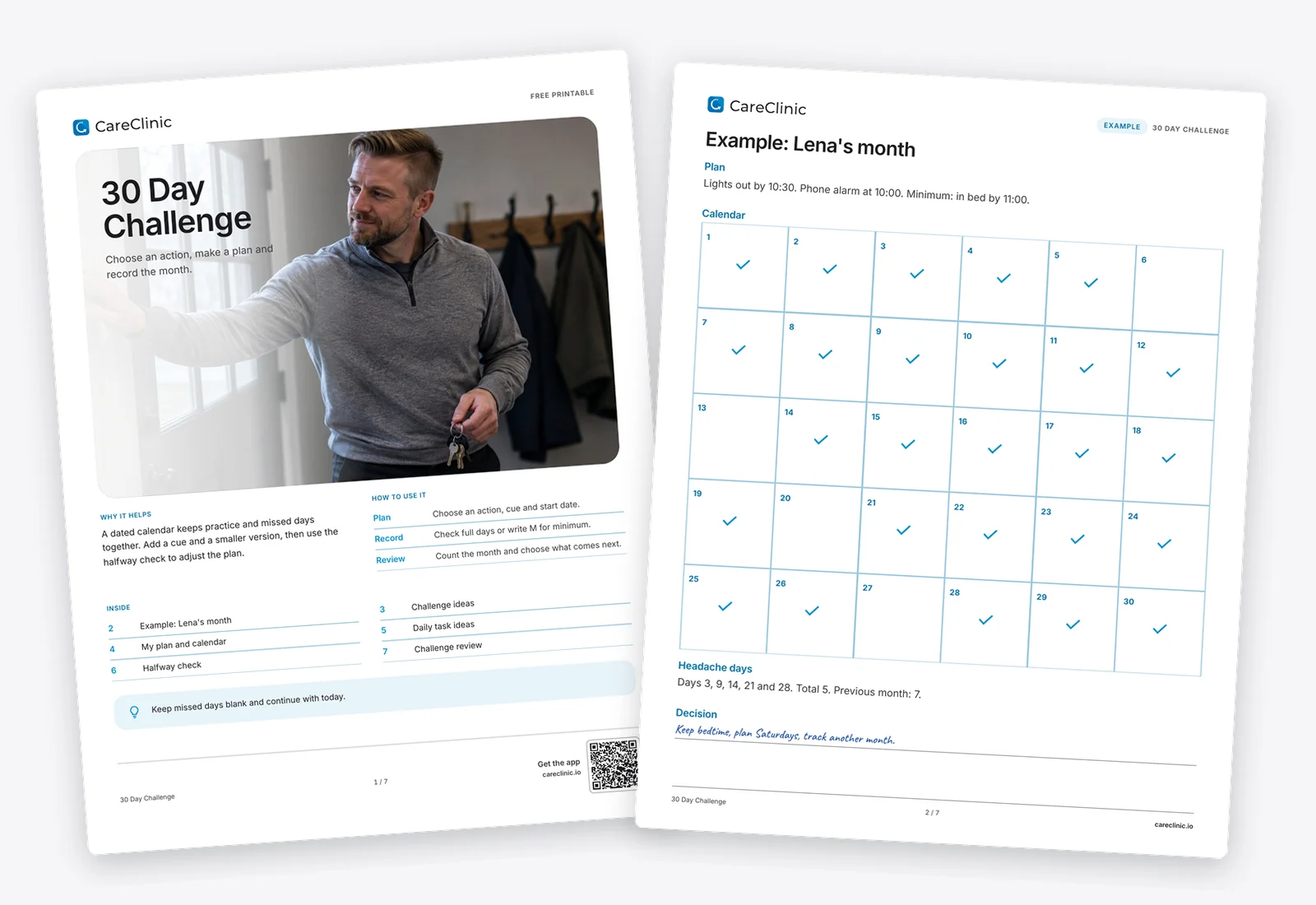
This printable has an ideas list, a plan page, a calendar of 30 numbered boxes, a halfway check and a review. The filled example comes from a woman who tried a steady bedtime for a month to see whether it changed her headache days.
Download the 30 Day Challenge
- Fill it in on your phone or computer, or print it
- US Letter and A4
- Includes a filled example
How it helps
Ideas to choose from
Fifteen small health actions if you are not sure where to start.
One month at a glance
Thirty boxes and a mark for each day.
See a pattern
An optional symptom row shows whether anything changed.
How to use it
- Choose one action. Use the ideas list or your own.
- Write your plan. When, where and your minimum on bad days.
- Mark each day. A tick for done, M for the minimum, blank for missed.
- Check halfway and at the end. Count, compare and decide on the next month.
What is inside
- Page 1, How to use itThe cover, why it helps, how to use it and the contents.
- Page 2, Example: Lena's monthMarked calendar and symptom notes.
- Page 3, Challenge ideasFifteen ideas to choose or adapt.
- Page 4, My plan and calendarAn action, cue, start date and calendar.
- Page 5, Daily task ideasPlan different small tasks under one theme.
- Page 6, Halfway checkA midway review of the first fifteen days.
- Page 7, Challenge reviewTotals, decision and appointment notes.
See a filled example
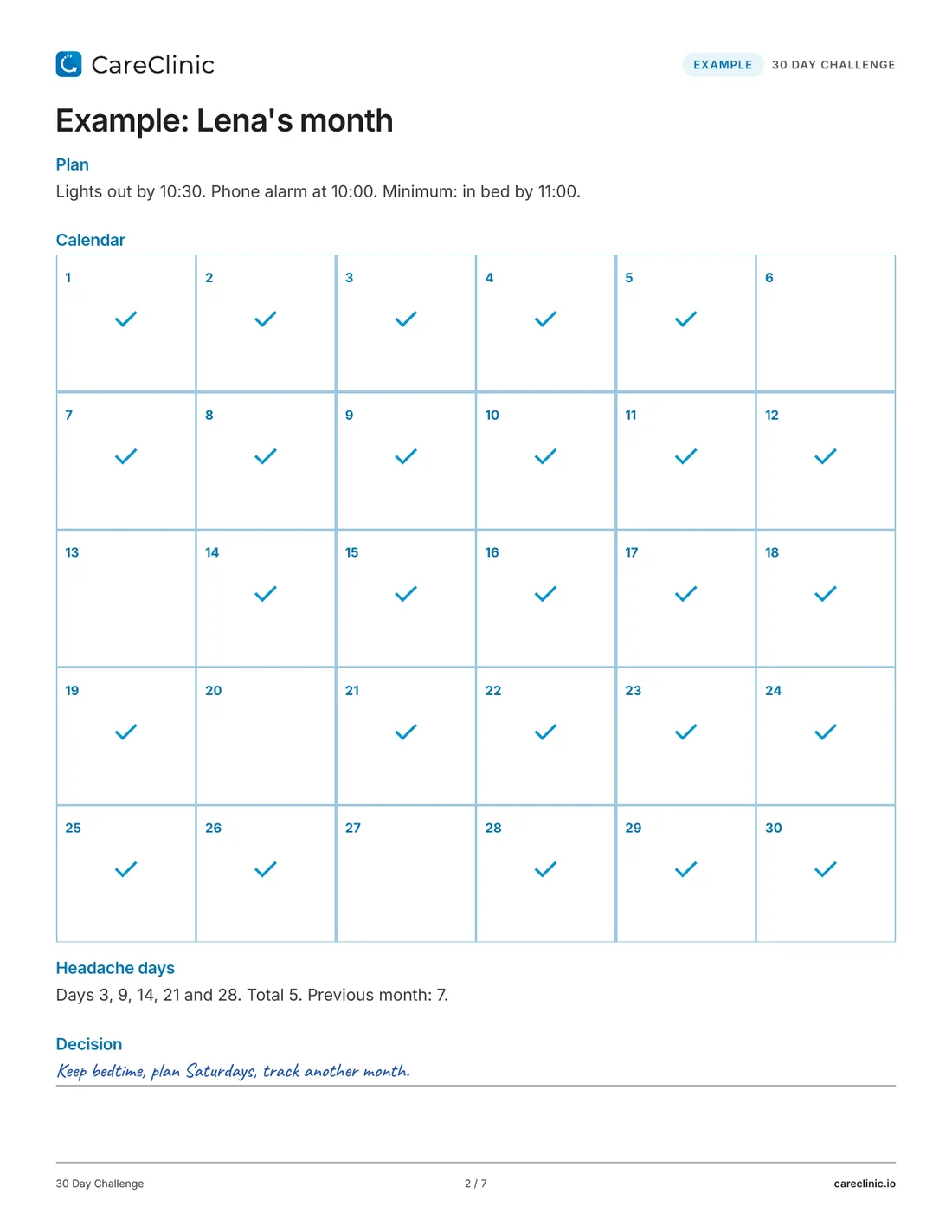
The 30 day challenge example belongs to Lena, who tracks headache days. Her plan was lights out by 10:30 with a phone alarm at 10:00, and a minimum of in bed by 11:00. She made it on 26 of 30 nights. The misses were all Saturdays, days 6, 13, 20 and 27. She logged headaches on days 3, 9, 14, 21 and 28, 5 in total, compared with 7 the month before, and decided to keep the bedtime, plan for Saturdays and track another month.
 Open the full PDF
Make the plan clear before day one
Begin your 30 day challenge by choosing a single action or a theme with different small tasks. The daily task page has fifteen rows. Use a second copy for days sixteen to thirty. The ideas page offers movement, sleep routines, meals, connection and other everyday options. You can also write your own. Choose something specific enough to recognize when it is complete. A ten minute walk after lunch has a clear end, while get more active leaves you guessing when to mark the box.
Write a cue that already occurs in your day. It could be finishing breakfast, putting work shoes away or hearing an evening alarm. Add a smaller version for days when the full action will not fit. Use that version only for actions you can sensibly shorten. Keep the definition on the plan so an M has the same meaning throughout the month.
Choose the start date and keep it with the 30 day challenge calendar. Day one can fall anywhere in the month. Numbered boxes track the sequence, so you do not need to wait for a Monday. Put the page near the place where you will record the action and leave a pen there if you are using paper.
Keep an accurate calendar
Mark the day after you do the action. Use a check for the full version and M for the smaller version you planned. Leave a missed day blank. A 30 day challenge gives you a count across the period, so a gap stays in the record rather than sending you back to day one. Resume with the next numbered box.
Use the optional symptom space for a short dated note. You might list headache days or write how your energy felt on particular dates. A symptom tracker gives more room for timing, severity and context if the short lines are not enough. Keep the records together when you want to compare the same dates.
At the halfway check, count completed days out of fifteen. Read where the blank boxes fell and what helped on marked days. Choose one practical adjustment for the remaining days. You could move the reminder, prepare an item earlier or make the smaller version easier to remember. Record the change so the second half has context.
Review the month before beginning again
At the end of the 30 day challenge, count full days and minimum days separately. Add context for any group of missed days. The example calendar leaves days six, thirteen, twenty and twenty seven blank, giving twenty six completed nights. That pattern lets Lena plan for Saturdays before beginning another month.
The example also records five headache days alongside seven in the previous month. These are observations from the record. Bring the dates and circumstances to an appointment when you want help discussing the pattern. A health diary can hold notes about work, sleep or other changes that happened during the same period.
Use the next month options to choose whether to keep, change, add to or stop the action. Keep a copy of the completed 30 day challenge before beginning a fresh calendar. The earlier page gives you the actual totals and notes to compare with the next period. Write one question for your care team if you need help deciding what to try.
Tips that make it work
- Pick a 30 day challenge you can do even on a tired day.
- Set a minimum version for bad days, and mark it with an M.
- Add one symptom row, such as headaches or energy, if you want to see a pattern.
- Look at where misses cluster, such as weekends, and plan for those days.
Bringing it to your doctor
Take the 30 day challenge calendar to an appointment if you want to discuss a routine and the symptoms you recorded alongside it. Explain what changed, how often you practiced and what else was happening that month. Write your questions in the final card so you remember them during the visit.
Questions
What is a 30 day challenge?
It is a month of doing one action every day and marking it on a calendar. People use it for exercise, sleep, food, screen time or learning something new.
Are 30 day challenges good for you?
They can be when the action is small and fits your health. Even small daily habits, such as a short walk or a regular bedtime, can help your energy and mood. The calendar gives you a way to record practice, review gaps and decide what to change next month.
What are good 30 day challenge ideas for adults?
A 10 minute walk, a regular bedtime, a vegetable at lunch, five minutes of stretching, morning daylight, no screens before bed or taking medicine at the same time daily.
What if I miss a day?
Mark it blank and keep going. Your result is a count out of 30, not a streak that resets.
What should I do after the 30 days?
Decide whether to keep the action, change it or add a second one. The review page walks you through it.
Is this 30 day challenge calendar free?
Yes. The 30 day challenge calendar is a free printable PDF in US Letter and A4, with ideas, a plan, a calendar, a halfway check and an example.
More free worksheets

References
- Caring for Your Mental Health. NIMH. https://www.nimh.nih.gov/health/topics/caring-for-your-mental-health