


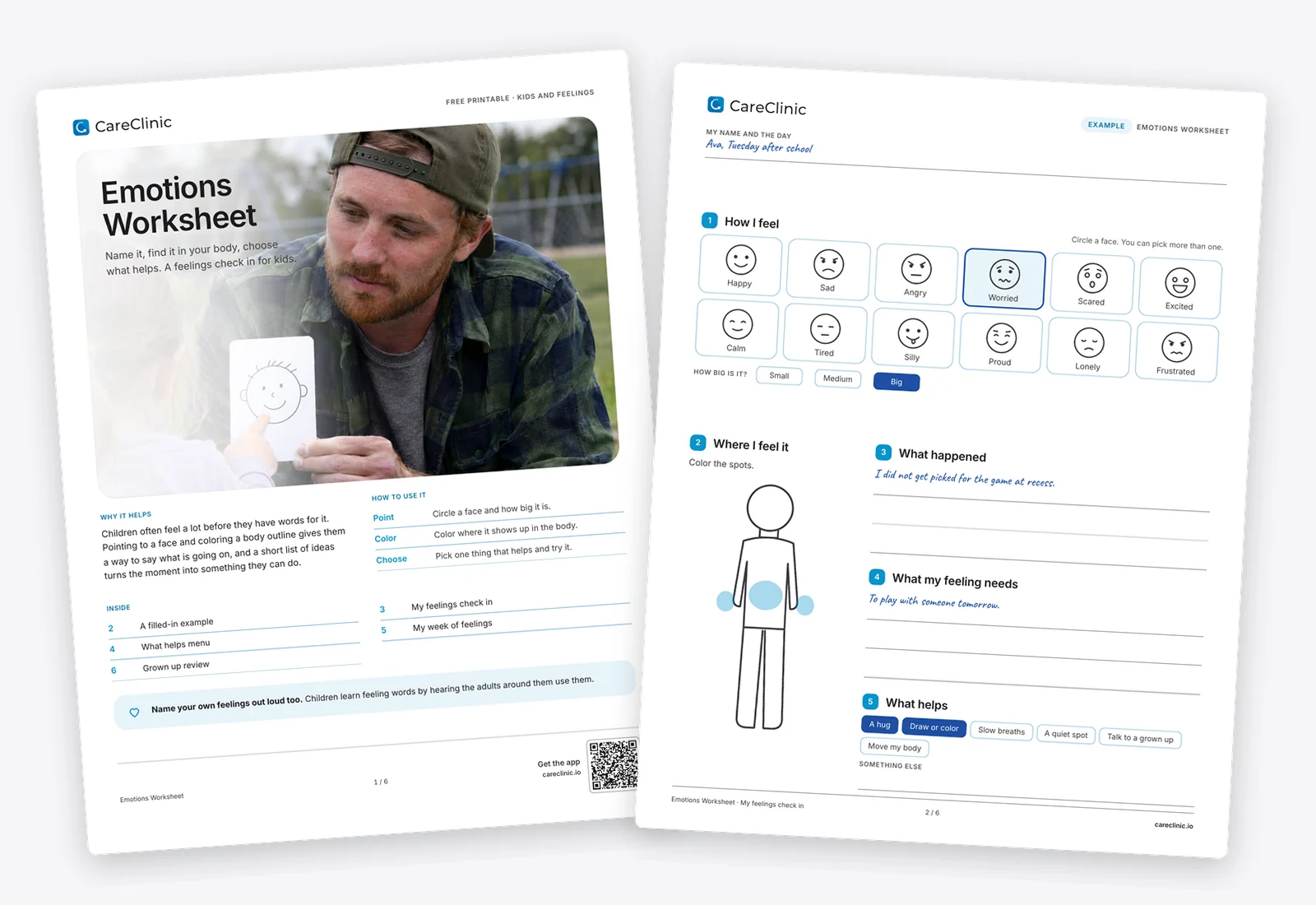
This emotions worksheet helps children name what they feel, find where it shows up in their body, and choose something that helps. Kids point to one of twelve drawn faces, color a body outline and pick an idea from a short menu, while an adult writes down their words.
It suits children from preschool to about age ten, at home, in class or with a school counselor. Younger children point and color. Older children can fill it in on their own. A week page and a grown up review help you see patterns and talk about them.
Download the Emotions Worksheet
- Fill it in on your phone or computer, or print it
- US Letter and A4
- Includes a filled example
How it helps
Words for feelings
Twelve faces with plain names give children a way to say what is going on.
Body clues
Coloring a body outline links a feeling to a tight tummy, hot cheeks or clenched hands.
Something to do
Each emotions worksheet check in ends with one idea to try, so a big feeling has a next step.
How to use it
- Pick a calm moment. After school, at bedtime or once a big feeling has passed works better than in the middle of it.
- Point and color. Your child circles a face, picks small, medium or big, and colors where they feel it.
- Ask and write. Ask what happened and what the feeling might need. Write their words, not yours.
- Choose what helps. Pick one idea from the menu and try it together.
What is inside
- Page 1, the coverHow to use the sheet and what is inside.
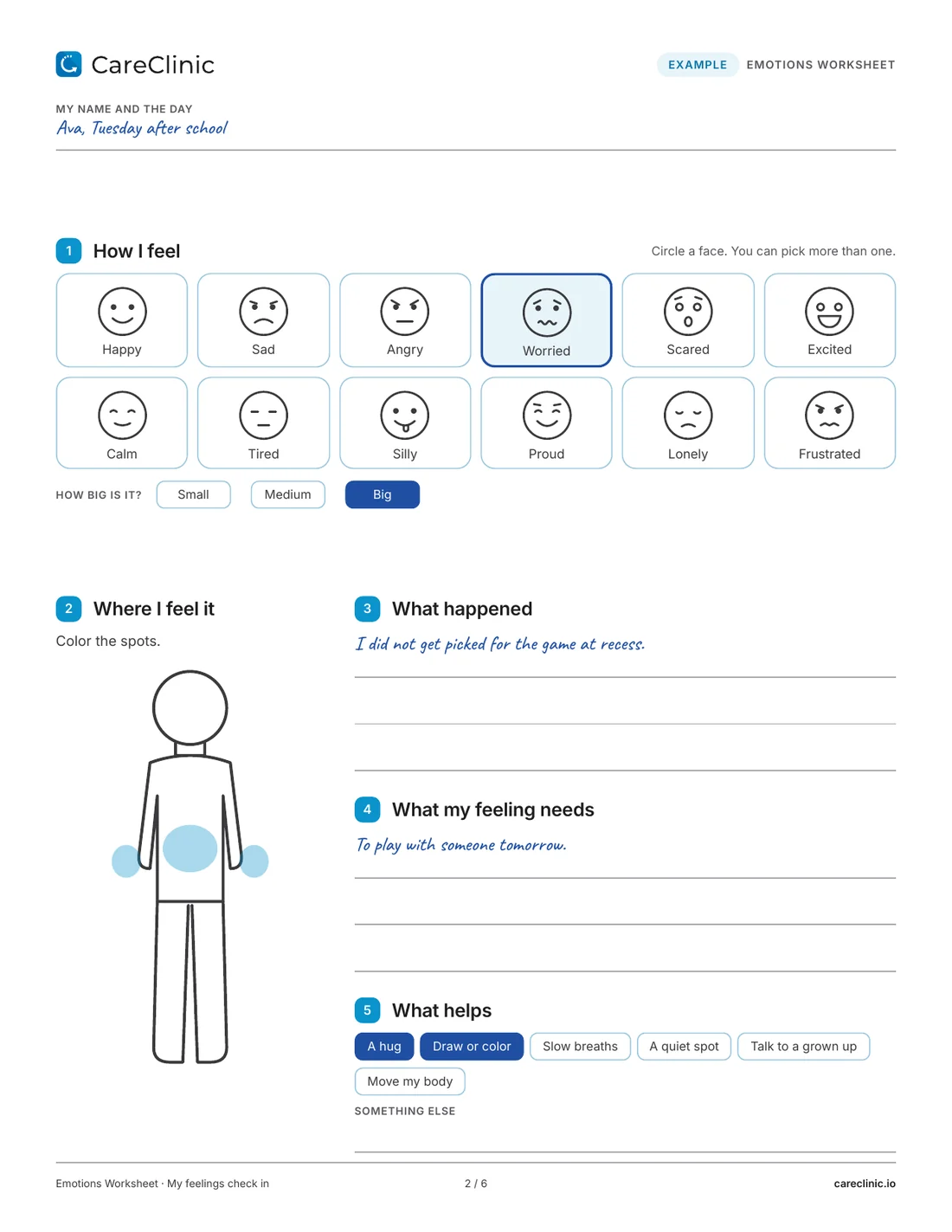
- Page 2, a filled-in exampleAva checks in after a hard day at recess.
- Page 3, My feelings check inFaces, a feeling size, a body outline, what happened, what the feeling needs and what helps.
- Page 4, What helps menuIdeas for calming down and cheering up, plus space for your own.
- Page 5, My week of feelingsTick a face each morning and after school, and note what helped.
- Page 6, Grown up reviewPatterns to notice and notes for your next appointment.
See a filled example
In the example, Ava checks in on a Tuesday after school. She circles the Worried face, marks it as Big and colors her tummy and both hands. When a grown up asks what happened, she says she did not get picked for the game at recess. For what her feeling needs, she says she wants to play with someone tomorrow. She chooses a hug and drawing a picture from the What helps choices.
 Open the full PDF
How to talk about feelings with a child
Keep the emotions worksheet short and calm. Two or three minutes is enough for young children. Sit beside them rather than across a table, and let them hold the pencil or crayon.
Ask open questions such as what happened before the feeling, or what the feeling wants. Repeat their answer back in their words. Avoid fixing the problem straight away. Naming the feeling comes first, and the What helps menu comes after.
Name your own feelings out loud during the day, for example saying you feel frustrated that the bus is late. Children learn feeling words and self-regulation by hearing adults use them in ordinary moments.
The twelve feeling faces
The faces cover pleasant, hard and in between feelings, so children see that every feeling has a name. Your child can circle more than one face, because mixed feelings are common.
Faces on the check in page
- Happy
- Sad
- Angry
- Worried
- Scared
- Excited
- Calm
- Tired
- Silly
- Proud
- Lonely
- Frustrated
Using it in class or counseling
Teachers can use the emotions worksheet week page as a morning check in. Counselors can use the check in page in a session and send the What helps menu home so parents use the same ideas.
Older children and preteens may prefer to write more. They can use the What happened lines for a few sentences, or move on to a simple mindfulness practice once they can name a feeling with ease.
What the pages can show
Over a few weeks the emotions worksheet pages show which feelings come up, at what times, where your child feels them, and which ideas help. They do not diagnose anxiety, depression or any other condition. A pattern that worries you is a good reason to talk with a professional.
Tips that make it work
- Keep the emotions worksheet where your child can reach it, so they can ask for it when a feeling is big.
- Accept every feeling. The aim is to name it, not to make it go away.
- Offer two faces to choose from if your child says they feel nothing.
- Bring the week pages to a teacher or counselor if one feeling shows up most days.
Bringing it to your doctor
Talk to your pediatrician if feelings or behavior last for weeks and get in the way of home, school or friends. Signs include frequent tantrums, often seeming worried or scared, stomachaches with no known cause, changes in sleep, or not wanting to play with other children. Bring the week pages and the grown up review to the visit. If a child talks about hurting themselves, get help right away. In the US or Canada, call or text 988. If anyone is in immediate danger, call 911 or the emergency number where you live.
Questions
What age is this emotions worksheet for?
It is made for children from preschool to about age ten. Younger children point and color while an adult writes. Older children can fill it in alone.
How do I help my child identify emotions?
Use simple names, link feelings to body clues, and name your own feelings out loud. Short, regular check ins at calm times help more than long talks during a meltdown.
Can I use it with preschool or kindergarten children?
Yes. Preschool and kindergarten children can point to a face and color the body outline while an adult writes their words.
What if my child picks more than one face?
That is fine. Mixed feelings are common, such as excited and scared before a new class. Circle both and talk about each one.
Is this emotions worksheet free?
Yes. The emotions worksheet is a free PDF in US Letter and A4. Print it or fill it in on a phone or computer.
More free worksheets


References
- Child and Adolescent Mental Health. National Institute of Mental Health. https://www.nimh.nih.gov/health/topics/child-and-adolescent-mental-health