


A stress management worksheet helps when everything feels like one big weight. You list each source of stress separately, sort it into what you can change, what you can change a little, and what is out of your hands, and pick one small action for each. Seeing it on paper often makes it smaller.
This printable also lists common signs of stress in the body, mind and behavior, so you notice it earlier, and a four week rating log shows whether your plan is working.
Download the Stress Management Worksheet
- Fill it in on your phone or computer, or print it
- US Letter and A4
- Includes a filled example
How it helps
Untangle the weight
Each stressor gets its own line instead of one heavy feeling.
One action each
A small step for things you can change, and a way to cope with things you cannot.
Four weeks of ratings
A weekly score shows whether stress is easing.
How to use it
- List your stressors. Work, money, health, family, caring for someone, the news. One per line.
- Sort by control. Mark each one: I can change it, I can change part of it, or it is out of my hands.
- Pick one action. A small step for what you can change, and a coping step for what you cannot.
- Rate each week. Score your overall stress from 0 to 10 every Sunday.
What is inside
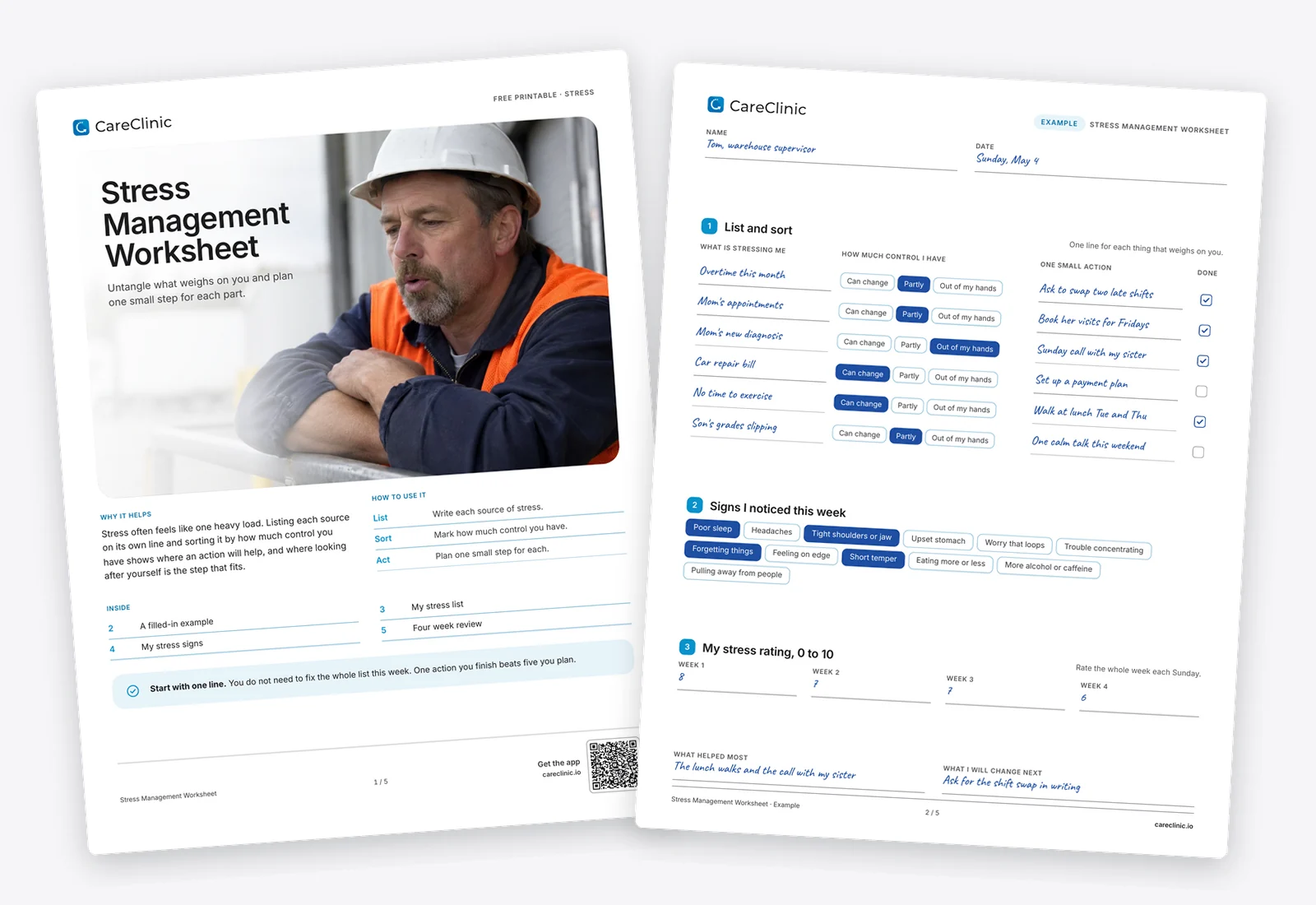
- Page 1, Stress Management WorksheetThe cover, contents and short guide.
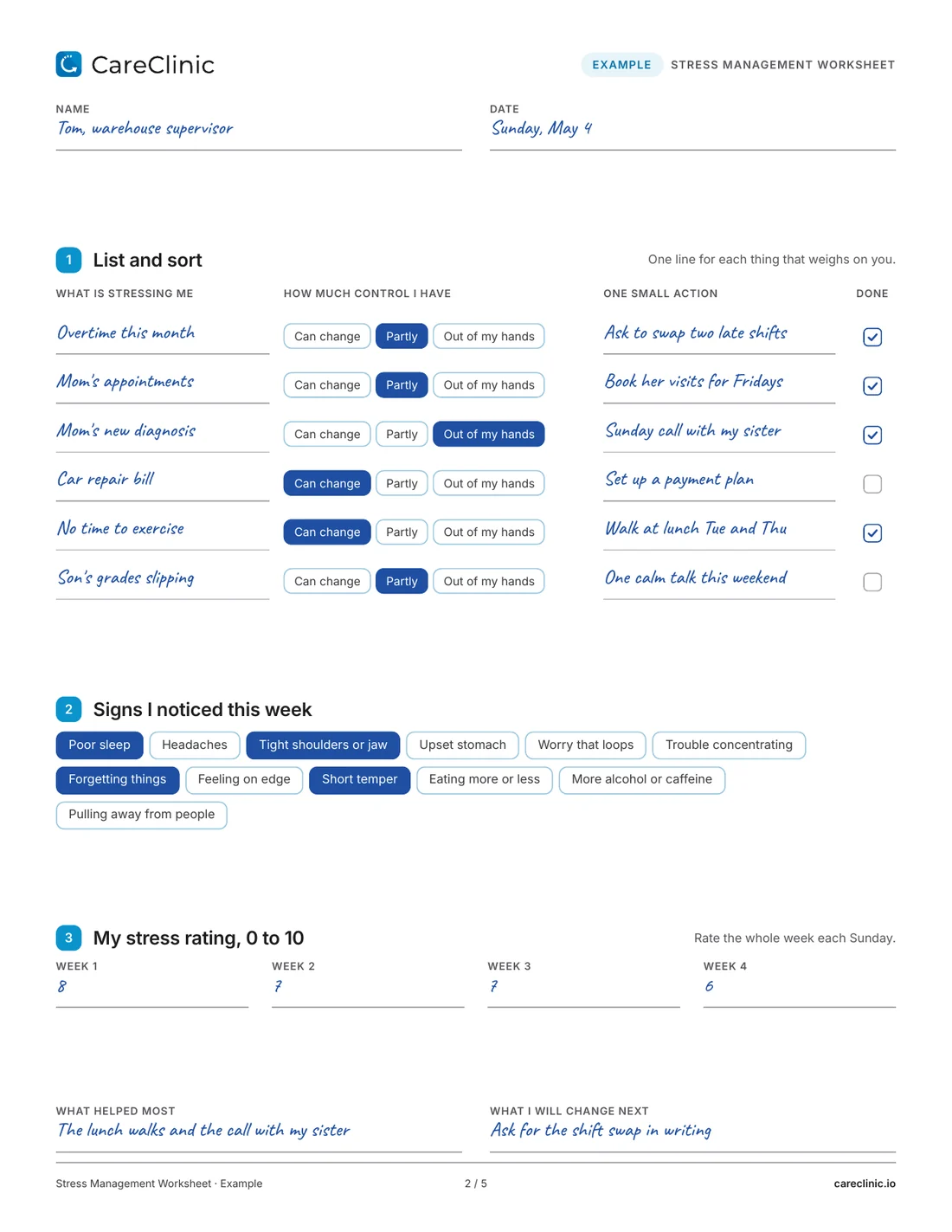
- Page 2, a filled-in exampleTom sorts six stressors, records signs and reviews his ratings.
- Page 3, My stress listA blank table for stressors, control, an action and a Done box.
- Page 4, My stress signsBody, Mind and Behavior checklists, early signs and support.
- Page 5, Four week reviewWeekly ratings, actions to keep or change and appointment notes.
See a filled example
Tom fills in the stress management worksheet while working as a warehouse supervisor and helping his mother. He lists six stressors separately. For overtime, which is partly in his control, he plans to ask for a shift swap. His mother's diagnosis is outside his control, so his action is a Sunday call with his sister. He notices poor sleep, tight shoulders, forgetfulness and a short temper. His weekly ratings are 8, 7, 7 and 6. The lunch walks and family call helped, and his next step is to put the shift request in writing.
 Open the full PDF
How to sort a stressor by control
The stress management worksheet gives three choices: Can change, Partly and Out of my hands. These refer to the source of stress, not whether you should care about it. You may be able to change a bill payment date but have no say over a relative's diagnosis.
Choose Partly when you can influence one piece. For overtime, you might ask for different shifts even if you cannot set the staffing level. Write a request you can make, rather than a result that depends on someone agreeing. This gives you a clear action without making you responsible for everything.
For a situation outside your control, choose a coping or support step. Calling someone, taking a break or asking your care team a question may help you face the situation even though it does not remove the cause.
Turn a stress list into a plan
Start with the loudest item on the stress management worksheet. Make its action specific enough that you know when you have done it. Call the garage to ask about installments is easier to begin than Sort out money. Choose a step you can finish or start this week.
Use the Done box for the action you wrote, not for whether the entire problem disappeared. Some rows will need a new step next week. If an action repeatedly stays unfinished, make it smaller or write who could help you begin.
A stress tracker can hold daily notes alongside this plan. That lets you compare a demanding workday with a quieter one instead of expecting one weekly number to tell the whole story.
Notice stress before it builds
The stress management worksheet groups signs into Body, Mind and Behavior. Tick what you notice and add your own in the Other rows. Look for an early clue you can recognize during an ordinary day, such as clenching your jaw when checking messages.
Stress can come with sleep problems, tension, worry and changes in habits. A symptom still deserves attention even when it happens during a stressful week. Avoid assuming a new physical symptom is only stress. Talk with a clinician about symptoms that concern you.
At the bottom, write when stress is worst and who you can talk to. People who help you may notice a change before you do. If you support a relative, consider whether sharing a task could make your plan more realistic.
Review your plan over four weeks
Choose roughly the same time each week to rate your stress from 0 to 10, with 0 for none and 10 for the most you can imagine. These personal ratings are for comparison, without diagnostic cutoffs. A hard week can raise the number even when you used helpful skills.
Use the stress management worksheet review page to name what helped and what needs changing. Keep actions that were useful, adapt steps that were too large, and bring questions to your next appointment. The point is a workable plan for your life, rather than a perfect line of falling scores.
Tips that make it work
- Fill in the stress management worksheet when you are calm, not at the peak of a bad day.
- Make actions small enough to do this week. Call HR is better than fix work.
- For things out of your hands, choose a coping step like a walk, a talk or a routine.
- Look for stress signs early. Short temper and poor sleep often come first.
Bringing it to your doctor
Bring your stress management worksheet to a doctor or counselor when stress is difficult to cope with or affects daily life. Point to the signs you noticed, how long they have lasted and any changes in sleep, alcohol use or functioning. Ask about support and treatment that fit your situation. Chest pain or other sudden, severe symptoms need urgent care, so do not put them down to stress. If you have thoughts of harming yourself, get help now. In the US or Canada, call or text 988. If anyone is in immediate danger, call 911 or the emergency number where you live.
Questions
What is a stress management worksheet?
It is a page that helps you list what is stressing you, sort it by what you can change, and plan one action for each item.
What are the signs of too much stress?
Common signs include poor sleep, headaches, tight muscles, a short temper, trouble concentrating, eating more or less, and pulling away from people.
Can students use it?
Yes. Students can list exams, deadlines, money and family, and use the same control sort.
How often should I fill it in?
Make the plan once, then rate stress weekly and update the list when things change.
Is this stress management worksheet free?
Yes. The stress management worksheet is a free printable PDF in US Letter and A4 with a filled example and a four week log.
More free worksheets



References