


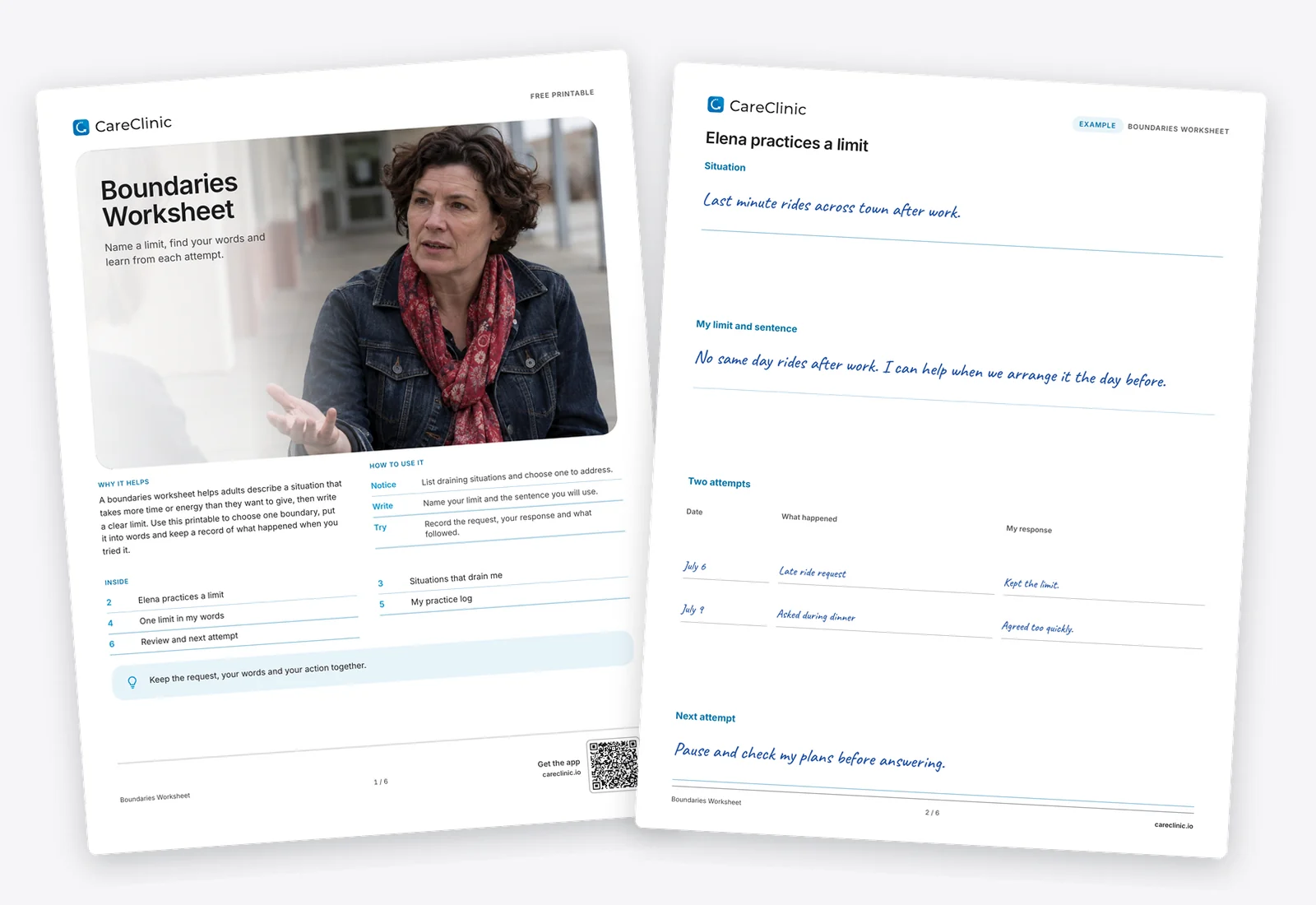
A boundaries worksheet helps adults describe a situation that takes more time or energy than they want to give, then write a clear limit. Use this printable to choose one boundary, put it into words and keep a record of what happened when you tried it.
The pages move from a list of draining situations to a single sentence and a practice log. A filled example shows a recurring request for a last minute ride. You can return to the same boundary several times before deciding whether its wording or your response needs to change.
Download the Boundaries Worksheet
- Fill it in on your phone or computer, or print it
- US Letter and A4
- Includes a filled example
How it helps
Name the situation
List specific requests or patterns that leave you stretched.
Write the words
Turn one limit into a sentence you can actually say.
Learn from practice
Use the boundaries worksheet to compare what happened with what you planned.
How to use it
- Notice. List draining situations and choose one to address.
- Write. Name your limit and the sentence you will use.
- Try. Record the request, your response and what followed.
- Review. Keep useful wording and choose your next attempt.
What is inside
- Page 1, Boundaries WorksheetInstructions and contents.
- Page 2, Elena practices a limitA completed example.
- Page 3, Situations that drain meSpace to complete this part of the printable.
- Page 4, One limit in my wordsSpace to complete this part of the printable.
- Page 5, My practice logSpace to complete this part of the printable.
- Page 6, Review and next attemptSpace to complete this part of the printable.
See a filled example
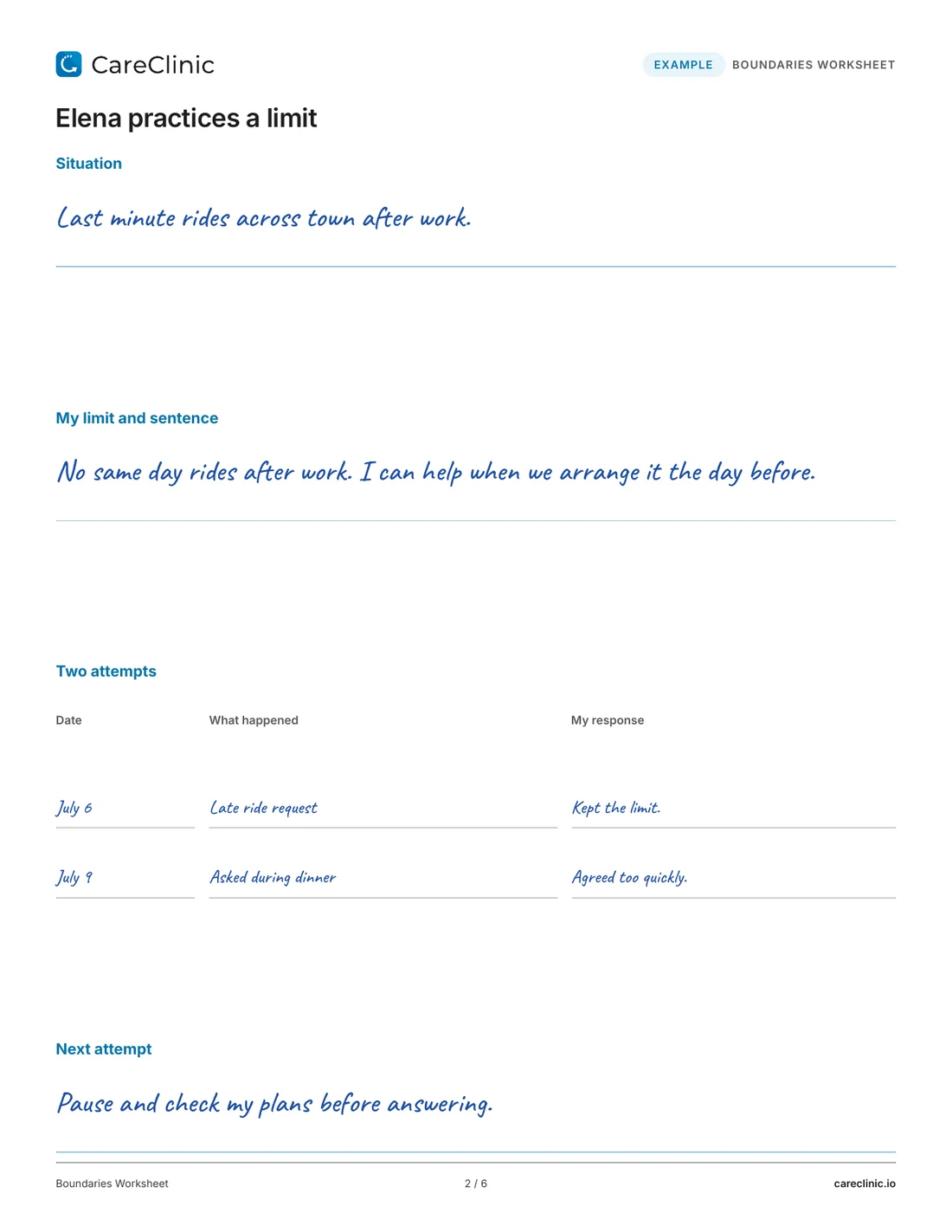
Elena receives last minute requests to drive her cousin across town. Her boundary is no same day rides after work. She writes, 'I can help when we arrange it the day before.' On July 6 she keeps the limit, while on July 9 she agrees before checking her evening plans. Her next note is to pause before answering.
 Open the full PDF
Describe a situation rather than a whole person
Start with an event you could recognize again. A request arriving at the end of a workday is more precise than saying someone is demanding. Write when it happens, what is being asked and what it costs you. The inventory has room for several situations, so you do not have to choose immediately.
Look across your entries for one you want to work on first. You might choose a repeated request, an interruption or a conversation that runs beyond the time you have. An emotion journal can help you find words for how the situation felt. Keep the event separate from your interpretation of another person’s intentions.
Keep the boundary sentence clear
The boundaries worksheet separates the limit from the sentence used to explain it. The limit names the action you are willing to take. The sentence puts that decision into ordinary words. You can be brief and still be specific about the time, task or condition involved.
Read your sentence aloud and check that it describes your own availability or action. You can offer an alternative when you want to, as Elena does with advance notice. An alternative belongs in the sentence only if you are willing to follow through. Leave out promises made to soften the answer.
Record what actually happened
Use a practice row soon after the conversation. Write the request, the words you used and what you did afterward. Mark if you kept the limit, changed it or want to think further. Those notes preserve the difference between a sentence that was hard to say and a decision you later chose to revise.
A boundaries worksheet can hold attempts that went differently from the plan. Add the detail that mattered, such as answering too quickly or forgetting an earlier commitment. A therapy journal can hold a longer reflection if you want one. On the final page, choose one change to try rather than rewriting every boundary at once.
Common mistakes when setting a boundary
The most common slip is explaining too much. A long list of reasons invites the other person to argue with each one. One clear sentence, said kindly, is easier to hear and easier to keep, which is why page 4 asks for the one sentence you will use.
Another is starting with a limit you cannot hold yet. If you know you will give in the moment someone pushes, choose something smaller. Elena began with same day rides only, not every favor her cousin asks for. A small limit kept three times teaches you more than a big one dropped on the first day.
A third is treating one lapse as failure. The practice log has a row for every attempt, including the ones that did not go to plan. On July 9 Elena said yes before she checked her evening, and the review page turns that into a next step: pause and check first. Expect some pushback the first few times. It usually fades once people see the limit stays the same.
Tips that make it work
- Keep the boundaries worksheet focused on one recurring situation at a time.
- Write a sentence you could say in your own voice.
- Record the action after the conversation as well as the words.
- Keep earlier practice rows when you change the sentence so you can compare attempts.
Bringing it to your doctor
Bring the boundaries worksheet to a counseling or care appointment when you want to discuss a recurring interaction. Point to the request, your planned limit and the response you found difficult. The final card gives you room to write questions before the visit.
Questions
How do I use a boundaries worksheet?
List situations, choose one limit and write the sentence you want to use. After trying it, record what happened in the practice log. Review the entries before deciding what to keep or change.
What are examples of personal boundaries?
A limit can concern your time, availability, personal space or a task you agree to do. This example concerns same day rides after work. Write your own situation rather than adopting the example as a rule.
What should adults write on a boundaries worksheet?
Describe a specific request and the time or energy it takes. Then name what you are willing to do and write a sentence that communicates it. Use the log to keep the outcome with the date.
How can I practice saying a boundary?
Read the sentence aloud and shorten anything you would not normally say. You can practice with someone you choose before using it in the situation. Write down which wording felt clear enough to repeat.
What if I change my mind about a limit?
Record the change and the reason. Compare a choice you made deliberately with an answer you gave before thinking. Your review can lead to a different limit or a clearer way to express the same one.
Is this boundaries worksheet free?
Yes. This boundaries worksheet is a free printable PDF in US Letter and A4. It includes a filled example, blank planning pages, a practice log and a review page.
More free worksheets

References
- Caring for Your Mental Health. National Institute of Mental Health. https://www.nimh.nih.gov/health/topics/caring-for-your-mental-health