


An emotional regulation worksheet gives you a slow, written way through a strong feeling: notice it, name it, rate it, spot the urge, and choose what to do. Regulation does not mean switching feelings off. It means having a little room between the feeling and what you do next.
This printable works for teens and adults, on your own or with a therapist. It has a filled example, a page for each strong moment, a skills menu to choose from, and a weekly look back to spot patterns.
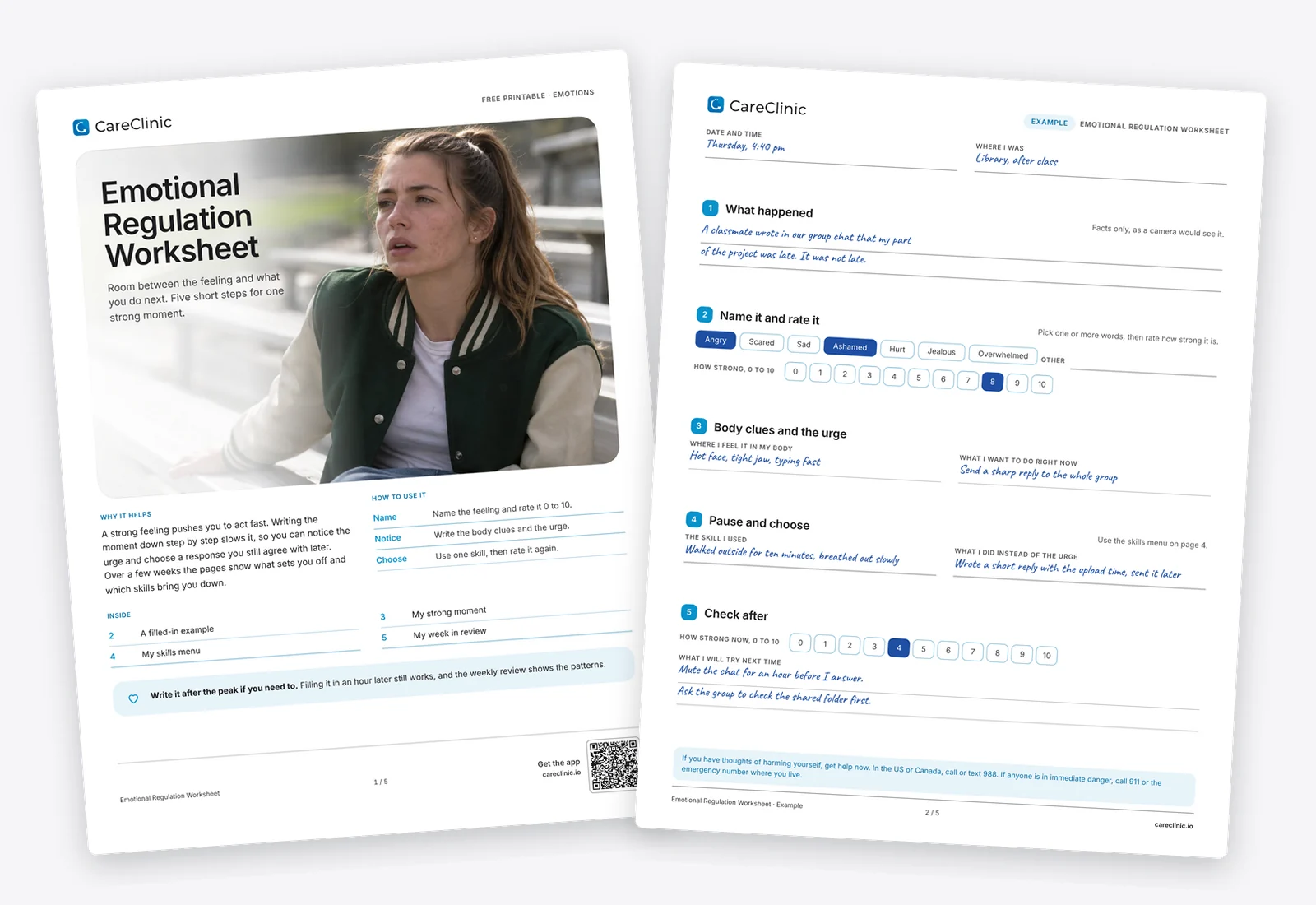
Download the Emotional Regulation Worksheet
- Fill it in on your phone or computer, or print it
- US Letter and A4
- Includes a filled example
How it helps
Feeling apart from action
Writing the urge separately from the choice makes room to pick a different response.
A menu of skills
Ready ideas for calming the body, changing the setting and solving the problem.
Patterns over time
A weekly review shows which situations and skills come up again.
How to use it
- Name and rate it. Write the feeling in one or two words and rate it from 0 to 10.
- Notice the body and the urge. Where do you feel it, and what do you want to do right now?
- Choose a skill. Pick one from the menu that fits the moment.
- Check after. Rate the feeling again and note what helped.
What is inside
- Page 1, Emotional Regulation WorksheetThe cover, a short guide and the contents.
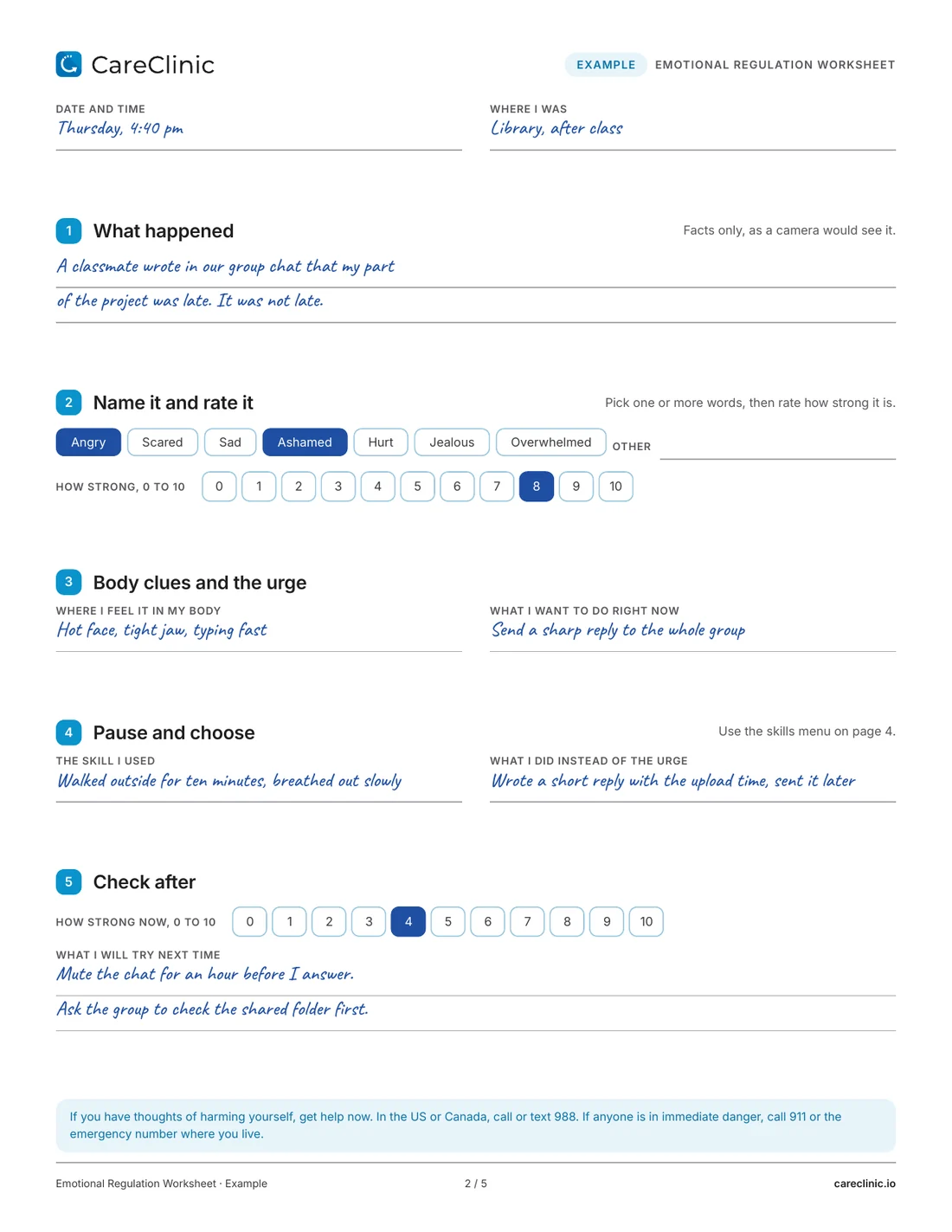
- Page 2, a filled-in exampleA student records an upsetting group chat and chooses a response.
- Page 3, My strong momentA blank page with five steps, feeling words and ratings.
- Page 4, My skills menuFive groups of ideas to try and space for your own.
- Page 5, My week in reviewA table of moments, patterns and notes for your next appointment.
See a filled example
In the example, a student fills in the emotional regulation worksheet after a group chat about a class project. A classmate wrote that her work was late, although she had already uploaded it. She checks Angry and Ashamed, circles 8, and notices a hot face, tight jaw and fast typing. Her urge is to send a sharp reply to everyone. She walks outside, then writes a brief reply with the upload time and sends it later. Her second rating is 4. Next time she plans to mute the chat before answering and ask the group to check the shared folder.
 Open the full PDF
How to separate a feeling from an action
The emotional regulation worksheet has separate spaces for the event, the feeling and the urge. Keep the event description short and concrete. Write what someone said or did before explaining what you think it means. This leaves room to consider another explanation later.
A feeling can be understandable even when acting on its first urge would cause trouble. The student in the example can be angry about the message and still decide to answer without attacking her classmate. Choosing a response does not mean approving of what happened.
Choose a skill you can use here
Start with one option on the emotional regulation worksheet skills menu. You might pause a conversation, slow your breathing, walk somewhere safe or talk with a trusted person. Use your own ideas in the My own rows. Check the skills you want to remember rather than trying every suggestion in a single moment.
The Think it through group asks you to examine the facts and consider another response. If an urge would make a safe situation worse, write an alternative action. When someone is threatening you, prioritize getting somewhere safe and seeking help. You do not need to remain in the situation to finish the page.
Read the pattern without grading yourself
The numbers on this emotional regulation worksheet describe how intense a feeling seems to you. They are not a medical score or a target you must reach. A lower second rating may be useful information, but also record whether your chosen action helped with the actual problem.
In My week in review, copy the day, trigger, feeling, first rating, skill and second rating. More than one moment can go in a day. Look for repeated situations or skills you can prepare in advance. An emotion journal can hold longer reflections, while this page keeps the immediate sequence together.
Use the notes area to prepare for therapy rather than judging each entry as good or bad. A skill that helps once may not suit another setting. Record what you tried, what happened and what you want to change next time.
Tips that make it work
- Fill in the emotional regulation worksheet after the peak if you cannot write during it.
- Use plain feeling words. Angry, scared, sad, ashamed and lonely are enough.
- Practice a skill when you feel steady too. Choose something you can do where the strong feeling usually happens, such as a quiet breath at work.
- Look back once a week. Patterns are easier to see on paper.
Bringing it to your doctor
Bring your emotional regulation worksheet and weekly review to a doctor or therapist if your reactions interfere with work, school, sleep or relationships. Point to a particular moment rather than trying to remember an entire difficult week. Ask which skills fit your needs and what to do when one does not help. If you have thoughts of harming yourself, get help now. In the US or Canada, call or text 988. If anyone is in immediate danger, call 911 or the emergency number where you live.
Questions
What is emotional regulation?
Emotional regulation means noticing and understanding a feeling, then choosing how to respond. A pause can help you consider the situation before acting. It does not require you to stop feeling upset.
Can adults use an emotional regulation worksheet?
Yes. Adults and older teens can use this emotional regulation worksheet to record a strong moment. It can be used alone or brought to a therapy session. An older teen may prefer to work through the example with a trusted adult.
What skills are on the menu?
The menu groups ideas under Calm the body, Change the setting, Think it through, Reach out and Solve it. Choose an option that fits your health, setting and situation. There are blank rows for skills you already use.
Is this a DBT worksheet?
It is an original practice sheet using common ideas about noticing feelings and choosing actions. It does not reproduce a therapy manual or licensed questionnaire. A therapist can help you decide how it fits the work you are doing together.
Is this emotional regulation worksheet free?
Yes. The emotional regulation worksheet is a free printable PDF in US Letter and A4 with a filled example and a skills menu.
More free worksheets

References
- Caring for Your Mental Health. National Institute of Mental Health. https://www.nimh.nih.gov/health/topics/caring-for-your-mental-health
- 988 Suicide and Crisis Lifeline. https://988lifeline.org/