


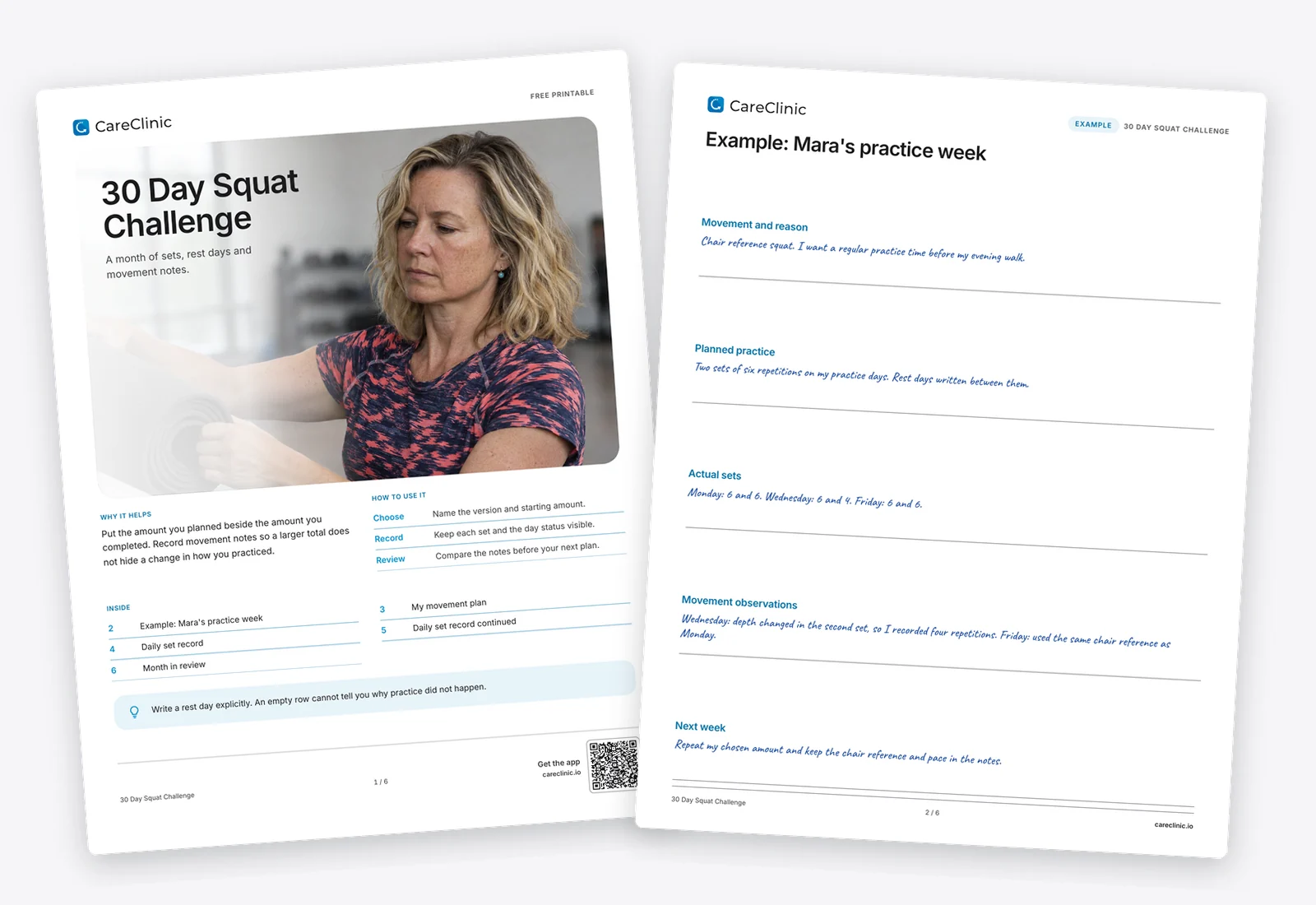
A 30 day squat challenge record helps you organize a month of squats, rest days and movement observations. Use the printable calendar to write the version you practice, the amount you plan and the sets you actually complete. Each daily row leaves space for a note about the session.
Mara’s example uses a chair as a depth reference and records each set separately. Blank planning and daily pages follow, ending with a review and appointment card. The amounts are open so the record can match the routine you have chosen.
Download the 30 Day Squat Challenge
- Fill it in on your phone or computer, or print it
- US Letter and A4
- Includes a filled example
How it helps
See each set
Keep repetitions separate instead of writing only a daily total.
Keep the month together
Use dated rows for practice, rest and changed plans.
Notice movement changes
Record the version, depth reference and pace alongside the count.
How to use it
- Name the movement. Write your squat version and any support or depth reference.
- Record actual sets. Keep planned amounts on the plan and completed repetitions in the daily rows.
- Read the notes. Compare movement details and choose what to keep next month.
What is inside
- Page 1, Squat ChallengeThe cover, how to use it and contents.
- Page 2, Example: Mara's practice weekA completed week with sets and movement notes.
- Page 3, My movement planYour chosen movement version and monthly plan.
- Page 4, Daily set recordDaily entries for the opening fifteen days.
- Page 5, Daily set record continuedDaily entries for the later fifteen days.
- Page 6, Month in reviewPractice observations and appointment questions.
See a filled example
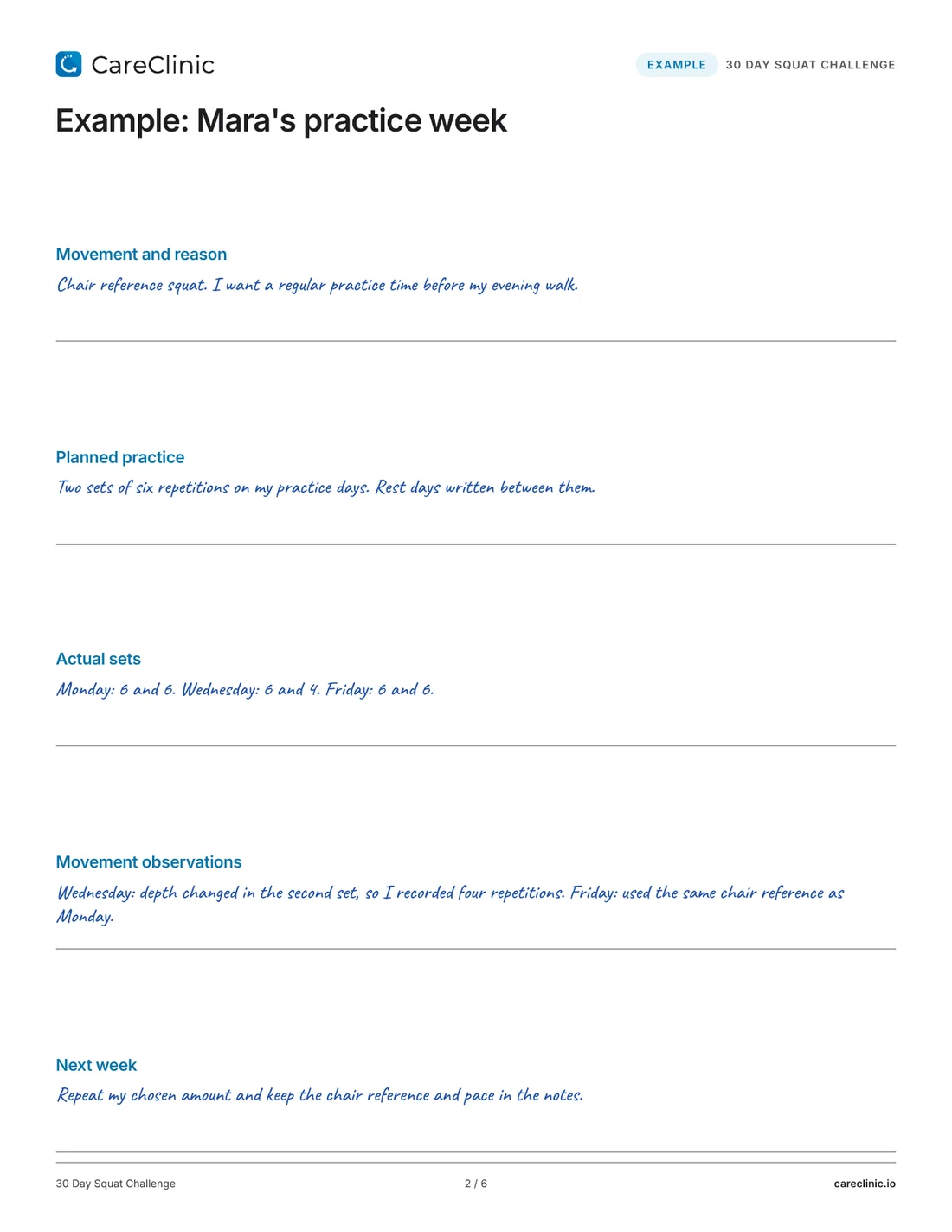
Mara plans two sets of six on practice days. On Wednesday she records six in the first set and four in the second because her depth changed. Friday’s entry notes that she used Monday’s chair reference again.
 Open the full PDF
Name the version before counting repetitions
Begin the 30 day squat challenge by describing the movement you will record. Write the starting date and any chair, support or depth reference used in your instruction. A simple name may be enough if you always use the same version. Add more detail when you might otherwise confuse two different practices.
The NHS strength exercise page includes mini-squats with support from a chair. Your record can name the version you use and the cues you are practicing. For example, write the depth reference, pace and foot position from your chosen instruction. These details give the repetition count a context when you read it later.
The 30 day squat challenge PDF keeps those movement notes beside a weekly planning table. Write practice days, rest days, sets and repetitions there. Leave room to describe a deliberate pace change. A slower movement and a higher count are different adjustments, so identify which one you chose rather than putting them into one unexplained number.
Keep planned and completed practice separate
A plan describes what you expect to do. The daily record describes the session that happened. Mara writes two sets of six in her plan and records six plus four on Wednesday. She leaves her original plan readable. The comparison then shows exactly where the session differed, without turning the smaller second set into a blank.
The 30 day squat challenge calendar offers three set columns. Use the columns that match your routine and label additional sets in the notes when needed. Do not fill unused cells just to make the row look complete. If you use a dash or another short mark, define its meaning on the planning page so you can read it consistently.
Add a date and a status to each challenge day. Rest, practice, shortened and missed can have distinct meanings. Write the reason for a changed plan only when it helps you understand the month. A health diary can hold a longer description while the printed row preserves the part you want to compare.
Read movement notes alongside the totals
At the end of a week, read each 30 day squat challenge entry for changes in version, amount and pace. Look for details you can compare directly. Mara’s Friday note matters because it names the same chair reference as Monday. Without that note, matching repetition counts might look more comparable than they actually were.
Keep a hard session visible even when the daily amount stays the same. A brief observation such as depth changed in the last set gives the next review a concrete detail. You can also record an easier session in your own words. The review works best when it preserves both experiences instead of keeping only the largest count.
The final 30 day squat challenge page asks what changed and what you want to keep. Read the plan and actual entries together before writing your next routine. A healthy habits routine can help you choose a practical time for it. Keep the completed record so the next month starts with specific observations rather than a memory of only the last session.
Tips that make it work
- Keep your 30 day squat challenge movement version visible on the planning page.
- Write each completed set instead of relying only on a total.
- Record a change in depth reference or pace beside the date.
- Label rest days and changed plans with different words.
Bringing it to your doctor
Bring the 30 day squat challenge review to an appointment if you want to discuss your activity routine. Choose dated examples and explain the version, amount and movement notes. Use the last card for questions about the practice you want to follow next.
Questions
How do I use a squat challenge calendar?
Write the start date and chosen movement on the plan. Record the status, sets and notes in each daily row.
Can I download the 30 day squat challenge for free?
Yes. The 30 day squat challenge PDF is free in US Letter and A4. Both versions include a completed example, planning page and daily records.
What should beginners record?
Name the movement version and any support used. Keep the planned amount separate from completed sets and add a short movement note.
Does the calendar include rest days?
It has a status space for each day. Write rest where it belongs in your chosen routine.
How do I track squat challenge results?
Compare the amount, version, depth reference and pace over time. Use the monthly review to describe the changes you observed.
What if I complete fewer repetitions than planned?
Write the actual number in the set column. Add a short note so the difference remains clear when you review the page.
More free worksheets


References
- Strength exercises. NHS. https://www.nhs.uk/live-well/exercise/strength-exercises/