


The RAIN technique is a short mindfulness practice for meeting a strong feeling without pushing it away or getting swept up in it. RAIN stands for four steps: recognize the feeling, allow it some room, investigate with kindness, and nurture yourself with care. This version follows the four stages taught by Tara Brach.
You can use the printable to reflect on shame, fear, anger or self criticism. It has prompts for each step, a pocket card, a log and a filled example showing how Kelsey names a feeling and offers herself a kind response.

Download the RAIN Technique
- Fill it in on your phone or computer, or print it
- US Letter and A4
- Includes a filled example
How it helps
Four clear steps
Recognize, allow, investigate, nurture.
Kindness built in
The last step is care for yourself.
Look closer
Where the feeling sits and what it needs.
How to use it
- Recognize. Name what is happening inside you right now.
- Allow. Let it be here for a moment without fixing it.
- Investigate with kindness. Where do you feel it? What does it believe? What does it need?
- Nurture. Offer yourself what you need, a kind word, a hand, a breath.
What is inside
- Page 1, RAIN TechniqueThe cover, why it helps, how to use it and the contents.
- Page 2, Example: Kelsey's flareKelsey's four steps and her shame rating before and after.
- Page 3, RAIN worksheetWhat happened, a rating now, a prompt for each step and a rating after.
- Page 4, Pocket cardSix cut out cards with the four steps.
- Page 5, RAIN logDate, feeling, belief, need and ratings before and after.
- Page 6, RAIN reviewFeelings that come up often, what you need most and notes for your next appointment.
See a filled example
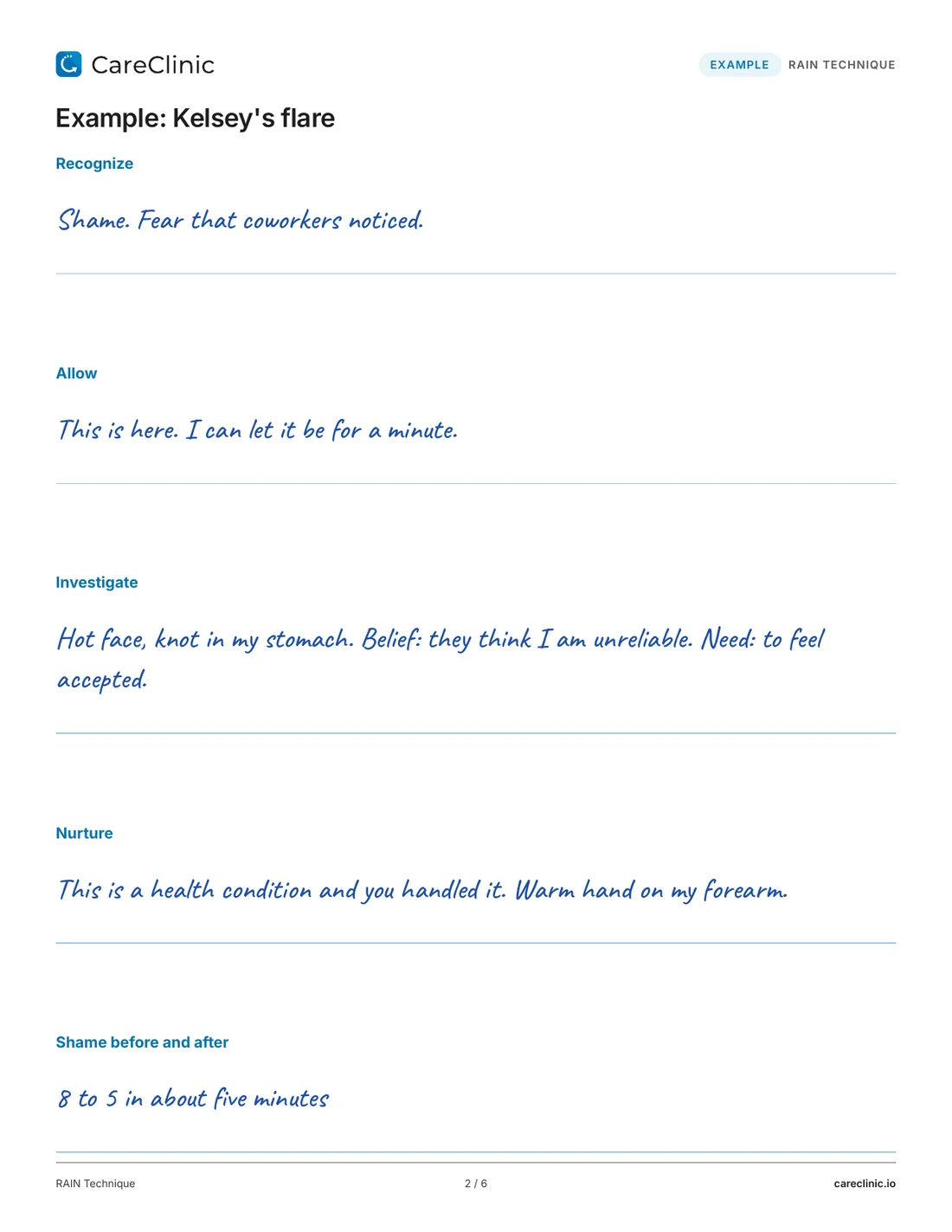
The RAIN technique example belongs to Kelsey, who begins by naming shame and fear that coworkers noticed. Allow: this is here, and she can let it be for a minute. Investigate: a hot face and a knot in her stomach, the belief that they think she is unreliable, and a need to feel accepted. Nurture: this is a health condition and she handled it, with a warm hand on her forearm. Her shame went from 8 to 5 in about five minutes.
 Open the full PDF
When to use it
Use it after an embarrassing moment, a harsh inner voice, a flare of anger, fear about a test result or shame about a health condition.
The first few times, use the full worksheet in a quiet place. Later, the pocket card is enough for a short version, even in a bathroom stall or a parked car.
Working through one feeling
Begin the RAIN technique with the feeling you can name most clearly. You might notice embarrassment after leaving a meeting, fear before a phone call or irritation when a plan changes. Describe the event separately from the story you are telling yourself about it. A few ordinary words are enough.
Allowing means making room for what is already present. You can still decide what to do next. Investigating asks about sensations, beliefs and needs. Write a belief as a belief, such as I think they are judging me, so it stays separate from what you actually observed.
Nurturing turns the response toward care. A useful sentence is one you could believe from a friend. It might acknowledge that the moment was difficult or recognize an effort you made. Read it back once and notice whether you want to change any words.
Using the log after a busy day
A meditation journal can hold longer reflections, while this log keeps the repeated parts together. Record the feeling, the belief you noticed and the need underneath. Use the same personal rating scale for before and after, then add another entry the next time you practice.
You can pair these notes with a stress tracker to remember what else was happening that day. Look for repeated circumstances such as interrupted sleep, a rushed meal or a difficult conversation. Choose one entry to revisit rather than trying to explain every feeling at once.
The RAIN technique is easiest to review when your notes describe one event at a time. On the review page, collect the feelings that appeared most often and the responses you want to use again. You may find that different situations point toward the same need, such as rest, company or a clearer plan.
Tips that make it work
- Use the RAIN technique to write about one specific moment.
- Name the feeling in one or two words.
- In the investigate step, be curious, not clinical.
- Nurture can be small: a kind sentence or a slow breath.
Bringing it to your doctor
Bring a completed page and the practice log to an appointment when you want to discuss recurring feelings about your health. Mark the words that were hardest to fill in and the kind responses that felt believable. Those details give you and your care team a concrete starting point for the conversation.
Questions
What does RAIN stand for?
Recognize, Allow, Investigate and Nurture. Some versions use Non identification for the last step. In this worksheet each word has its own space. Work from the top of the page to the bottom so that the kind response follows what you noticed.
How is RAIN meditation taught by Tara Brach?
Her version moves through recognizing, allowing, investigating and nurturing. The final step asks for a caring response to what you found. This worksheet uses original prompts for those stages, with room to write a response that sounds like your own voice.
How long does it take?
Take the time you need to work through the four steps. Leave enough room to answer the prompts in your own words. A brief entry on a busy day and a longer reflection on a quiet evening can both follow the same sequence.
How do I use a RAIN technique worksheet?
Choose one recent moment and describe it in plain words. Move through the prompts in order, then add a short note to the log. You can use the pocket card later as a reminder of the same sequence.
Is it the same as DBT skills?
No. This worksheet follows the RAIN sequence taught by Tara Brach. It has four mindfulness and self compassion prompts rather than a collection of DBT skills.
Is this RAIN technique worksheet free?
Yes. This RAIN technique worksheet is a free printable PDF in US Letter and A4, with prompts, a card, a log and an example.
More free worksheets



References
- RAIN practice resources. Tara Brach. https://www.tarabrach.com/rain/