


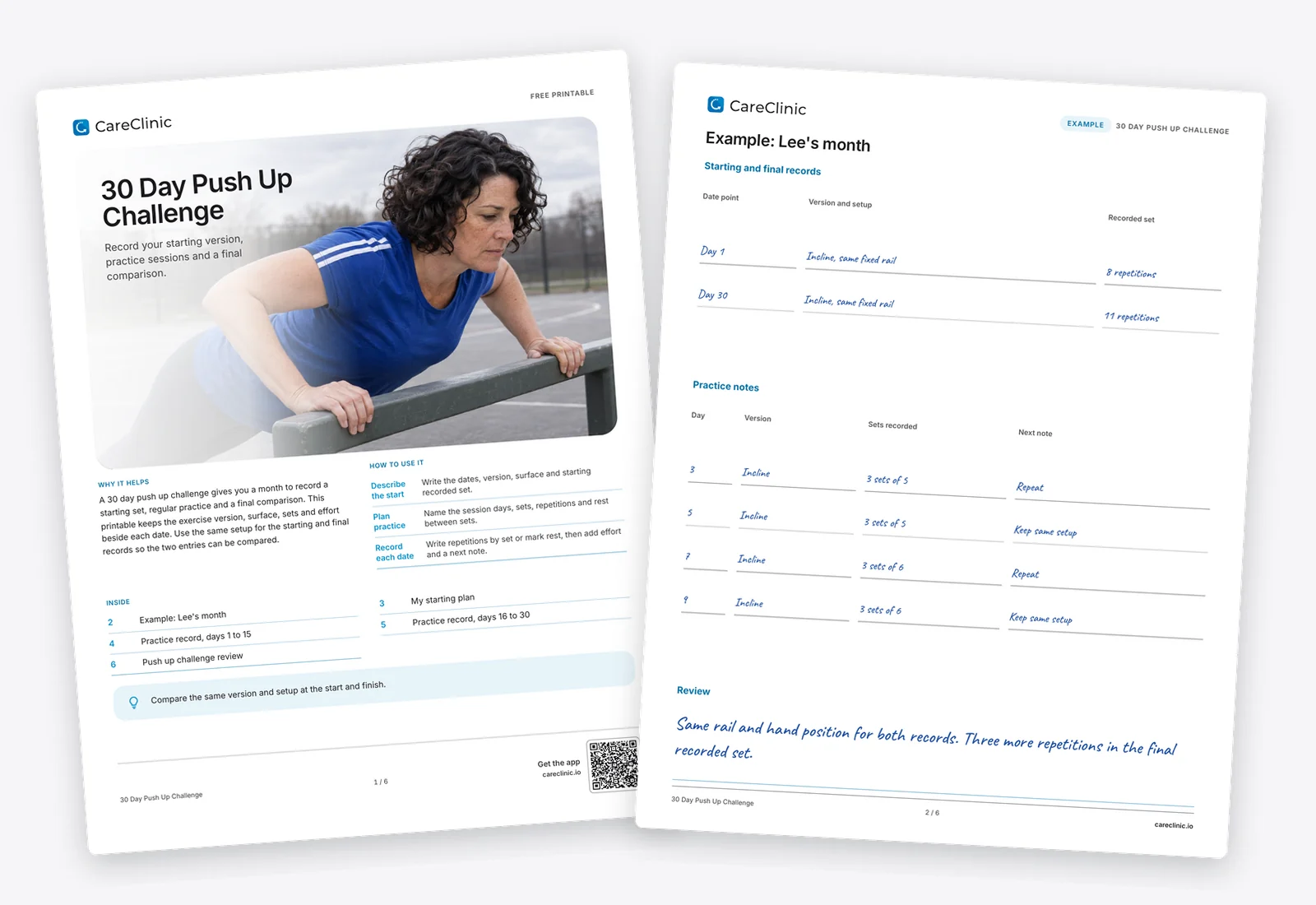
A 30 day push up challenge gives you a month to record a starting set, regular practice and a final comparison. This printable keeps the exercise version, surface, sets and effort beside each date. Use the same setup for the starting and final records so the two entries can be compared.
The planning page includes wall, incline, knees and floor versions as choices to describe. You write the schedule and amounts from the routine you follow. The example uses an incline at one fixed rail, with practice notes showing when Lee repeats an amount and when the recorded sets change.
Download the 30 Day Push Up Challenge
- Fill it in on your phone or computer, or print it
- US Letter and A4
- Includes a filled example
How it helps
Keep the setup clear
Record the version, surface and hand position used for your comparison.
Track practice and rest
Give every date a row with room for sets and effort.
Compare matching records
Use the 30 day push up challenge review to compare the starting plan with your notes.
How to use it
- Describe the start. Write the dates, version, surface and starting recorded set.
- Plan practice. Name the session days, sets, repetitions and rest between sets.
- Record each date. Write repetitions by set or mark rest, then add effort and a next note.
- Compare. Repeat the original setup for the final record and review the month.
What is inside
- Page 1, Thirty Day Push Up ChallengeThe cover, why it helps, how to use it and the contents.
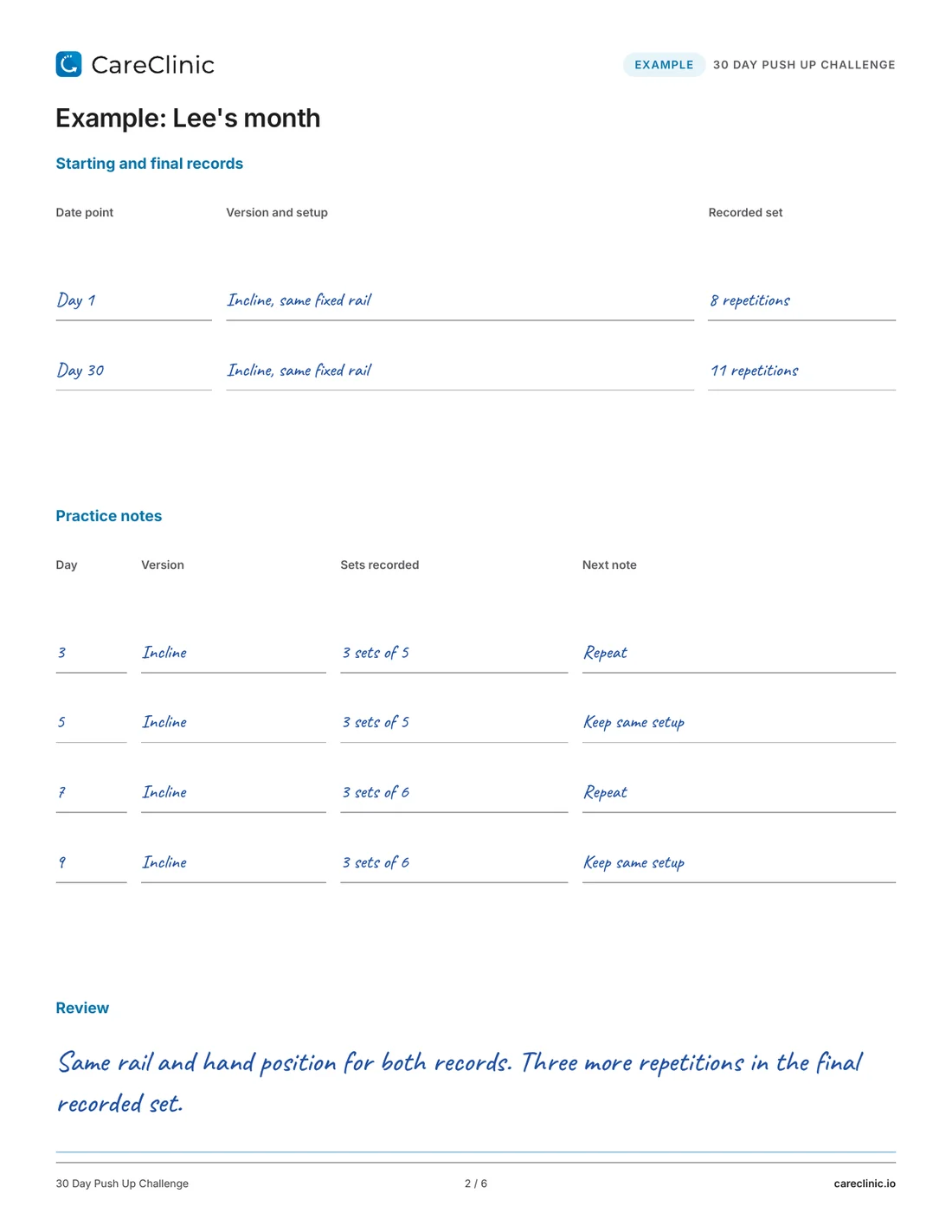
- Page 2, Example: Lee's monthLee's day 1 and day 30 records on the same rail, four practice days and a review.
- Page 3, My starting planStart and final record dates, version and setup, a practice plan with sets and rest, and what you want to repeat.
- Page 4, Practice record, days one to fifteenDays 1 to 15 with version or rest, repetitions by set, effort, a next note and setup notes.
- Page 5, Practice record, days sixteen to thirtyDays 16 to 30 with the same columns and setup notes.
- Page 6, Push up challenge reviewStarting and final comparison, what changed, your next practice plan and appointment notes.
See a filled example
Lee records 8 incline push ups at a fixed rail on day 1 and 11 using the same setup on day 30. Practice notes show 3 sets of 5 on days 3 and 5, then 3 sets of 6 on days 7 and 9. The review notes the same rail and hand position and three more repetitions in the final recorded set.
 Open the full PDF
Name the version and the surface
Write more than the word push up in your starting plan. If you use a wall or incline, describe the surface so you can return to it. A different rail height changes the setup. For a knees or floor version, note the position you use. Keep that description beside the first recorded set.
The 30 day push up challenge has room for a starting record without turning every practice day into a test. During practice, write repetitions for each set separately. Three sets with different counts are more informative than a single total because they show how the work was spread through the session.
Use the next note for one decision
After a session, describe effort in a few words. Then write the next decision, such as repeat the same plan or ask about a different version. If you change the amount, keep the earlier entry. The daily rows let you see the sequence rather than relying on memory at the end of the month.
A physical therapy exercise tracker can hold additional instructions from a specific program. Use this page beside that plan when it helps you keep dates together. Note a changed surface, a shorter session or an interruption in practice. Those details make a final comparison easier to explain.
Compare the same thing twice
At the final record, return to the original version and setup described on the first page. Write what you actually completed. A change in repetitions is easier to interpret when the surface and hand position stayed the same. If you used a different setup, describe the difference beside the number.
The review page also asks what changed during the month and what belongs in the next practice plan. A daily activity tracker can help recall other activity around the sessions. Read the effort notes before deciding whether to keep the same schedule, change an amount or choose another version to discuss.
Tips that make it work
- Keep the 30 day push up challenge near the routine you follow so the dates stay current.
- Write every set separately, including a shorter final set.
- Record rest days instead of leaving their dates unexplained.
- Use the same surface description when you make the final comparison.
Bringing it to your doctor
Bring the 30 day push up challenge plan and record to an appointment when you want to discuss exercise choices with your clinician or physical therapist. Circle a session you want to explain. Use the review card for the version, setup and questions you want to discuss next.
Questions
How does a 30 day push up challenge work?
You record a starting set, follow your practice plan and make a final comparison after the month. This PDF has room for different push up versions and personal amounts. Rest days stay in the daily record.
Can beginners use the push up tracker?
Yes. Describe the version and routine you are learning on the planning page. The blank amounts let you record your own plan. Keep the setup details with the counts so later entries have context.
Can I record wall push ups?
Yes. Wall is one of the version choices on the starting page. Describe the position and surface you use. Repeat those details when you make your final record. Keep this entry with your 30 day push up challenge so the setup remains clear.
How do I track several sets?
Write the count for each set in the repetitions column. Use a separator between counts, such as 5, 5, 4. Keep the effort and next note beside the same date.
Do I have to practice every day?
The planning page lets you write the session days from the routine you follow. Mark rest on the other dates. The daily rows cover the whole month so gaps can be explained.
Is this 30 day push up challenge free?
Yes. This 30 day push up challenge is a free printable PDF in US Letter and A4. It includes a filled example, a starting plan, daily records and a final review.
More free worksheets

References
- How to improve strength and flexibility. NHS. https://www.nhs.uk/live-well/exercise/how-to-improve-strength-flexibility/