


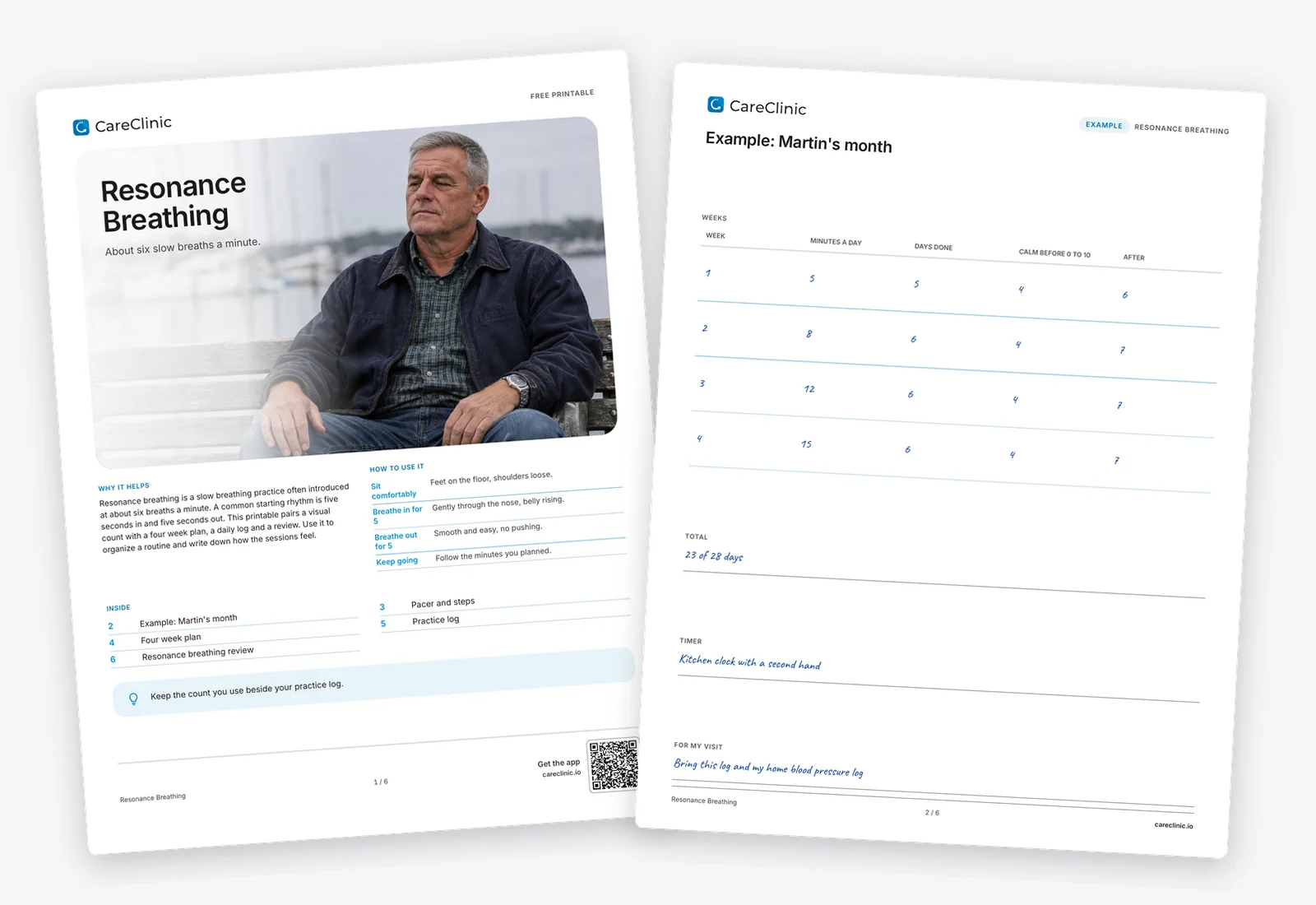
Resonance breathing is a slow breathing practice often introduced at about six breaths a minute. A common starting rhythm is five seconds in and five seconds out. This printable pairs a visual count with a four week plan, a daily log and a review. Use it to organize a routine and write down how the sessions feel.
You can follow the count with a clock that shows seconds. The paper wave shows the order of the in and out breaths while the clock keeps time. There is room to note the count you used and the minutes you practiced. A filled example shows how one person organizes the month.
Download the Resonance Breathing
- Fill it in on your phone or computer, or print it
- US Letter and A4
- Includes a filled example
How it helps
Six breaths a minute
Five seconds in, five seconds out.
Four week plan
Write minutes, time of day and planned days.
No device needed
A clock or timer is enough.
How to use it
- Sit comfortably. Feet on the floor, shoulders loose.
- Breathe in for 5. Gently through the nose, belly rising.
- Breathe out for 5. Smooth and easy, no pushing.
- Keep going. Follow the minutes you planned.
What is inside
- Page 1, Resonance BreathingInstructions and contents.
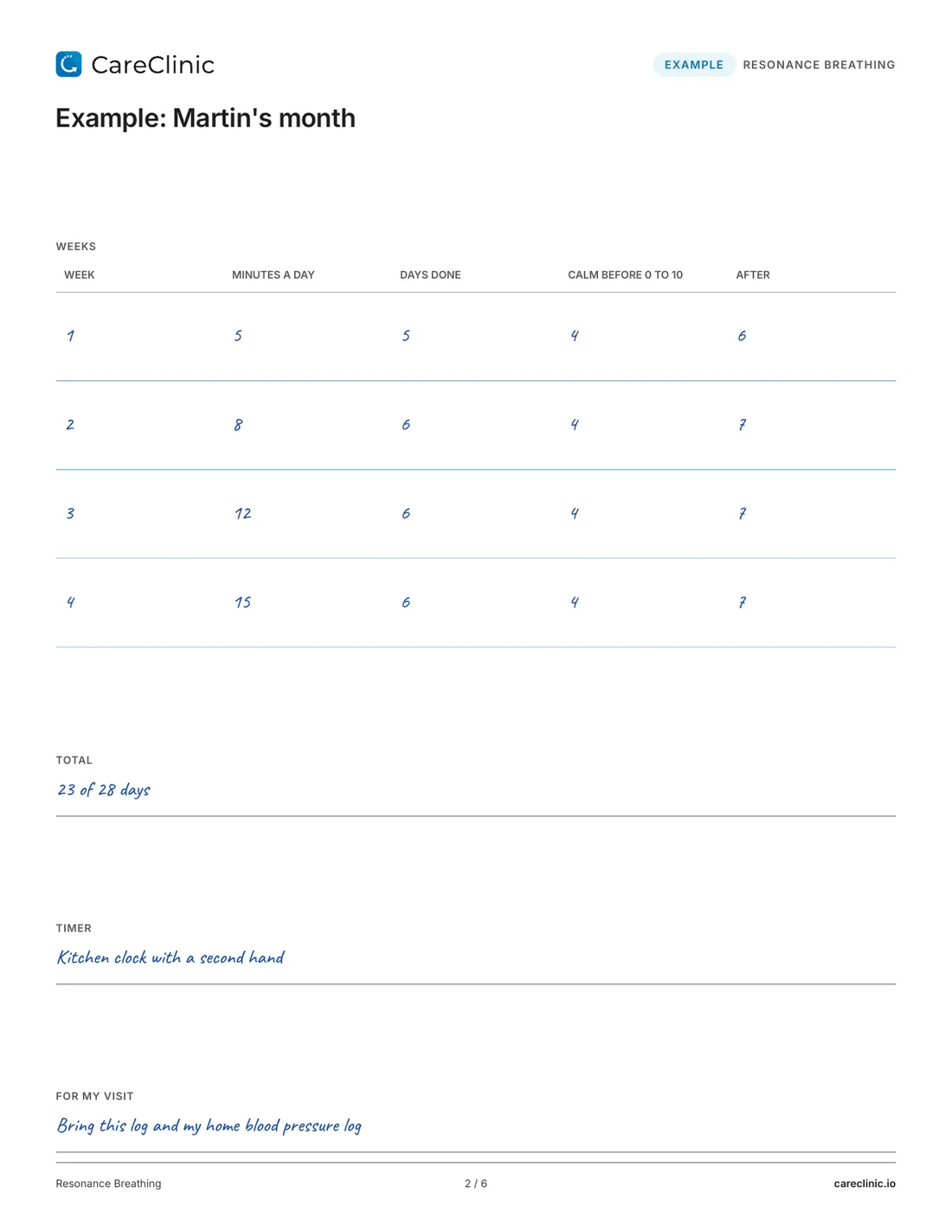
- Page 2, Example: Martin's monthA completed example showing how the entries fit together.
- Page 3, Pacer and stepsPacer, Steps, Count options.
- Page 4, Four week planPlan, My next small change.
- Page 5, Practice logLog.
- Page 6, Resonance breathing reviewAverage calm before and after, Minutes that suit me, For my next appointment.
See a filled example
Martin’s example covers four weeks. He practices for 5, 8, 12 and 15 minutes per session in successive weeks, completing 5, 6, 6 and 6 days. That adds up to 23 of 28 days. His calm rating is 4 before practice each week, and 6, 7, 7 and 7 afterward. He uses a kitchen clock with a second hand and writes a reminder to bring the record to his visit. These are sample entries for learning the form.
 Open the full PDF
Follow the count on paper
The resonance breathing guide has a rising section for the inhale and a falling section for the exhale. A count from one to five appears above and below the wave. Follow a rise as you breathe in, then follow a fall as you breathe out. Use seconds from a clock rather than racing through the count. The repeated wave lets you keep track of where you are in the cycle.
The count options show different ways to divide the same ten second cycle. Record your choice in the Count column of the log. Keeping this detail makes it easier to discuss the sessions later. It also helps you notice whether an entry used the same rhythm as the previous week.
Make the plan fit your day
The four week plan has separate spaces for minutes a day, time of day and days planned. Write a time that you can recognize, such as after changing out of work clothes. The example increases session length gradually, but your own plan stays blank so you can record a routine that fits your circumstances.
Choose where the sheet will live. A paper guide by your usual chair is easier to find than a file saved among many other downloads. If you use the fillable PDF, save a named copy for the month before adding entries. Keep your earlier month when you begin a new one.
Look back at the month
For each resonance breathing session, enter the day, minutes, count and calm ratings. Use a consistent personal scale from 0 to 10, with higher numbers meaning calmer. Add a few words in the Note column about the setting. A late shift and a quiet day off give useful context when the numbers differ.
At the end of the month, count the completed days and read the notes as well as the ratings. Write a brief observation on the review page. Keep entries where the rating stayed the same. If you want more space to describe a session, use a meditation journal and put the same date on both pages.
Tips that make it work
- Keep your resonance breathing count beside the log so you record the same rhythm you practiced.
- Use a clock with seconds to keep the pace. A printed wave gives the sequence, while the clock gives the timing.
- Write the date and length of the session before moving on with your evening.
- Keep the notes short enough that you will still make an entry on a busy day.
Bringing it to your doctor
Bring the resonance breathing review to a visit when you want to discuss your practice routine. Note which count you used, how long you practiced and what you noticed. Use the appointment card for questions about a personal breathing pace or biofeedback. A stress tracker can help you describe the situations around the sessions without relying on memory.
Questions
What is resonance breathing?
It is slow paced breathing linked to the study of heart rate variability. Six breaths per minute is a common starting pace. A personal resonance frequency can differ, and a biofeedback assessment can identify that pace.
How do you do resonance breathing?
Sit comfortably and follow a gentle, even in and out rhythm. The guide shows five seconds in and five out. Keep the count alongside your log so the entry describes the rhythm you used.
Is resonance breathing the same as coherent breathing?
The names are often used for similar slow breathing practices. Here the printable uses a ten second breathing cycle as a starting guide, with room to record the count that you practiced.
Do I need a resonance breathing app?
No. You can use a clock with a second hand. Put the paper guide where you can see it, then record the session on the log.
What is resonance breathing HRV?
HRV means heart rate variability, the changing interval between heartbeats. Researchers use paced breathing and biofeedback to study and train this pattern. The printable gives you space for your practice notes.
Is this resonance breathing printable free?
Yes. This resonance breathing printable is a free PDF in US Letter and A4. You can type in the blank fields or print the pages. Keep a fresh copy for the next month.
More free worksheets


References
- Heart rate variability biofeedback: how and why does it work? Lehrer and Gevirtz, 2014. https://www.frontiersin.org/journals/psychology/articles/10.3389/fpsyg.2014.00756/full