


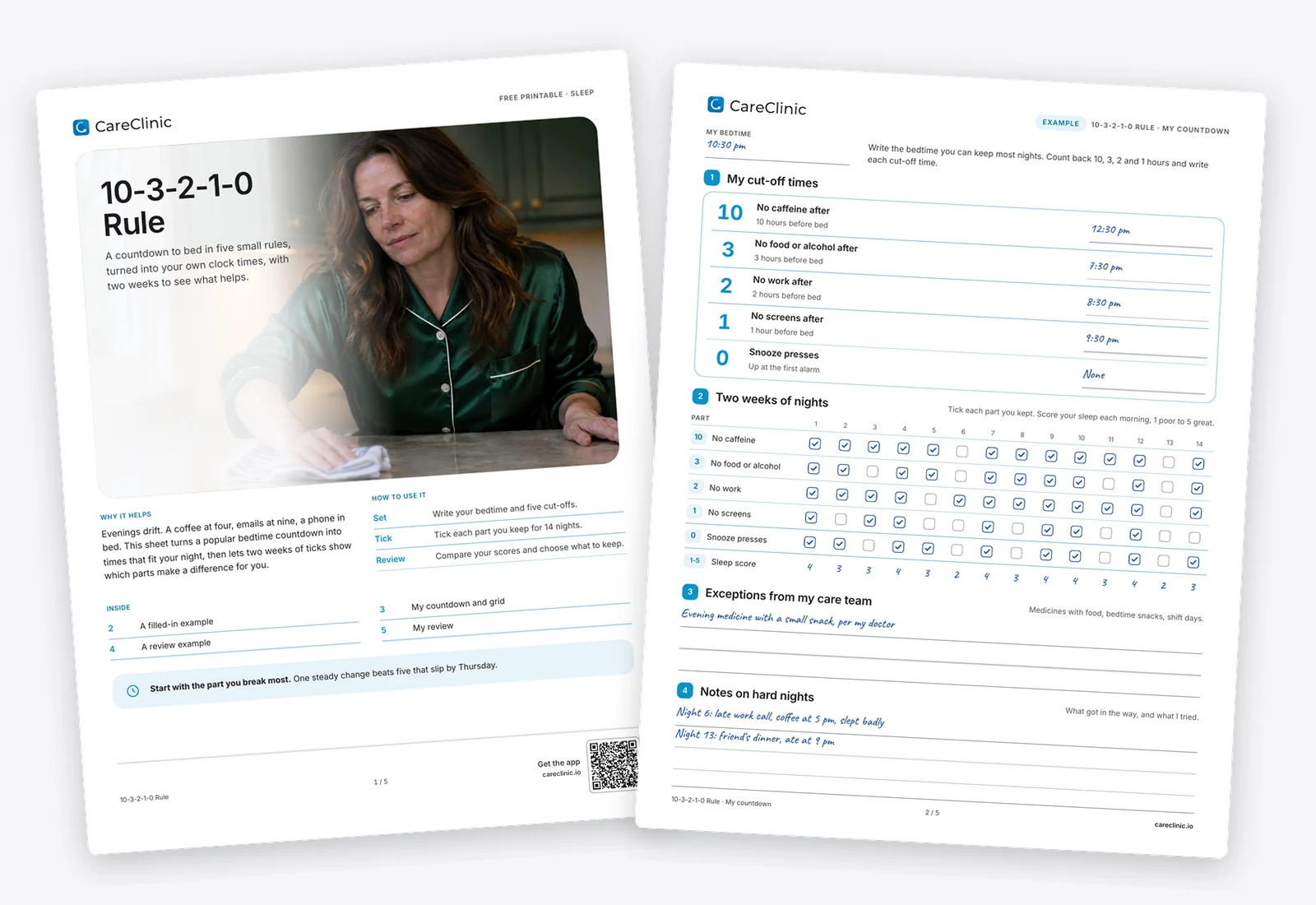
This 10-3-2-1-0 rule planner turns a bedtime countdown into your own clock times: caffeine stops 10 hours before bed, food and alcohol stop 3 hours before, work stops 2 hours before, screens go away 1 hour before, and the snooze button gets zero presses in the morning. It is for adults whose evenings keep running late and who want a simple structure to test.
You write your bedtime once, work out each cut-off time, then tick what you kept for 14 nights and score each morning. The review page shows which parts you keep, which ones slip, and whether nights with more ticks felt better.
Download the 10-3-2-1-0 Rule
- Fill it in on your phone or computer, or print it
- US Letter and A4
- Includes a filled example
How it helps
Your own clock times
Write your bedtime once and count back to four cut-off times, then note your wake-up plan.
Five small rules
Each part is simple on its own, so you can start with one or two.
See what matters for you
Two weeks of ticks and morning scores show which parts make a difference.
How to use it
- Set. Write the bedtime you can keep most nights, then fill in the four cut-off times and your snooze plan.
- Tick. Each night, tick every part you kept. Each morning, score your sleep from 1 to 5.
- Review. After 14 nights, count each row and compare scores on nights with all five against the rest.
What is inside
- Page 1, the coverHow the countdown works and what is inside.
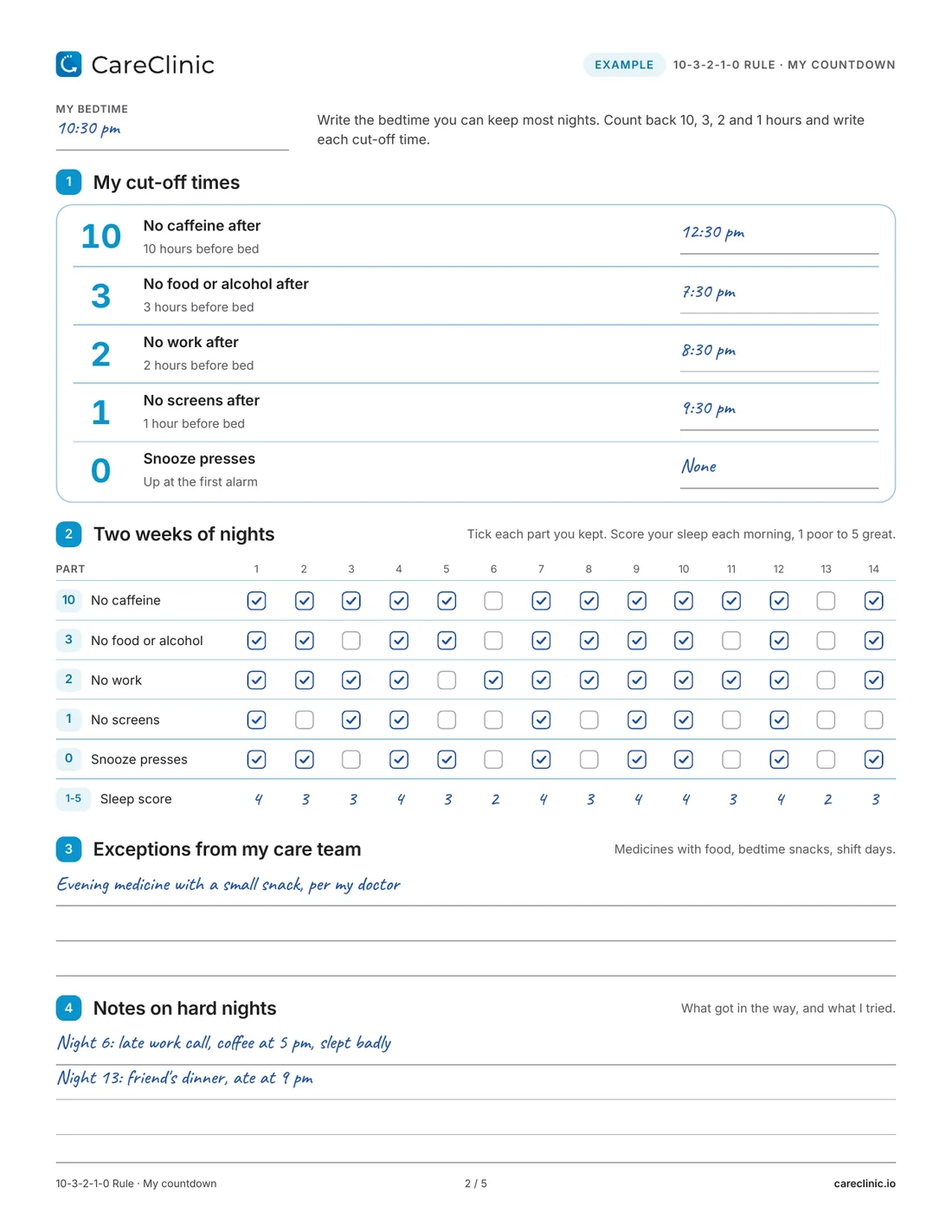
- Page 2, a filled-in exampleA 10:30 pm bedtime with cut-offs, 14 nights of ticks and notes.
- Page 3, my countdown and gridYour bedtime, five cut-off times, the tick grid and care team exceptions.
- Page 4, a review exampleNights kept per part, average scores and what to keep or change.
- Page 5, my reviewYour counts, scores, next steps and a box for your next appointment.
See a filled example
In the example, bedtime is 10:30 pm, so the cut-offs are caffeine by 12:30 pm, food and alcohol by 7:30 pm, work by 8:30 pm and screens by 9:30 pm. Over 14 nights the caffeine and work rows were kept 12 times, food 10, snooze 9 and screens 7. The 6 nights with all five parts averaged a sleep score of 4.0, against 2.8 on the other 8 nights. The plan for the next two weeks is to charge the phone in the kitchen at 9:30 and put the alarm across the room.
 Open the full PDF
What each number in a 10-3-2-1-0 rule means
Each number is a count of hours before your bedtime, except the last one. The planner prints the same five rows on pages 2 and 3.
The five parts
- 10 No caffeine after
- 3 No food or alcohol after
- 2 No work after
- 1 No screens after
- 0 Snooze presses
Why each part is there
Caffeine is a stimulant and can keep you alert for hours after your last cup, so the earliest cut-off goes to coffee, tea, cola and energy drinks.
A large meal close to bed can bring on heartburn, and alcohol may help you nod off but tends to break up sleep later in the night.
Work and screens keep your mind busy and bright light reaches your eyes. Stopping both gives you a quieter last hour, which suits a calmer evening routine.
Zero snooze means getting up at the first alarm. A steady wake time helps your body clock, and it also makes the next bedtime easier.
Does a 10-3-2-1-0 rule routine work?
The countdown is a rule of thumb rather than a tested medical treatment. Its advice about limiting late caffeine, large meals, alcohol and screens overlaps with sleep guidance, but the exact cut-offs do not suit everyone.
That is why the planner is built as a two-week test. Your ticks and morning ratings can show patterns to discuss with your care team. They cannot prove that a particular change caused better sleep, because stress, illness and other changes can affect the same nights.
When to adjust the countdown
Shift workers can count back from the start of their main sleep, whatever the clock says. If you take medicines with food, have diabetes, have reflux or are pregnant, ask your care team about evening meals and snacks, and write their advice in the exceptions box. A night owl can start with a later bedtime and move it earlier by small steps.
Tips that make it work
- Start your 10-3-2-1-0 rule with the one part you break most often, then add the rest.
- Charge your phone outside the bedroom. It makes the screens part and the zero snooze part easier.
- Set a phone reminder at your 2 hour cut-off so work has a clear end.
- Score your sleep as soon as you get up, before you check your phone.
- Keep a simple sleep diary next to the grid if you want bedtimes and wake times on record too.
Bringing it to your doctor
Bring your 10-3-2-1-0 rule grid and the review page if you see a doctor about sleep. If you keep all five parts for two weeks and still sleep badly, wake often, snore loudly or feel very sleepy in the day, book a visit. Ask your care team about meal and medicine timing before you cut evening food if you have diabetes or reflux, or are pregnant.
Questions
What does 10-3-2-1-0 rule mean for sleep?
It is a countdown to bedtime: no caffeine 10 hours before bed, no food or alcohol 3 hours before, no work 2 hours before, no screens 1 hour before, and 0 snooze presses in the morning.
Does a 10-3-2-1-0 rule routine actually work?
It is a rule of thumb rather than a tested treatment. Each part matches common sleep advice, such as limiting late caffeine and alcohol. Two weeks of ticks and scores on this planner show whether it helps you.
Can shift workers use a 10-3-2-1-0 rule planner?
Count back from the start of your main sleep, even if that is during the day. Use the exceptions box for shift changes and for advice from your care team about meals and medicines.
Can I eat 3 hours before bed if I have diabetes?
Follow your diabetes team's advice on evening snacks and medicine timing. Some people need a bedtime snack to stay safe overnight. Write it in the exceptions box.
Is this 10-3-2-1-0 rule planner free?
Yes. This 10-3-2-1-0 rule planner is a free printable PDF in US Letter and A4. Fill it in on your phone or computer, or print it.
More free worksheets

References
- Mastering Sleep Hygiene: Your Path to Quality Sleep. Sleep Foundation. https://www.sleepfoundation.org/sleep-hygiene
- Healthy Sleep Habits. American Academy of Sleep Medicine, Sleep Education. https://sleepeducation.org/healthy-sleep/healthy-sleep-habits/