


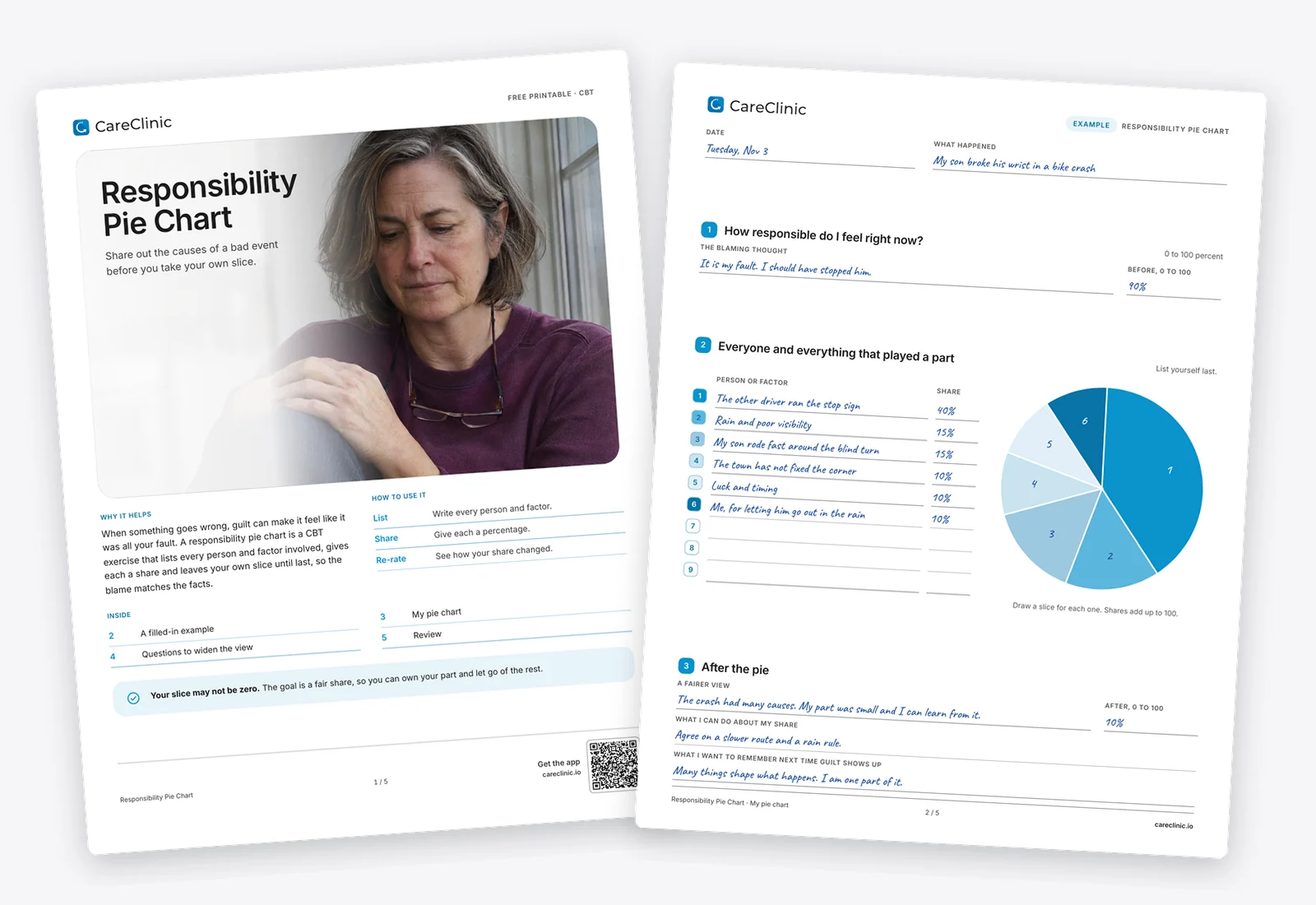
A responsibility pie chart is a cognitive behavioral therapy (CBT) exercise for times when guilt makes you feel as if a bad event was all your fault. You list every person and factor involved, give each a share out of 100 percent, and look at your own slice last. The goal is a fair share of responsibility.
The free PDF has a filled example, a blank pie chart, questions to widen the view and a review page with notes for your next appointment. It is for adults and older teens working on excess guilt or self blame, alone or with a therapist.
Download the Responsibility Pie Chart
- Fill it in on your phone or computer, or print it
- US Letter and A4
- Includes a filled example
How it helps
Widen the view
Listing everyone and everything involved shows causes you may have overlooked.
Find your fair share
Percentages make it easier to see when guilt is giving you too much of the blame.
Act on what is yours
The last box turns your share into something you can learn from or put right.
How to use it
- Write what happened. Describe the event, the blaming thought and how responsible you feel from 0 to 100 percent.
- List every person and factor. Include choices, circumstances, chance and timing, and list yourself last.
- Give each a share. Divide 100 percent between the factors, drawing a slice for each one.
- Rerate and act. Write a fairer view, rate your responsibility again and choose one action for your share.
What is inside
- Page 1, Responsibility Pie ChartThe cover and a short guide.
- Page 2, a filled-in exampleA parent's guilt after a child's bike crash, with six causes and a pie.
- Page 3, My pie chartThe event, before rating, nine factor rows, a blank pie and after questions.
- Page 4, Questions to widen the viewSix questions to help find causes besides yourself.
- Page 5, ReviewA log of events and before and after ratings, patterns in self blame and appointment notes.
See a filled example
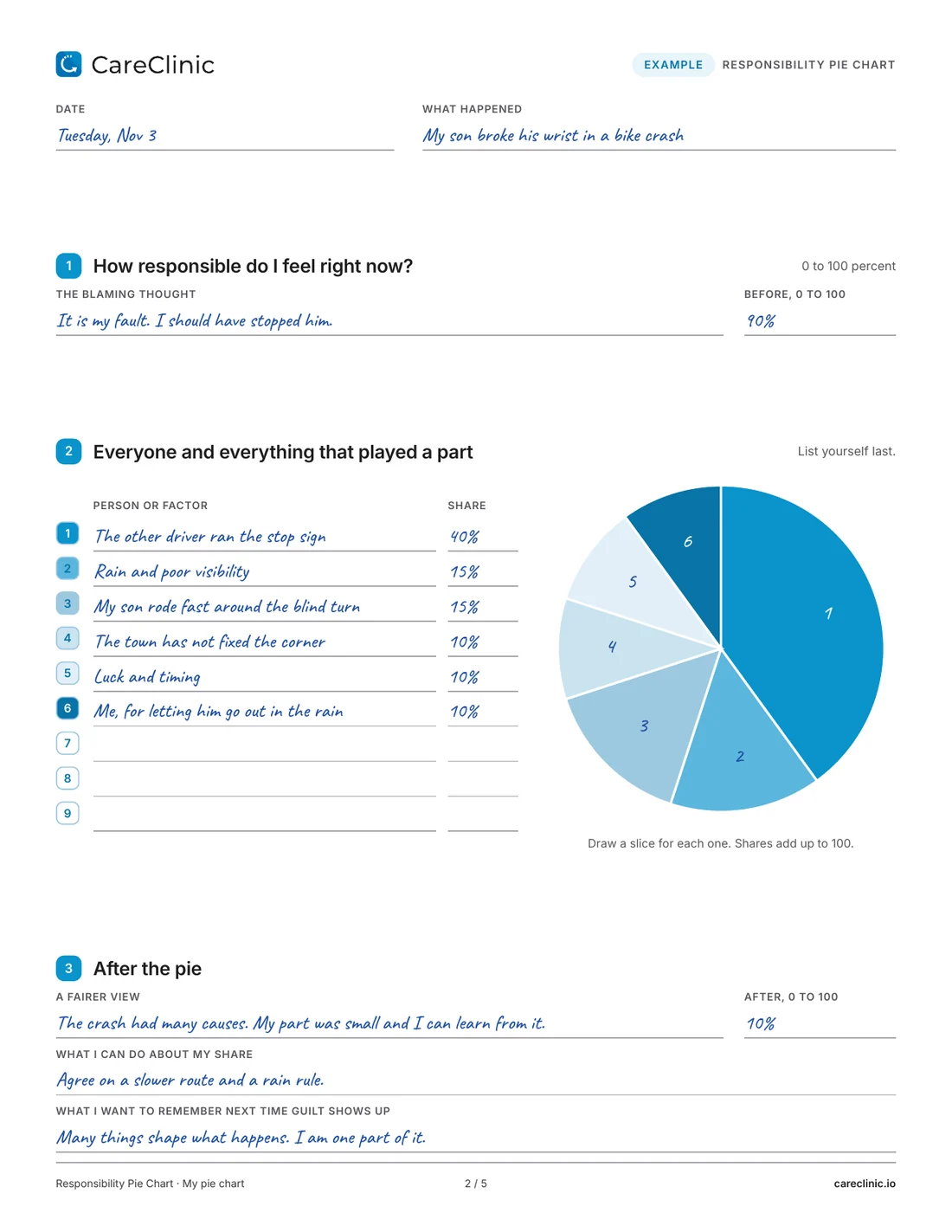
The responsibility pie chart example starts with a parent whose son broke his wrist in a bike crash. The parent first feels 90 percent responsible. The pie gives 40 percent to the other driver running a stop sign, 15 to rain and poor visibility, 15 to the son riding fast around a blind turn, 10 to an unfixed corner, 10 to luck and timing and 10 to the parent letting him out in the rain. After looking at all six causes, the parent feels 10 percent responsible and plans to agree on a slower route and a rain rule.
 Open the full PDF
Why guilt needs the whole picture
Guilt often narrows attention to one thing you did or did not do. A responsibility pie chart widens it again. Looking at choices made by other people, the circumstances, what you knew at the time and chance helps you see the event more fairly.
The exercise is common among CBT techniques for excessive guilt. It does not let you off the hook for real harm. Your slice may still be large, and the action box asks what you can do about it. A fair share is more useful than either taking all the blame or none of it.
How to divide the pie
Start by listing causes without numbers. Ask who else had a choice, what was outside anyone's control and what you knew at the time rather than what you know now. The six questions on page 4 help if the only name you can think of is your own.
Then give the other causes their shares before choosing yours. The percentages should add to 100. They are estimates, not a legal finding or a scientific calculation. The point is to see how the causes fit together and whether your first feeling of responsibility matches them.
What to do with your slice
When you finish the pie, write a fairer view in one sentence and rate how responsible you feel again. A smaller rating does not have to mean zero. If your share is real, use the action box to make amends, learn a skill, set a rule or plan differently next time.
The review page helps you notice situations where you tend to take too much blame. If you already keep an anxiety journal, you can use it for the longer story and the pie for the part about responsibility.
Using it with a therapist
For some people, especially those with OCD, repeatedly checking responsibility can turn into a way of seeking certainty. If you keep redrawing the same pie or need reassurance before you can move on, discuss it with your therapist rather than doing more pies. Tracking compulsion patterns may be more useful in that situation.
Tips that make it work
- Use a responsibility pie chart for one specific event rather than your whole life or a general feeling that you are a bad person.
- List yourself last so the other causes get a fair look first.
- Use rough numbers such as 10 or 20 percent. Fine tuning the slices for an hour usually misses the point.
- Keep completed pies and review them before an appointment to spot recurring self blame.
Bringing it to your doctor
Bring your pie charts to a doctor or therapist if guilt is constant, keeps you from sleeping or functioning, or comes with low mood, anxiety or repeated checking. A therapist trained in CBT can help when your fair share is hard to see. If you have thoughts of harming yourself, get help now. In the US or Canada, call or text 988. If anyone is in immediate danger, call 911 or the emergency number where you live.
Questions
What is a responsibility pie chart?
It is a CBT exercise that divides responsibility for an event between all the people and factors involved. Each gets a percentage, and all the slices add to 100. It is used when guilt makes someone take too much blame.
How do I fill in a responsibility pie chart?
Write the event and your first feeling of responsibility, then list every cause with yourself last. Give each a share out of 100 and draw the slices. Finish with a fairer view and one action for your own share.
What if my slice is still big?
Then the pie has helped you see your real responsibility. Use the last box to decide what you can repair or learn. The aim is fairness, not to prove that nothing was your fault.
Can I use a responsibility pie chart for OCD?
Use it with your therapist's guidance. For some people, repeating the exercise becomes reassurance seeking or checking. If that happens, ask your therapist what to do instead.
Is this responsibility pie chart free?
Yes. This responsibility pie chart is a free PDF in US Letter and A4. Fill it in digitally or print page 3 for each event you want to work through.
More free worksheets



References
- Cognitive Behavioral Therapy (CBT). Cleveland Clinic. https://my.clevelandclinic.org/health/treatments/21208-cognitive-behavioral-therapy-cbt
- Obsessive-Compulsive Disorder. National Institute of Mental Health. https://www.nimh.nih.gov/health/topics/obsessive-compulsive-disorder-ocd