


This sleep hygiene checklist helps you check 16 everyday habits against what sleep research supports. Tick what is true for most nights in the last two weeks, and you get a score, the three habits most worth changing, and a printable copy for your next appointment.
Most people know a few sleep rules but rarely test them against a real week. The sheet turns those habits into plain yes or no questions, so you can see which ones cost you sleep and change a few at a time.
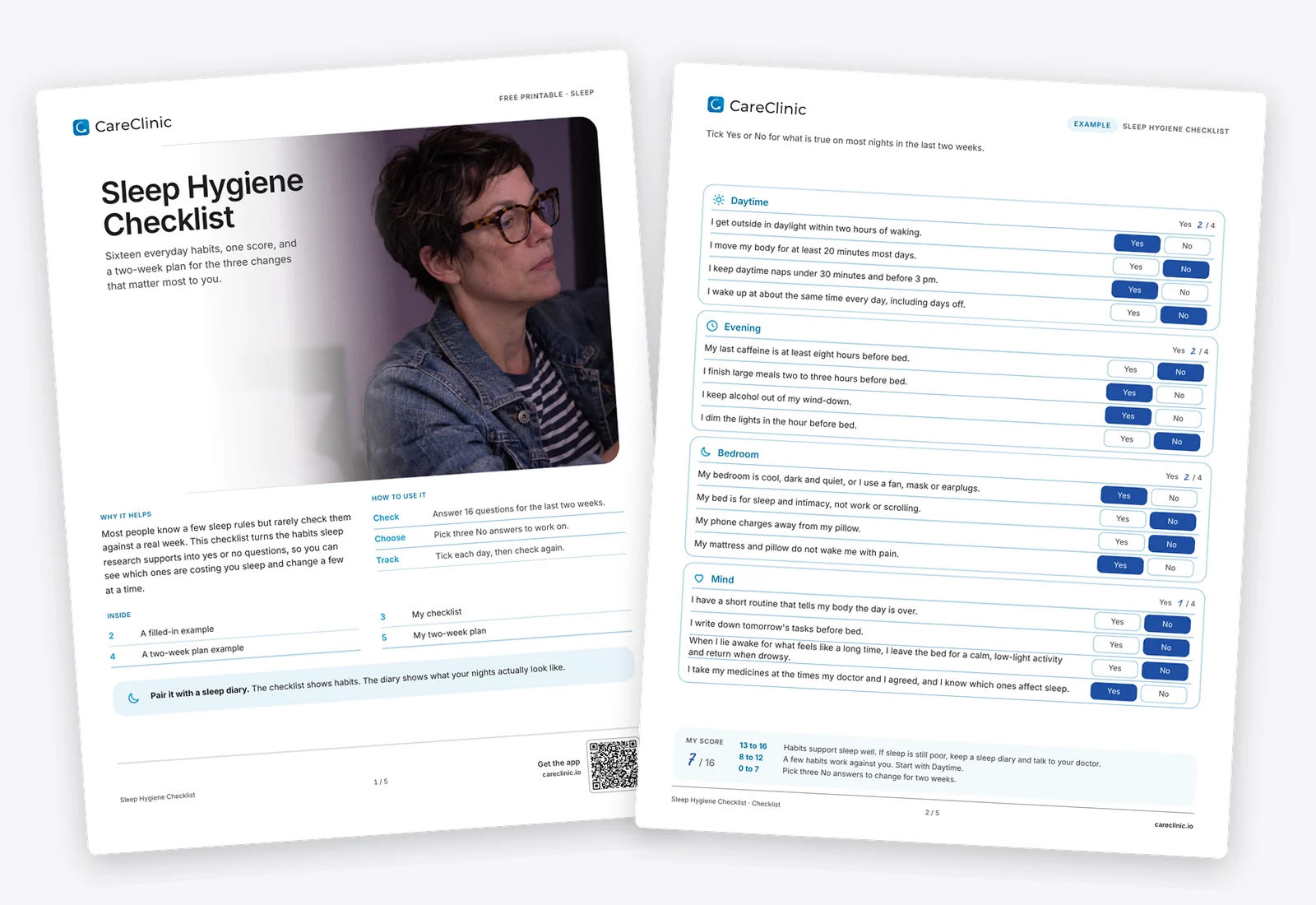
Download the Sleep Hygiene Checklist
- Fill it in on your phone or computer, or print it
- US Letter and A4
- Includes a filled example
How it helps
Sixteen yes or no questions
Daytime, evening, bedroom and mind habits, each answered for the last two weeks.
A score by group
Subtotals show whether daytime, evening, bedroom or mind habits need the most work.
A two-week plan
Three changes, a tick for each day you keep them, and a second score.
How to use it
- Check. Answer the 16 lines for the last two weeks, thinking of a typical night.
- Choose. Pick three No answers that feel doable.
- Track. Tick each day you keep a change, then take the sleep hygiene checklist again on day 14.
What is inside
- Page 1, the coverHow to use it and what is inside.
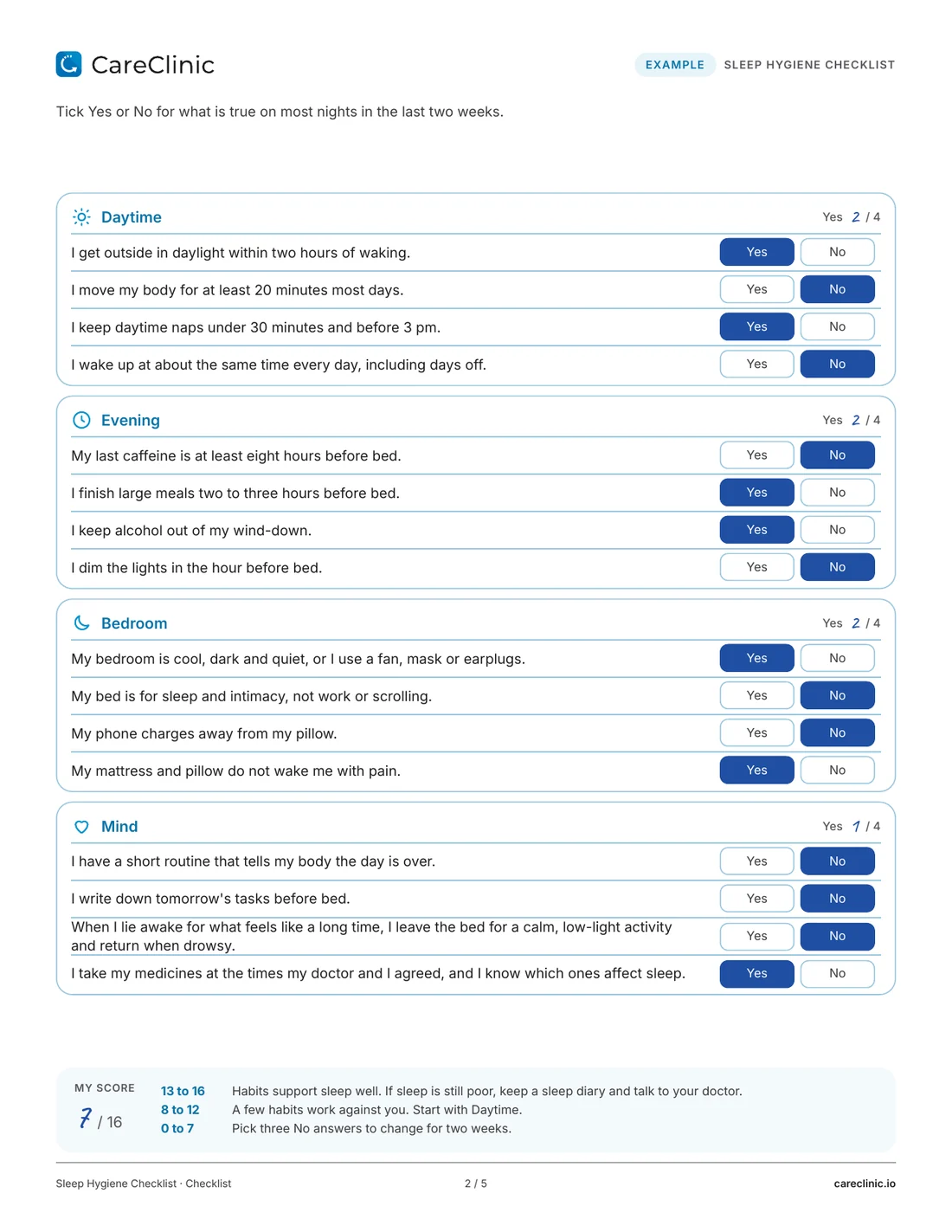
- Page 2, a filled-in exampleA completed checklist with a score of 7 out of 16.
- Page 3, my checklistThe 16 questions, group subtotals and your score.
- Page 4, a two-week plan exampleThree chosen changes, daily ticks and the score two weeks later.
- Page 5, my two-week planYour three changes, both scores, notes and a box for your next appointment.
See a filled example
The filled-in sleep hygiene checklist example scores 7 out of 16: 2 in Daytime, 2 in Evening, 2 in Bedroom and 1 in Mind. The three changes chosen are the same wake time at 7 am every day, the last coffee by noon, and the phone charging in the kitchen. Two weeks later the score is 10 out of 16, with falling asleep faster on most nights but still waking at 3 am two nights a week.
 Open the full PDF
The 16 habits on the sleep hygiene checklist
Answer Yes if a line is true on most nights and No if it is not. These are the lines printed on pages 2 and 3.
Daytime
- I get outside in daylight within two hours of waking.
- I move my body for at least 20 minutes most days.
- I keep daytime naps under 30 minutes and before 3 pm.
- I wake up at about the same time every day, including days off.
Evening
- My last caffeine is at least eight hours before bed.
- I finish large meals two to three hours before bed.
- I keep alcohol out of my wind-down.
- I dim the lights in the hour before bed.
Bedroom
- My bedroom is cool, dark and quiet, or I use a fan, mask or earplugs.
- My bed is for sleep and intimacy, not work or scrolling.
- My phone charges away from my pillow.
- My mattress and pillow do not wake me with pain.
Mind
- I have a short routine that tells my body the day is over.
- I write down tomorrow's tasks before bed.
- When I lie awake for what feels like a long time, I leave the bed for a calm, low-light activity and return when drowsy.
- I take my medicines at the times my doctor and I agreed, and I know which ones affect sleep.
When to use it
Use the sheet when poor sleep has lasted two weeks or longer, or when you spend enough hours in bed and still wake tired. It also helps during a flare, after a new medicine or a shift change, when sleep often slips first.
Fill it in alongside a two-week sleep diary before a sleep clinic or doctor visit, so both your habits and your actual nights are on paper.
How the score works
Score the sleep hygiene checklist with one point for each Yes. Each group holds four habits, so each group runs from 0 to 4 and the total from 0 to 16.
The group subtotals show where to start. Low Daytime points to light, movement and timing. Low Evening points to caffeine, food and alcohol. Low Bedroom points to your room and phone, and low Mind to your wind-down.
The bands on the sheet read: 13 to 16, habits support sleep well, and if sleep is still poor, keep a sleep diary and talk to your doctor. 8 to 12, a few habits work against you, so start with Daytime. 0 to 7, pick three No answers to change for two weeks.
What it can and cannot show
The sleep hygiene checklist score is a habit count written by CareClinic. The bands are a rough guide, not a tested medical scale. It does not diagnose a sleep disorder.
Good habits help most people, but they rarely fix chronic insomnia on their own. The American Academy of Sleep Medicine calls CBT for insomnia (CBT-I) the most effective long-term treatment, and sleep hygiene is one part of it.
Using it with teens and kids
The sleep hygiene checklist is written for adults, but most lines fit teens as they are. Teens need more sleep than adults and tend to fall asleep later, so a steady wake time and a phone that charges outside the bedroom often matter most. For a younger child, a parent can answer for the family evening routine.
Tips that make it work
- Answer the sleep hygiene checklist for a typical night, not your best one, or the score will look better than your week really was.
- Start with Daytime. A steady wake time and morning light make the evening and bedroom habits easier to keep.
- If you wake at small sounds, a fan or earplugs count as a Yes on the bedroom line.
- Change three habits at a time and keep the same wake time on days off.
Bringing it to your doctor
Take your completed sleep hygiene checklist to your doctor if poor sleep lasts more than a few weeks. Show them which groups scored lowest and which changes you tried, and ask whether CBT-I fits. If you snore loudly, stop breathing in your sleep, or feel very sleepy while driving, see a doctor even if your score is high.
Questions
What is sleep hygiene?
It is the set of daily habits, timing choices and bedroom settings that make it easier to fall asleep and stay asleep. This sheet turns those habits into 16 yes or no questions you can answer in a few minutes.
How long does sleep hygiene take to work?
It varies from person to person. Give each change at least two weeks before you judge it, which is why the plan page runs for 14 days. Some changes, such as an earlier last coffee, can show sooner.
Does sleep hygiene work for insomnia?
On its own it rarely fixes long-lasting insomnia. It works best as part of CBT-I, which the American Academy of Sleep Medicine calls the most effective long-term treatment for chronic insomnia.
Can poor sleep hygiene cause insomnia?
It can add to it. Late caffeine, an irregular wake time and screens in bed make sleep harder to start and keep. Stress, pain, medicines and other health problems can also cause insomnia, so habits are one piece to check.
Is this sleep hygiene checklist free?
Yes. The sleep hygiene checklist is a free printable PDF in US Letter and A4, with a filled-in example and a two-week plan. Fill it in on your phone or computer, or print it.
More free worksheets
References
- Healthy Sleep Habits. American Academy of Sleep Medicine, Sleep Education. https://sleepeducation.org/healthy-sleep/healthy-sleep-habits/
- Mastering Sleep Hygiene: Your Path to Quality Sleep. Sleep Foundation. https://www.sleepfoundation.org/sleep-hygiene