


Japanese walking is interval walking for adults: 3 minutes at an easy pace, then 3 minutes brisk enough that talking gets hard, repeated five times for about 30 minutes. It came out of research at Shinshu University in Matsumoto, Japan, and suits people who want more from a daily walk without taking up running.
This free printable gives you the session on one timeline, a talk test to judge your effort, a build up plan and a four week log. If you are new to exercise or live with a long term condition such as type 2 diabetes or high blood pressure, start with fewer rounds and build up.
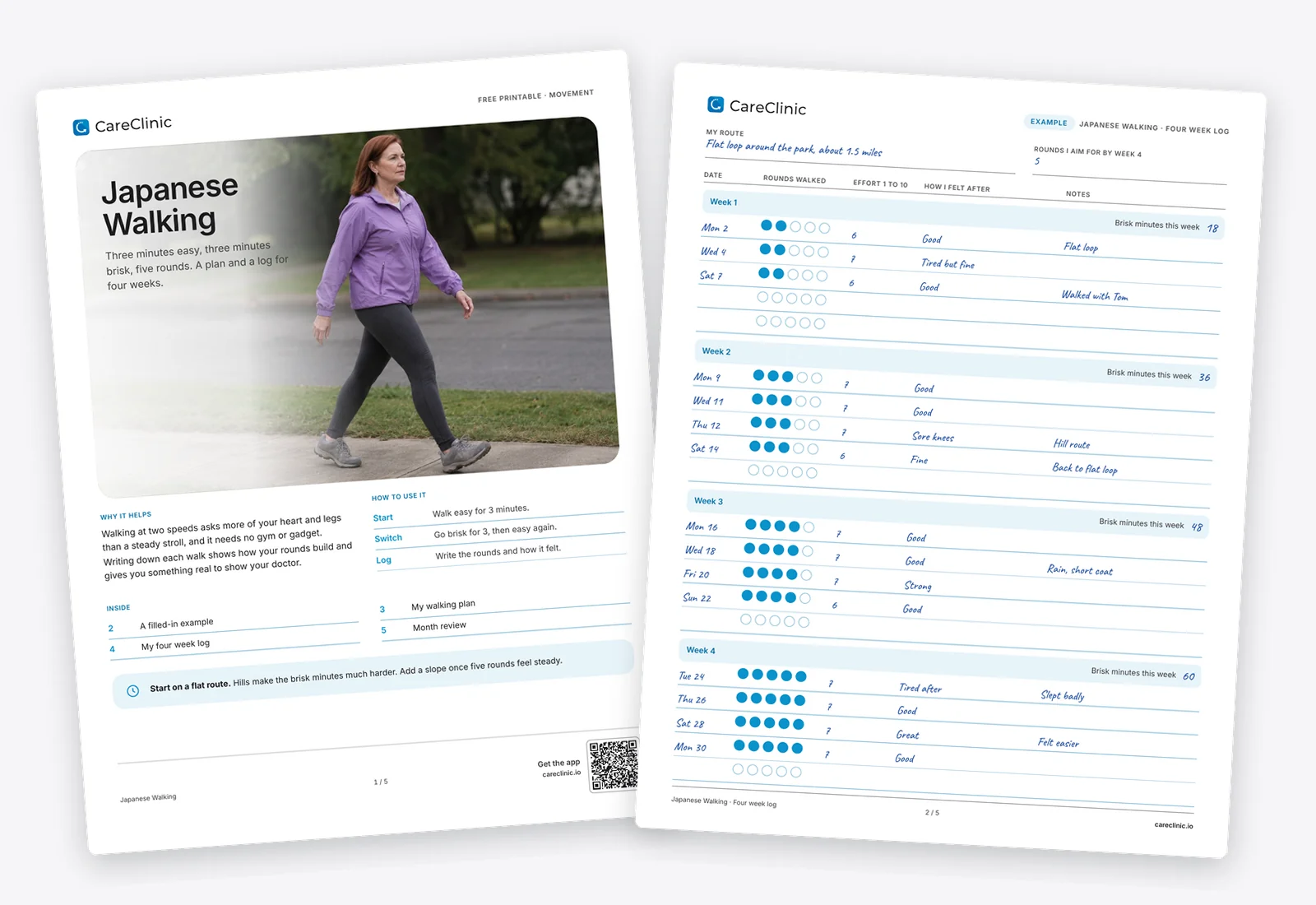
Download the Japanese Walking
- Fill it in on your phone or computer, or print it
- US Letter and A4
- Includes a filled example
How it helps
A clear session
Five rounds of 3 easy and 3 brisk minutes, so you always know what comes next.
Effort you can feel
A talk test and a 1 to 10 effort guide take the place of gadgets and heart rate zones.
See it build
The log turns rounds into brisk minutes for each week, so progress is easy to see.
How to use it
- Start easy. Walk at a relaxed pace for 3 minutes. This doubles as your warm up.
- Switch to brisk. Take longer steps and pump your arms for 3 minutes, then ease back to easy.
- Build the rounds. Begin with what feels right, even two rounds, and add a round when the brisk minutes stop feeling hard.
- Log each walk. Fill in the rounds dots, your effort and how you felt after.
What is inside
- Page 1, the coverHow to use it and what is inside.
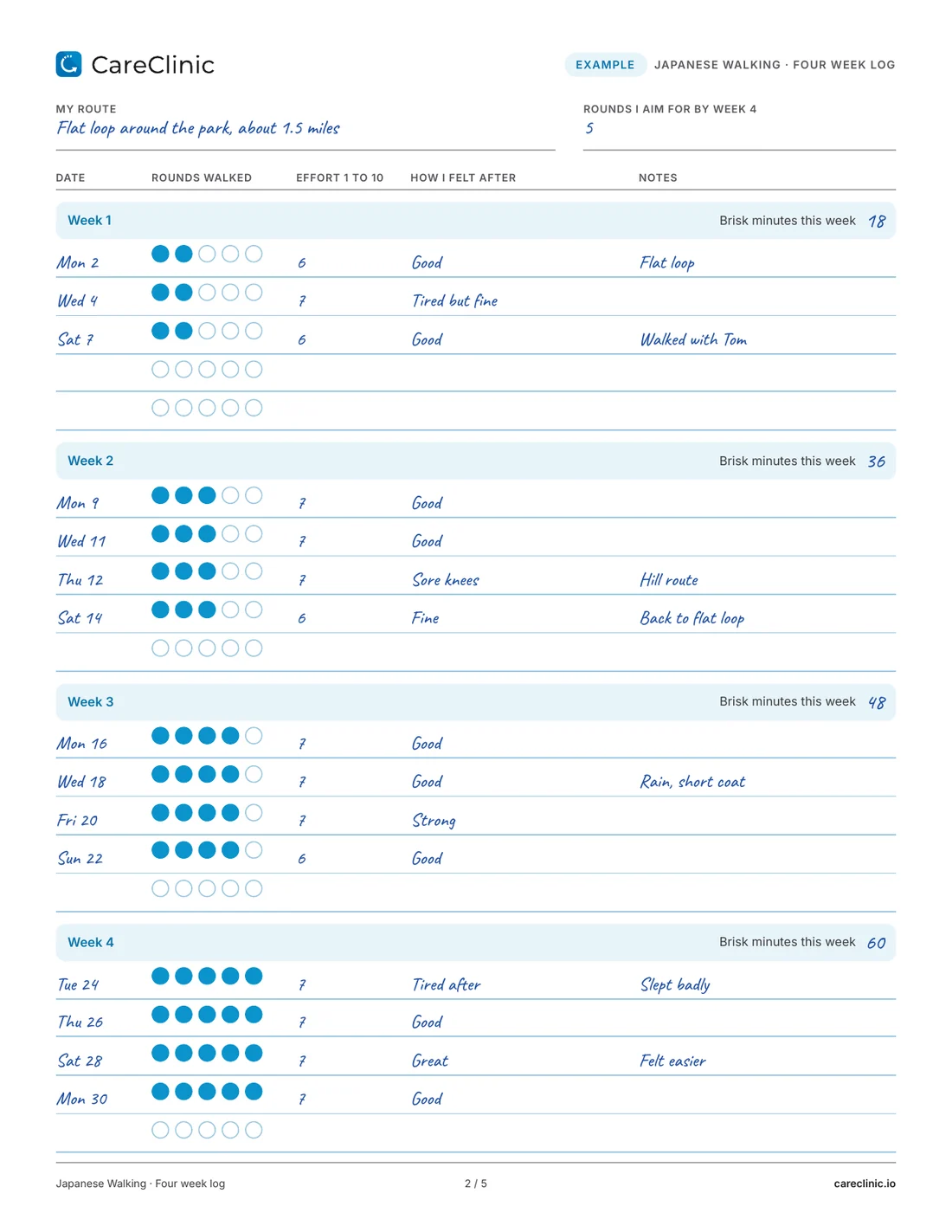
- Page 2, a filled-in exampleFour weeks of walks building from two rounds to five.
- Page 3, my walking planThe session timeline, the talk test, your start and your build up.
- Page 4, my four week logDate, rounds walked, effort, how you felt and notes, with brisk minutes for each week.
- Page 5, month reviewWeek by week totals, what changed and notes for your next appointment.
See a filled example
In the example, the walker starts on a flat park loop with two rounds three times in week 1, which is 18 brisk minutes. By week 4 she walks five rounds four times, 60 brisk minutes for the week. One hill walk in week 2 left her knees sore, so she went back to the flat loop and wrote it down.
 Open the full PDF
How to do Japanese walking
Pick a route where you can walk without stopping for 30 minutes. Set a timer that repeats every 3 minutes, or use a watch you can glance at.
Walk the first 3 minutes at an easy pace. When the timer goes, take longer steps, pump your arms and pick up the pace until your breathing climbs. After 3 minutes, ease back. One easy stretch plus one brisk stretch is a round. Five rounds make the classic 30 minute session.
How brisk should it feel
- About 3 to 4 out of 10. You can talk in full sentences.
- About 7 out of 10. You can say a few words but could not sing.
- 9 or 10 out of 10. You cannot speak. Slow down.
What the research found
Researchers at Shinshu University, led by Hiroshi Nose, designed interval walking training for middle aged and older adults. Their program asked for five or more rounds a day on four or more days a week. Fast walking was set at 70% of each person's peak walking capacity or more, and slow walking at about 40%.
After five months, people in their programs improved fitness and several markers of lifestyle related disease by 10 to 20% on average. The walkers wore a meter that measured their effort, so a phone timer and the talk test are a simpler stand in, not a copy of the study.
Japanese walking on a treadmill or indoors
On a treadmill, set a comfortable speed for the easy minutes and raise it for the brisk minutes until the talk test says 7 out of 10. Hold the rails only for balance. Leaning on them makes the walk easier than the speed suggests.
Indoors without a machine, walk laps of a hallway or march in place with high knees for the brisk minutes. Write treadmill or indoor in the notes column so you can compare like with like.
Compared with steady walking and step counts
A steady stroll is easy to keep up but rarely pushes your heart and legs. The brisk minutes add that push, and the easy minutes let you recover so you can repeat it.
Step counts measure how much you move, not how hard. The log counts brisk minutes instead, because that is the part of the session that changes as you get fitter.
Tips that make it work
- Do your first Japanese walking sessions on a flat, safe route. Hills make the brisk minutes much harder.
- Use a repeating 3 minute timer so you can stop checking the time.
- On a low energy or flare day, walk easy rounds only and write rest walk in the notes.
- Wear supportive shoes and swing your arms. Arm swing makes it easier to speed up.
Bringing it to your doctor
Talk to your doctor first if you have heart disease, high blood pressure that is not controlled, diabetes with foot problems or a joint replacement. Bring the month review to your appointment. It shows how often you walked, how hard it felt and any symptoms along the way. If you have chest pain, faintness or breathlessness that does not settle when you slow down, stop and call 911 or the emergency number where you live.
Questions
What is the Japanese walking method?
It is interval walking: 3 minutes at an easy pace, then 3 minutes brisk, repeated five times or more. It was developed at Shinshu University in Japan for middle aged and older adults.
How fast should Japanese walking be?
Brisk minutes should feel like about 7 out of 10, where you can say a few words but could not sing. Easy minutes should feel like 3 to 4 out of 10, where you can talk in full sentences.
How often should you do Japanese walking?
The original programs asked for at least four days a week. Start with what your body allows and add days and rounds slowly.
Is Japanese walking good for beginners and seniors?
Yes, if you start small. Begin with one or two rounds on a flat route and build up over weeks. If you have a heart, lung or joint condition, ask your doctor first.
Can Japanese walking help with weight loss?
It can be part of a plan, because it adds harder minutes to an activity you already do. The Shinshu studies focused on fitness and health markers rather than weight, so pair it with eating changes if weight loss is your aim.
Is this Japanese walking plan free?
Yes. The Japanese walking plan is a free printable PDF in US Letter and A4. Fill it in on your phone or computer, or print it.
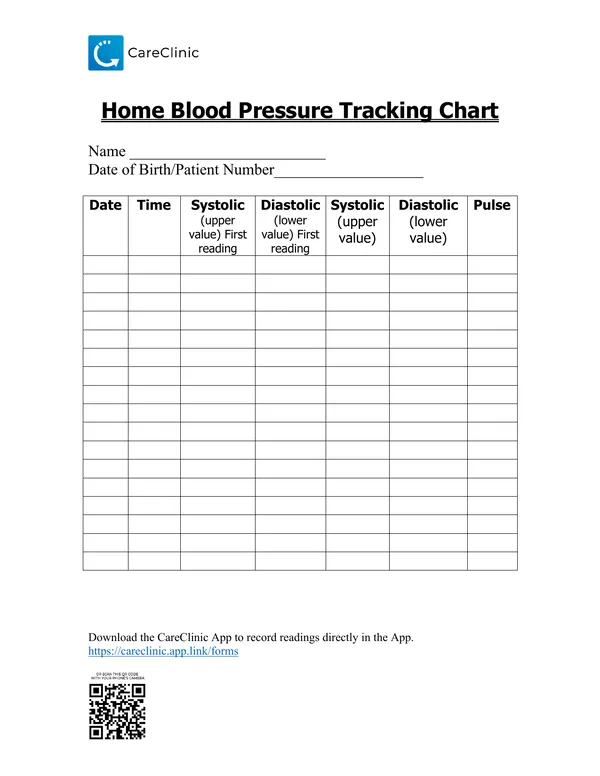
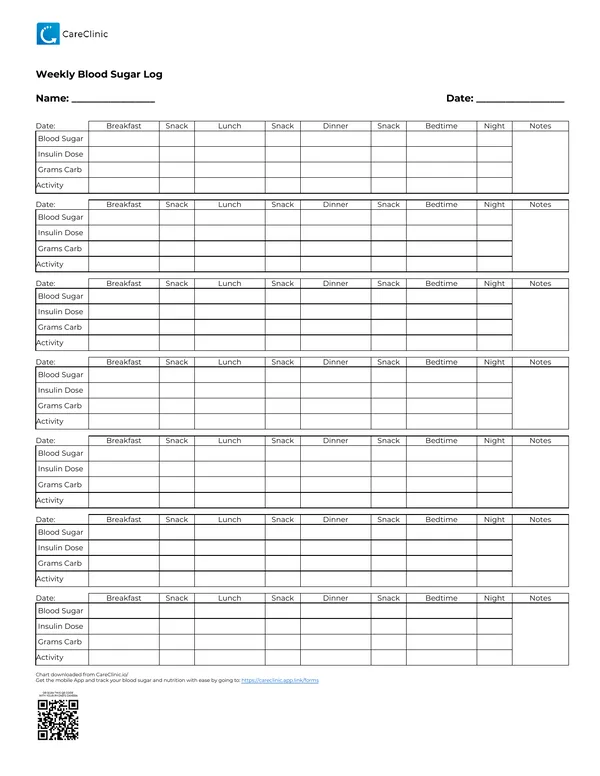
More free worksheets

References
- Nose H, et al. Beyond epidemiology: field studies and the physiology laboratory as the whole world. The Journal of Physiology, 2009. https://pmc.ncbi.nlm.nih.gov/articles/PMC2805369/
- Walking for health. NHS. https://www.nhs.uk/live-well/exercise/walking-for-health/