


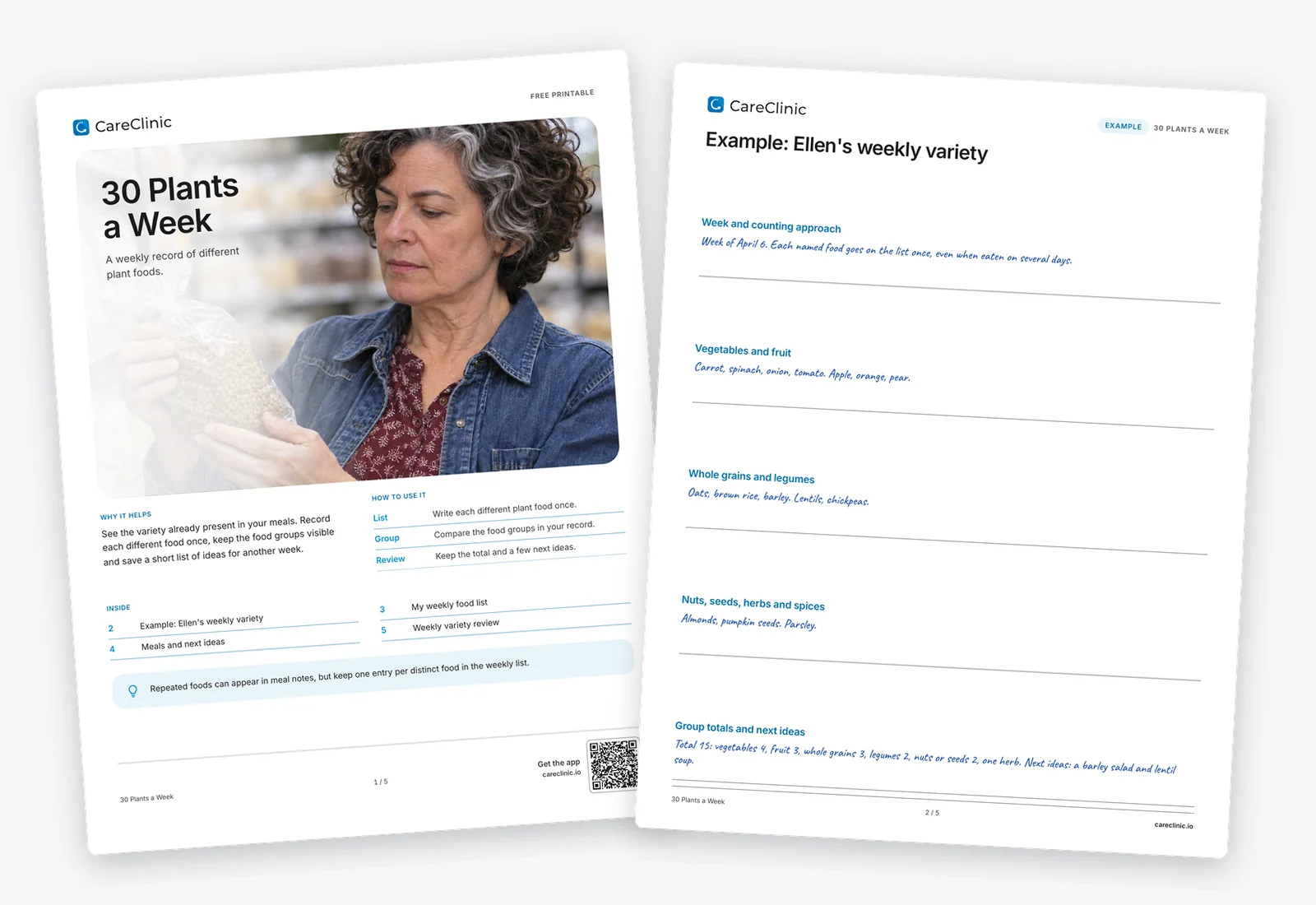
A 30 plants a week tracker records the different plant foods you eat during one week. Use this free printable to list each food once, compare food groups and keep meal ideas for later. It gives you a visible record of variety across the meals you already eat.
The example follows Ellen’s fifteen foods across six groups. The blank list has thirty spaces, followed by meal notes and a weekly review. You can keep extra entries in the notes when your list continues beyond the printed spaces.
Download the 30 Plants a Week
- Fill it in on your phone or computer, or print it
- US Letter and A4
- Includes a filled example
How it helps
See different foods
Keep one entry for each food during the week.
Compare groups
Review which groups appear most often in the list.
Save the weekly record
Keep totals with a practical idea for another week.
How to use it
- Set the week. Write its start date and the counting approach you will use.
- List each food. Add different plant foods once and note the group and first meal.
- Compare and save. Count entries by group, then write the total in weekly history.
What is inside
- Page 1, Thirty Plants a WeekThe cover, why it helps, how to use it and the contents.
- Page 2, Example: Ellen's weekly varietyA completed list of fifteen foods across six groups.
- Page 3, My weekly food listThirty spaces for different plant foods and their groups.
- Page 4, Meals and next ideasDaily meal notes and foods to check against the list.
- Page 5, Weekly variety reviewGroup review, weekly history and appointment questions.
See a filled example
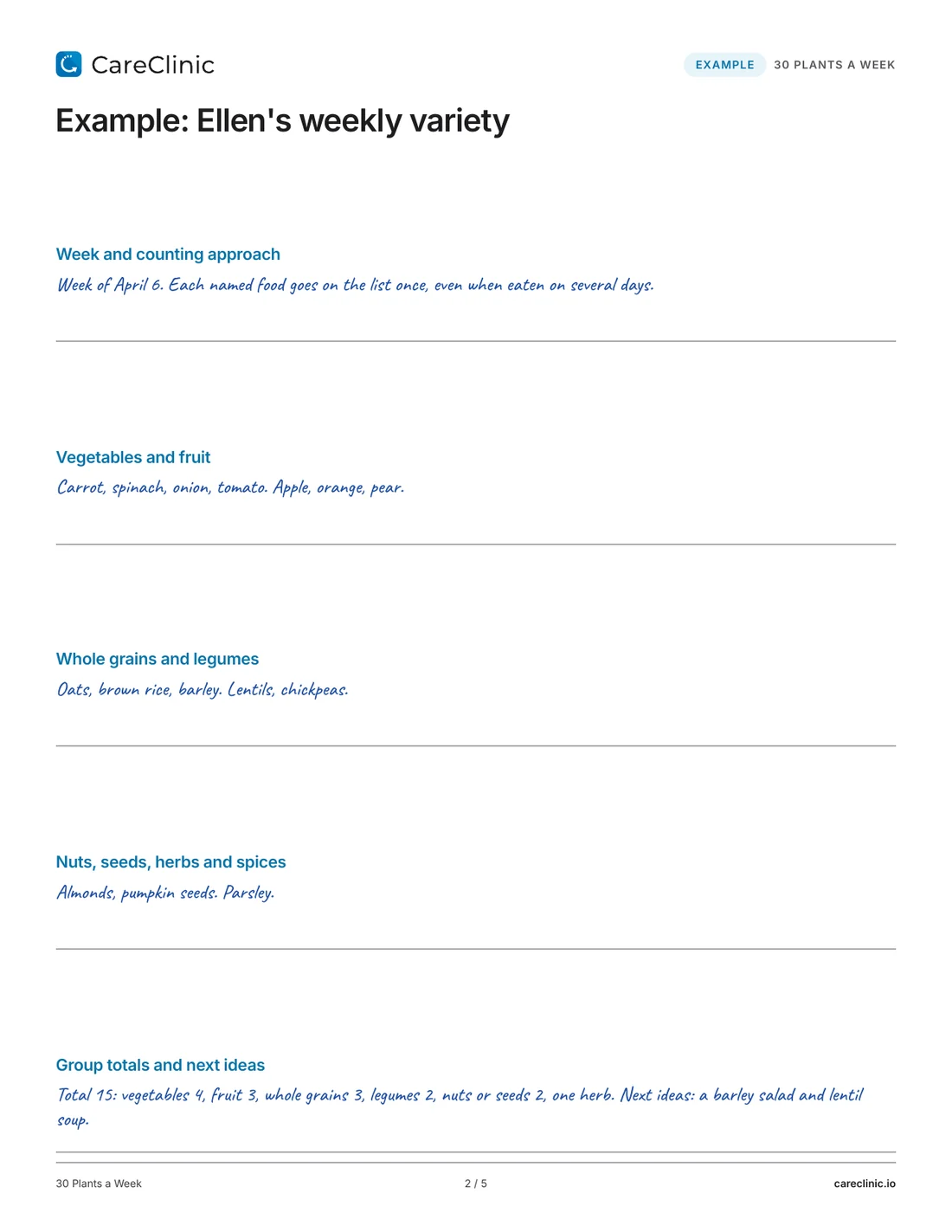
Ellen's week of April 6 lists four vegetables (carrot, spinach, onion, tomato), three fruits (apple, orange, pear), three whole grains (oats, brown rice, barley), two legumes (lentils, chickpeas), two nuts or seeds (almonds, pumpkin seeds) and one herb, parsley. Her total is fifteen different foods. She keeps barley salad and lentil soup as meal ideas for another week.
 Open the full PDF
What the weekly list records
The 30 plants a week idea focuses on different plant foods during a week. MyHealthLondon, an NHS service, includes a weekly variety approach in its healthy eating information and includes herbs and spices. This printable organizes your own record into vegetables, fruit, whole grains, legumes, herbs and spices, and nuts or seeds.
Choose the week’s starting date before adding entries. Monday to Sunday can work, but any clear seven day period gives the record a boundary. Use the same starting day when comparing weeks. Put the date on each new list so a food eaten at the end of one week does not accidentally get assigned to the next.
The 30 plants a week list keeps one entry per different food. Repeated apples stay one apple entry for that week. Meal notes can still show apples on several days. Decide how you will name mixed foods or varieties and write that approach above the list. A consistent record is easier to compare than a total assembled from changing rules.
Use meal notes to build the list
After a meal, write the plant foods you remember in the daily notes. Check the weekly list before adding a new entry. The first meal or day column helps you see where a food entered the week. It also provides a place to return if you later wonder whether a listed ingredient was actually eaten.
Ellen’s 30 plants a week example includes carrot, spinach, onion and tomato as vegetables. Apple, orange and pear sit in the fruit group. Oats, brown rice and barley are whole grains, while lentils and chickpeas are legumes. Almonds and pumpkin seeds appear under nuts and seeds. Parsley is her herb entry.
A food diary can hold fuller meal details while this page keeps the different foods visible. For a mixed meal, list ingredients you can identify and leave a question in the notes when a label needs checking. Keep the name you use consistent across the week so the same food does not enter twice under different wording.
Compare the groups and save a meal idea
At the end of your 30 plants a week record, count the entries in each group. Ellen’s totals are four, three, three, two, two and one, giving fifteen foods altogether. Check the list itself when adding the numbers. A group total describes the entries you recorded, so a duplicate or missing name should be corrected there first.
Use the meal ideas space for something you want to remember. Ellen chooses barley salad and lentil soup because those names connect foods on her list with meals she can picture. Your ideas might use familiar ingredients in another meal or preserve a recipe you enjoyed. Write enough detail to recognize the idea next week.
The 30 plants a week history table keeps several weekly totals together with a short observation. A healthy habits routine can help you decide when to update the list. Compare the groups as well as the totals, and keep the meal notes nearby. They show how the recorded variety fitted into the week rather than leaving only an isolated number.
Tips that make it work
- Write the starting date on each 30 plants a week record.
- Check the list before adding a food already eaten that week.
- Use a consistent name for each ingredient.
- Keep one meal idea with the weekly total.
Bringing it to your doctor
Bring the 30 plants a week review to an appointment if you want to discuss the foods and meals you recorded. Choose a week with clear meal notes and explain the counting approach you used. Put questions about your own food routine on the last card.
Questions
What counts toward a weekly plant food list?
This list has groups for vegetables, fruit, whole grains, legumes, herbs and spices, and nuts or seeds. Write the ingredient names and the counting approach you use.
Can I download the 30 plants a week tracker for free?
Yes. The 30 plants a week tracker is a free PDF in US Letter and A4. It includes an example, weekly list, meal notes and review.
Do repeated foods count again?
On this worksheet, each different food gets one entry during the week. Repeats can stay in the meal notes.
How do I track mixed meals?
Write the ingredients you can identify in the meal notes. Check each one against the weekly list before adding it.
Does the tracker include herbs and spices?
Yes. They have a group in the list and the final comparison table. Use ingredient names you can recognize later.
How do I compare weeks?
Keep the same counting approach and starting day. Compare group totals and meal notes alongside the overall number.
More free worksheets


References
- Eat. MyHealthLondon NHS. https://www.myhealthlondon.nhs.uk/be-healthier/healthy-lifestyle/eat/