


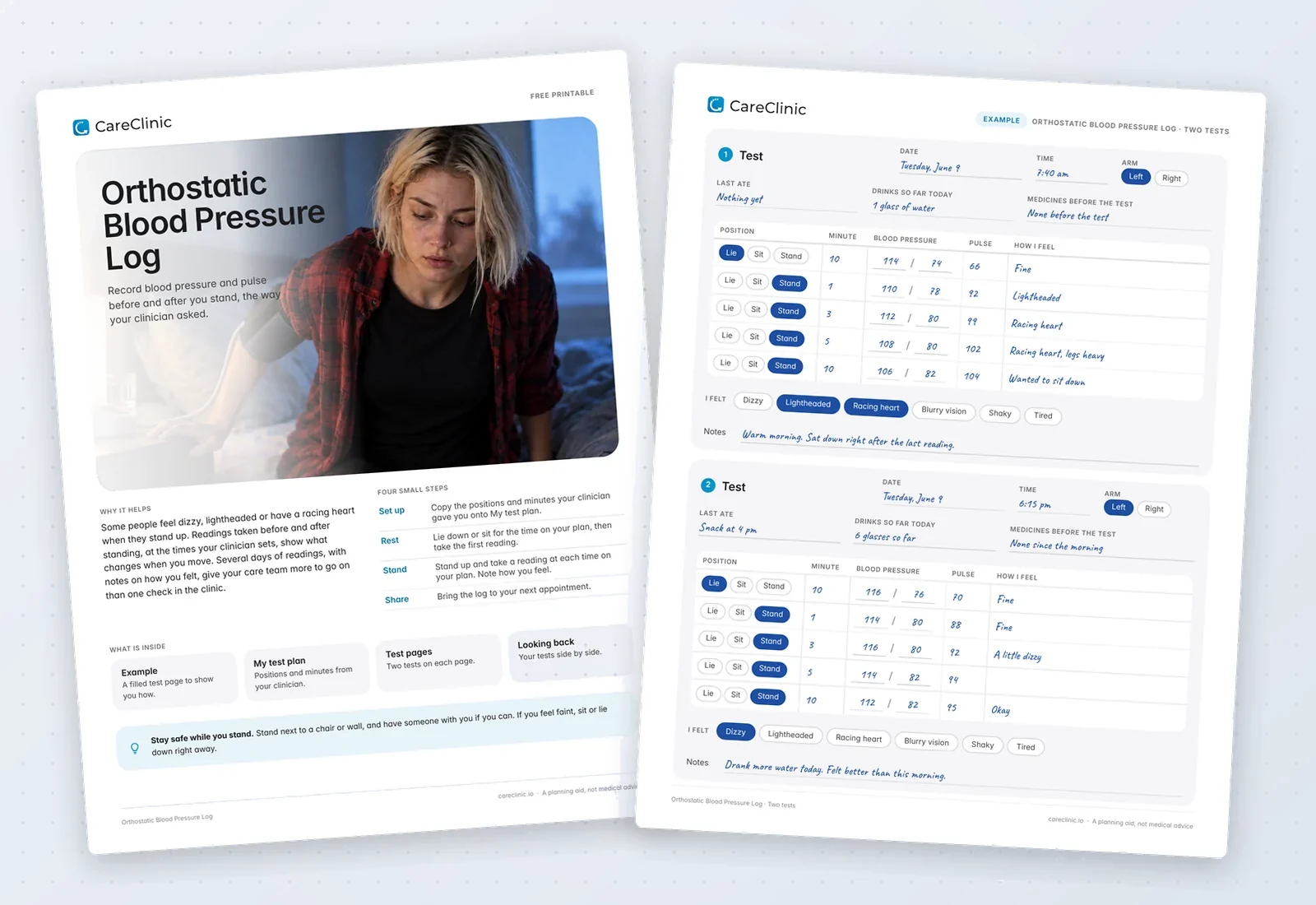
This orthostatic vitals log is a free printable for anyone whose clinician has asked them to check orthostatic blood pressure and pulse before and after standing at home. It suits people who feel dizzy when they stand, and people being checked for POTS.
When you stand up, blood moves toward your legs and your body has to adjust. For some people that brings dizziness, lightheadedness or a racing heart. Writing each reading next to its position, the minute and how you felt gives your care team a clear record to review.
Download the Orthostatic Vitals Log
- Fill it in on your phone or computer, or print it
- US Letter and A4
- Includes a filled example
US Letter suits the US and Canada. A4 suits most other countries.
How it helps
Readings in context
Each reading sits next to its position, the minute it was taken and how you felt at that moment.
Every test done the same way
My test plan holds the positions and minutes your clinician sets, so each test matches the last.
Patterns over several days
Looking back lines up your first and last standing readings so changes across days are easy to see.
How to use it
- Set up Copy the positions and minutes your clinician gave you onto My test plan.
- Rest Lie down or sit for the time on your plan, then take the first reading.
- Stand Stand up and take a reading at each time on your plan. Note how you feel.
- Share Bring the log to your next appointment.
What is inside
- Two testsA filled example and five blank pages, each with two tests and room for five readings per test.
- My test planRest position and time, the readings to take, how often to test, when to stop and who to contact.
- Looking backYour first and last standing readings side by side, what seemed to make things better or worse, and a card for your next appointment.
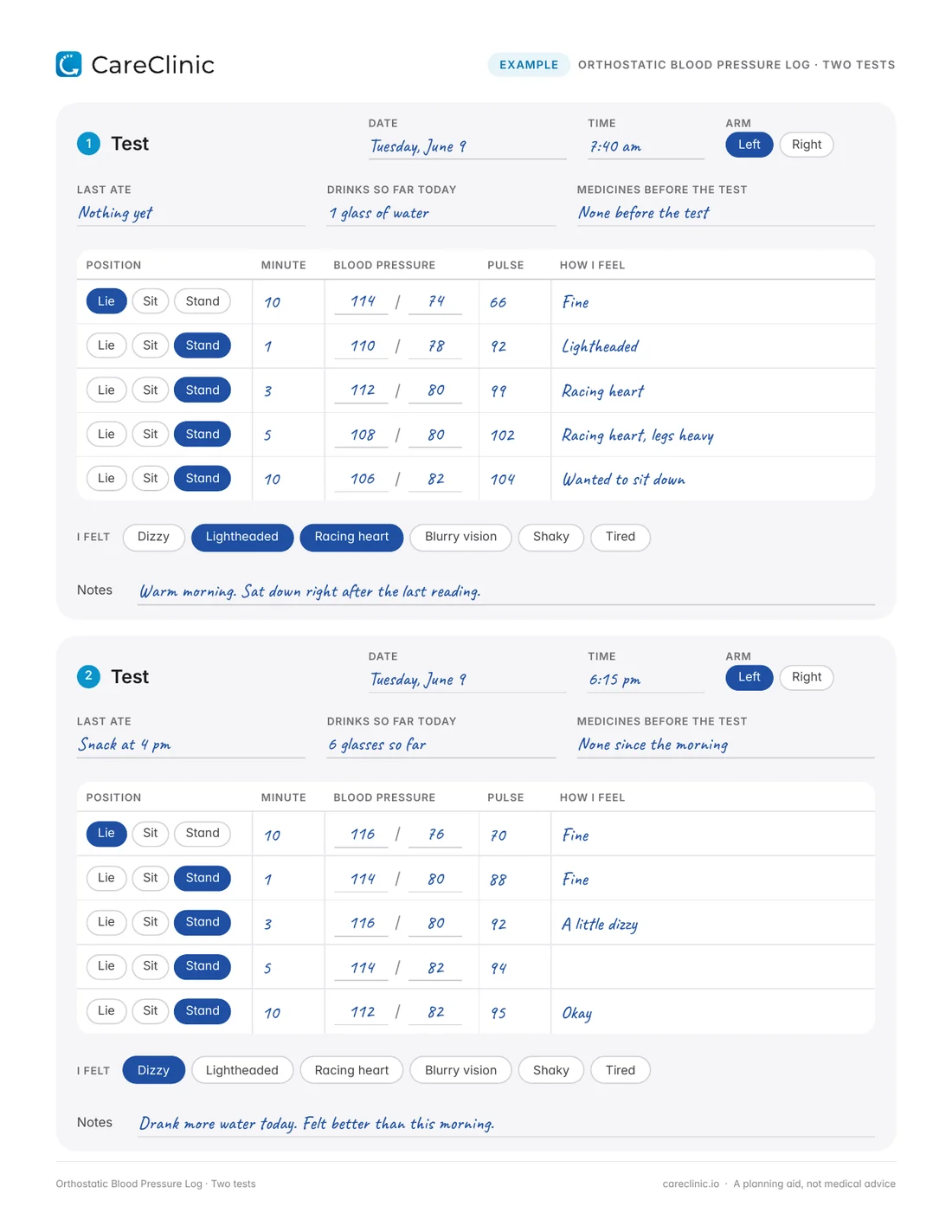
See a filled example
The example shows two tests on Tuesday, June 9, both on the left arm. In the 7:40 am test the first reading, lying down, is 114/74 with a pulse of 66, and by the last standing reading the pulse is 104, with lightheadedness and a racing heart marked. The 6:15 pm test goes from a pulse of 70 lying down to 95 standing, with a note about drinking more water that day.
 Open the full PDF
Tips that make it work
- Copy the positions and minutes from your clinician onto My test plan before your first test, and follow them the same way each time.
- Stand next to a chair or wall, and have someone with you if you can. If you feel faint, sit or lie down right away.
- Use the same arm and the same monitor for every test, and note what you ate and drank beforehand.
- Write how you feel at each reading as well as the numbers. Symptoms help your clinician understand the results.
Bringing it to your doctor
Bring the log and My test plan to your next appointment. Your clinician will look at the readings and symptoms together and explain what they mean for you. Contact your doctor if you often feel dizzy when you stand up, even if it only happens some of the time.
Questions
What are orthostatic vitals?
Orthostatic vitals, also called orthostatic vital signs, are blood pressure and pulse readings taken in more than one position, before and after you stand up. Comparing them shows how your body responds to the change. Your clinician decides which positions and timings to use.
How to check orthostatic blood pressure at home?
Follow the plan your clinician gives you. Rest first and take a reading, then stand and take more readings at the minutes on your plan. Write down the position, minute, blood pressure, pulse and how you feel each time, and stand near a chair.
How to take orthostatic vitals for POTS?
Ask your clinician how they want the test done, because the steps can differ. A doctor may check your blood pressure and heart rate before and after you stand up, and repeating this is called an active stand test. This POTS heart rate log has a row for every reading your clinician asks for.
What is orthostatic hypotension?
Orthostatic hypotension is a drop in blood pressure when you stand up after sitting or lying down. It can make you feel dizzy, lightheaded or faint. Your clinician will look at your readings to see whether this is happening.
How to record orthostatic blood pressure?
Write each reading with its position and the minute it was taken. Record both blood pressure numbers and the pulse, then add how you felt. This orthostatic blood pressure recording sheet has a row for each reading.
Is this orthostatic vitals log free?
Yes. The log is a free orthostatic blood pressure log PDF in US Letter and A4. Fill it in on your phone or computer, or print it and keep it next to your monitor.
More free worksheets
References
- NHS. Postural tachycardia syndrome (PoTS). https://www.nhs.uk/conditions/postural-tachycardia-syndrome/
- Cleveland Clinic. Orthostatic Hypotension. https://my.clevelandclinic.org/health/diseases/9385-low-blood-pressure-orthostatic-hypotension