


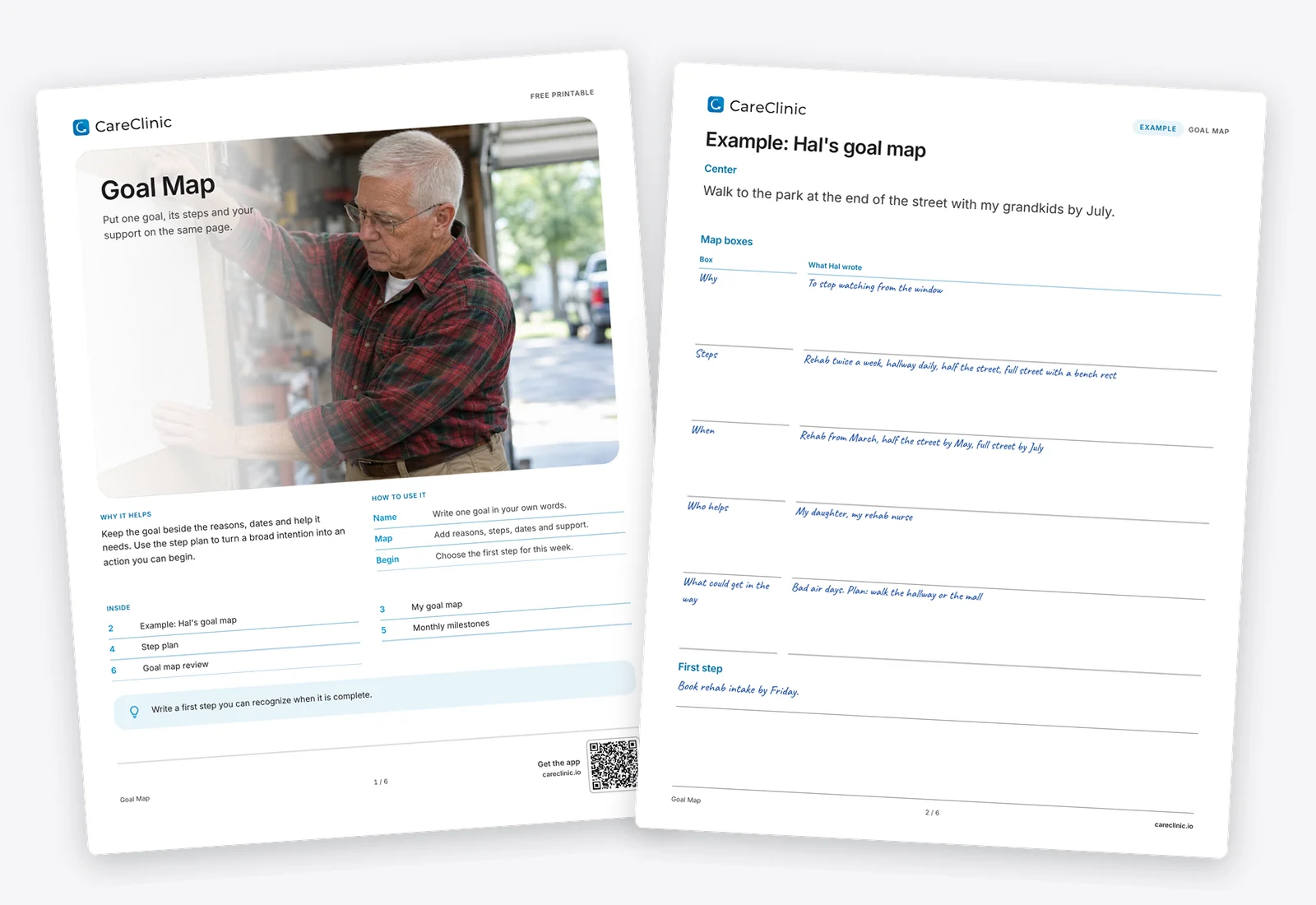
A goal map is a one page picture of a single goal, with space for why it matters, the steps, dates, helpers and obstacles. Keeping those details together lets you see what you want to do next. This printable also includes a monthly milestone page for a start date, deadline and target.
This printable has a blank map, space to sketch a small picture of your goal, a page to break the steps down, and a review. The filled example comes from a man in rehab who wanted to walk to the park with his grandchildren by summer.
Download the Goal Map
- Fill it in on your phone or computer, or print it
- US Letter and A4
- Includes a filled example
How it helps
All on one page
The goal and everything around it, visible at a glance.
Why comes first
Keep your reason beside the goal and steps.
Steps with dates
Each step gets a when, so the goal is not someday.
How to use it
- Write the goal in the highlighted box. Specific and in your words. Add a small sketch if you like.
- Fill in why. Who and what it is for. Be personal.
- Add steps, dates and helpers. Three to six steps, each with a when and a who.
- Plan for obstacles and start. Write what could get in the way, your plan for it and your first step this week.
What is inside
- Page 1, Goal MapThe cover, why it helps, how to use it and the contents.
- Page 2, Example: Hal's goal mapA completed health goal, reasons, steps and support.
- Page 3, My goal mapGoal, sketch space and five other planning boxes.
- Page 4, Step planSix steps with actions, dates, helpers and completion.
- Page 5, Monthly milestonesStart, deadline, target and six monthly milestones.
- Page 6, Goal map reviewProgress, next steps and appointment notes.
See a filled example
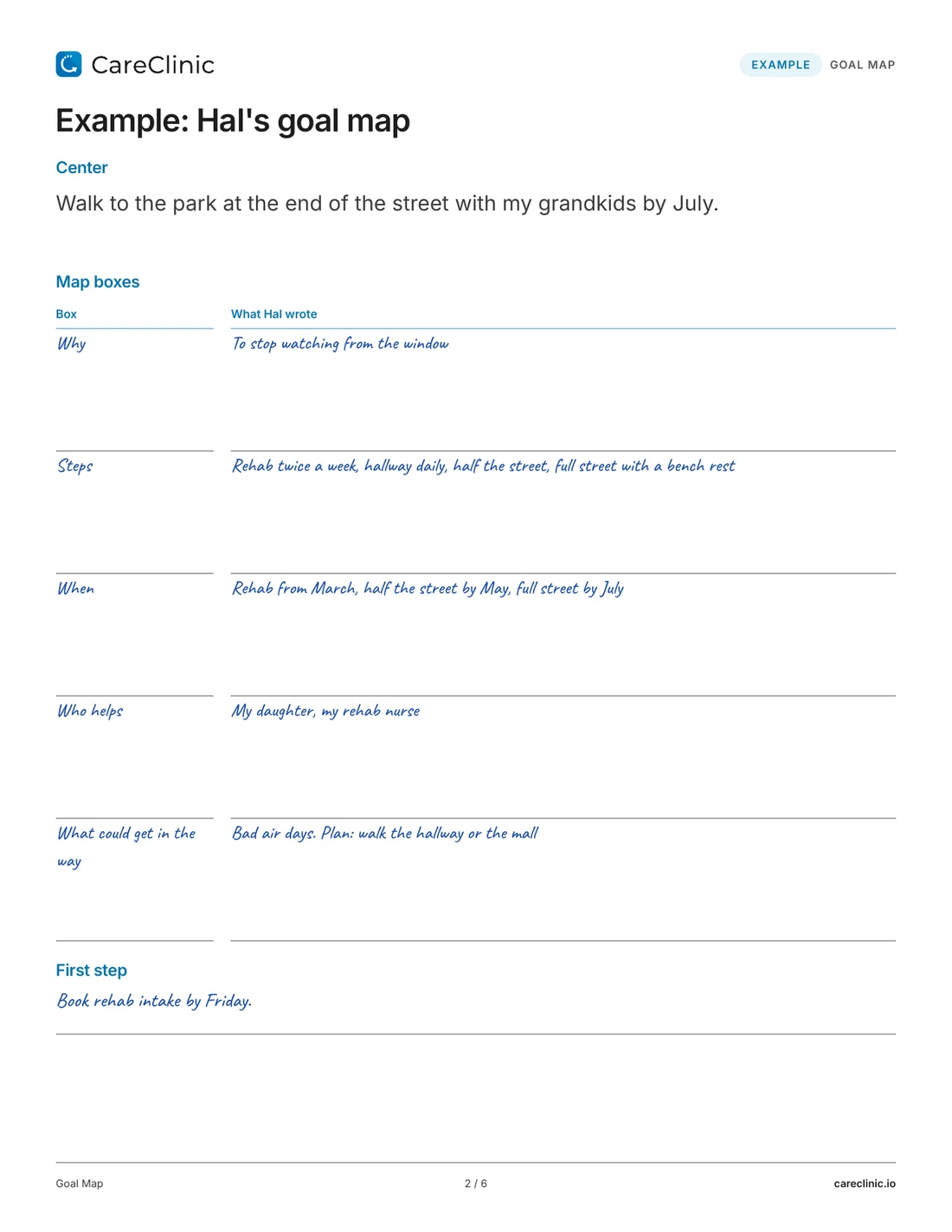
The goal map example belongs to Hal. His center said: walk to the park at the end of the street with my grandkids by July. His why was to stop watching from the window. His steps were rehab twice a week, walking the hallway daily, then half the street, then the full street with a bench rest, with rehab from March, half the street by May and the full street by July. His daughter and his rehab nurse were the helpers. Bad air days were the obstacle, so he planned to walk the hallway or the mall on those days. His first step was to book a rehab intake by Friday.
 Open the full PDF
Choose one goal you can describe
Begin the goal map with something you would like to do. Use your own words and include the detail that tells you when you have reached it. Hal’s example is walking to the park with his grandchildren by July. His reason explains why that particular destination matters. Your reason can name a person, activity or part of daily life.
Keep one goal on the page. If two goals need different steps and support, give them separate copies. Use the sketch space for a simple picture or symbol when that helps you remember the purpose. The map works with words alone too. Complete the goal box before the other boxes so every detail supports the same intention.
Write why the goal matters in the next box. Be specific about the experience you want. Then list the larger steps that could lead there. A goal map keeps these details close enough to compare. If a step has no clear connection to the goal, leave it out and use the room for something that does.
Add dates, support and obstacles
Use When for the dates you are working toward. They can be checkpoints rather than a single deadline. In Who helps, name the people you want to ask and the type of help you need. A reminder, a ride or a conversation with a care team member are different requests, so write the request beside the name.
The obstacles box holds things that could interrupt the plan and a response you want to try. Hal uses an indoor walking option for bad air days. Choose a response that fits the goal and the circumstances you know about. A health diary can hold a longer account when an obstacle needs more explanation than the box allows.
Finish the goal map by writing the first step for this week. Keep it small enough to begin and specific enough to check. Book the intake by Friday tells you what to do and when to look back. Transfer the larger steps to the Step plan so each has an action, a date and a helper where needed.
Use milestones to follow the road
The monthly milestones page adds a start date, deadline and target with a unit. Use it when your goal has a count you want to follow, or write a descriptive milestone when a number would not help. The six monthly rows let you record a checkpoint, actual progress and the next action together.
Your plan can also have several paths toward the same outcome. Write those paths in the lines below the milestones. One path might involve an appointment, another practice and another practical help. Keep the recorded progress tied to something you actually completed. Update later milestones when your plan changes and keep a note of the reason.
At review time, write the date, steps completed and what changed. Add a next step before putting the page away. A symptom tracker can provide context when a symptom affected your plan on particular dates. Bring both records when you want to discuss how the goal fits your daily life with your care team.
Keep the earlier goal map when starting a revised one. It shows the original plan and the changes you made along the way. Use a new date on the revised page so you can tell which version you are following. The appointment card gives you a place for questions that arise while reviewing the steps.
Tips that make it work
- Hang the map where you pass it each day, such as the fridge door.
- Keep each goal map to one goal. A second goal gets its own page.
- Make the why personal. Write a name or add a picture.
- Write the first step for this week before you put the pen down.
Bringing it to your doctor
Bring your goal map to an appointment when you want to discuss a health goal or the steps your care team suggested. Add what you have tried and questions about the next step. Use the final card to record symptoms, practical limits or support you want to discuss.
Questions
What is goal mapping?
It means arranging a goal and its supporting details on one page. Add the reason, actions, dates, helpers and obstacles, then choose a first step.
How do you do goal mapping?
Write your goal in the highlighted box, then fill in why it matters, the steps, a date for each, who can help and the obstacles. Finish with one first step for this week.
What does a goal map look like?
This goal map has six planning boxes, including a highlighted goal box with room for a sketch. The remaining boxes hold the reason, steps, dates, support and obstacles.
Which goals work well on a map?
Walking to the park by summer, sleeping seven hours most nights, cooking at home four nights a week, or getting back to work after surgery.
How is a goal map different from a goal planner?
The map shows one goal on one page. A goal planner holds several goals and plans them across months.
Is this goal map template free?
Yes. This goal map template is a free printable PDF in US Letter and A4, with a blank map, a step plan, a review and an example.
More free worksheets

References
- Caring for Your Mental Health. NIMH. https://www.nimh.nih.gov/health/topics/caring-for-your-mental-health