


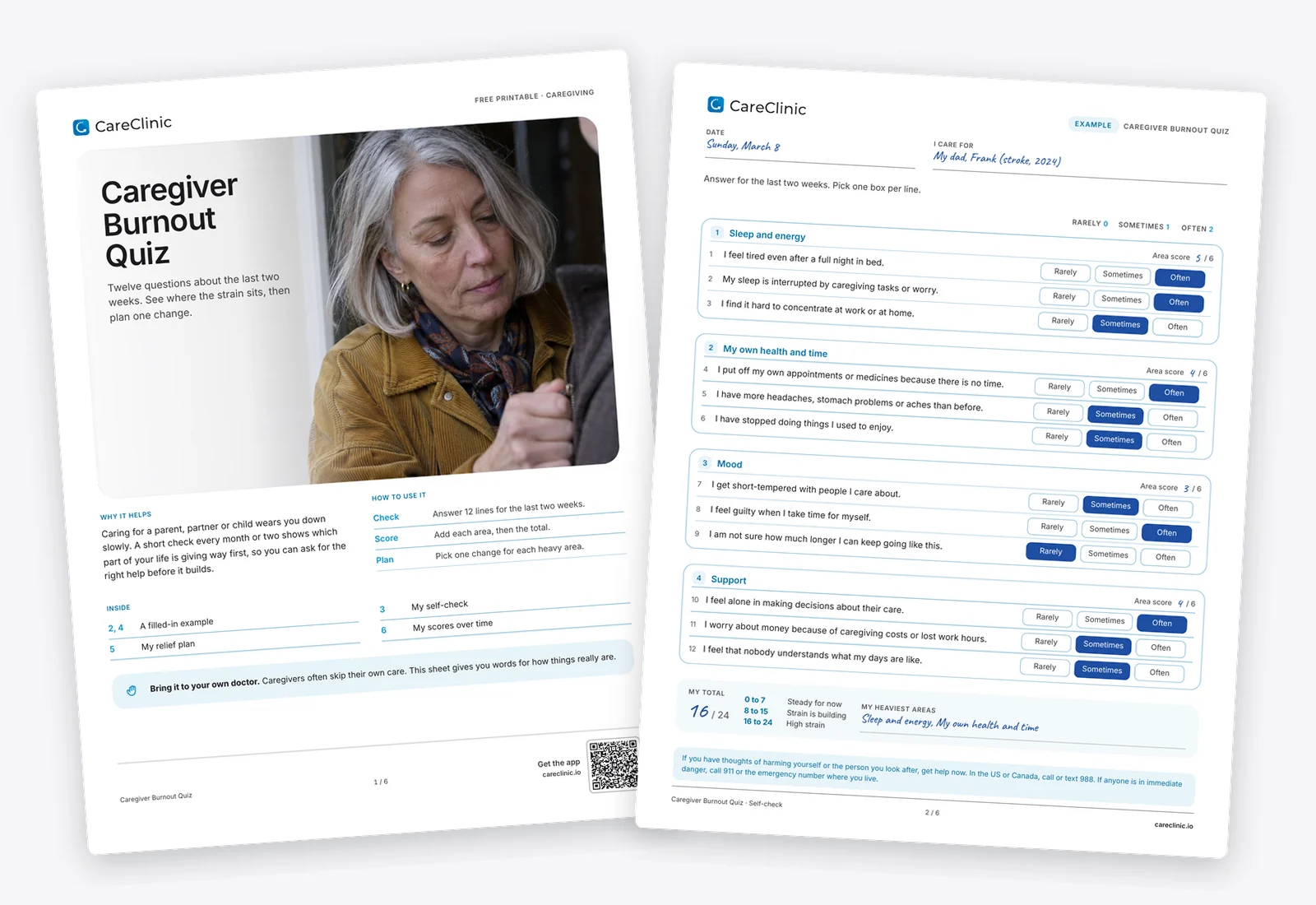
This caregiver burnout quiz is a short self-check for anyone caring for a parent, partner or child with an illness or disability. It takes about three minutes and asks how the last two weeks have felt. Caring can wear you down so slowly that you only notice when something gives.
Your answers fall into four areas: sleep and energy, your own health and time, mood, and support. You see where the strain is building and choose one thing to change.
Download the Caregiver Burnout Quiz
- Fill it in on your phone or computer, or print it
- US Letter and A4
- Includes a filled example
How it helps
See the pattern
The caregiver burnout quiz scores four areas, so you can see which part of life is taking the hit.
Bring it to your doctor
Take your result to your own next appointment.
Track change over time
Retake it after you add help, such as respite care, and compare scores.
How to use it
- Check. Answer all 12 lines for the last two weeks, one box per line.
- Score. Add each area out of 6, then the total out of 24.
- Plan. Pick one change for each heavy area and name who could take a task off your hands.
- Repeat. Take the caregiver burnout quiz again every four to eight weeks and log your scores.
What is inside
- Page 1, the coverHow to use it and what is inside.
- Pages 2 and 4, a filled-in exampleA completed self-check and relief plan.
- Page 3, my self-checkThe 12 questions, area scores and your total.
- Page 5, my relief planChanges, hand-offs and people to call.
- Page 6, my scores over timeA row for each retake and notes for your doctor.
See a filled example
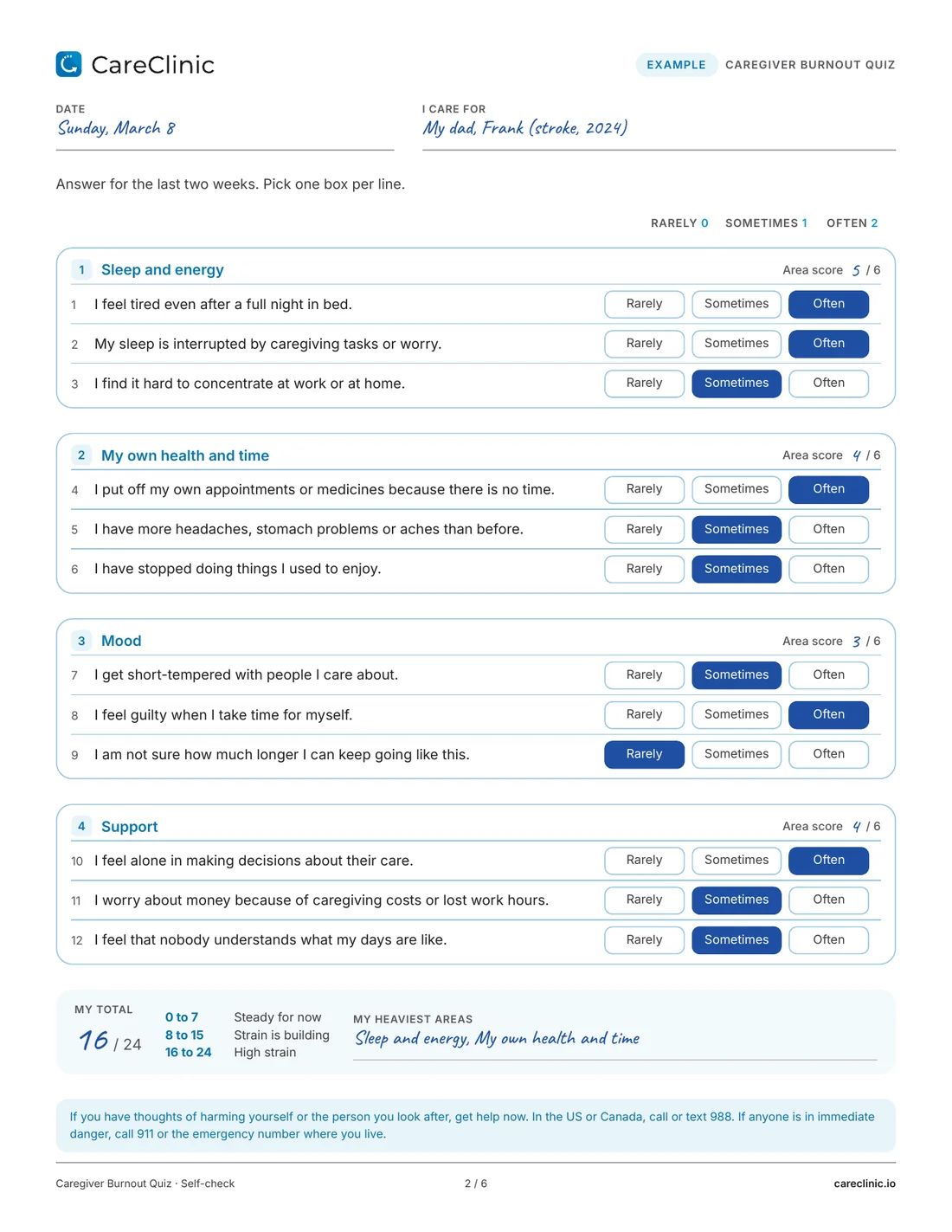
In the example, a caregiver looks after their dad, Frank, who had a stroke in 2024. The area scores are 5, 4, 3 and 4, a total of 16 out of 24, in the High strain band. Sleep and energy, and my own health and time, are the heaviest areas, so the relief plan asks their brother Dan to cover Saturday night and books the physical that keeps getting moved. Their sister Ana drives Dad to physio on Friday morning.
 Open the full PDF
The 12 questions
Answer each question for the last two weeks. Score Rarely 0, Sometimes 1 and Often 2. Each area score runs from 0 to 6.
Sleep and energy
- I feel tired even after a full night in bed.
- My sleep is interrupted by caregiving tasks or worry.
- I find it hard to concentrate at work or at home.
My own health and time
- I put off my own appointments or medicines because there is no time.
- I have more headaches, stomach problems or aches than before.
- I have stopped doing things I used to enjoy.
Mood
- I get short-tempered with people I care about.
- I feel guilty when I take time for myself.
- I am not sure how much longer I can keep going like this.
Support
- I feel alone in making decisions about their care.
- I worry about money because of caregiving costs or lost work hours.
- I feel that nobody understands what my days are like.
What your score means
Add up your total and find your band. 0 to 7, Steady for now. You still have some reserve. Keep the routines that protect your sleep and your own appointments.
8 to 15, Strain is building. Several parts of your life are giving way to caregiving. Find your highest area and plan one change for it this week.
16 to 24, High strain. This level of strain is hard to sustain. Talk to your doctor about how you are doing, and ask family, friends or local caregiver services for regular help.
A 5 or 6 in one area shows where one change will help most, even when the total is low.
If you answered Often to question 9, talk to your doctor or a person you trust this week, whatever your total.
If you have thoughts of harming yourself or the person you look after, get help now. In the US or Canada, call or text 988. If anyone is in immediate danger, call 911 or the emergency number where you live.
Signs of caregiver burnout
Common signs are exhaustion, pulling away from friends and family, feeling hopeless, changes in sleep, appetite or weight, getting sick more often, and irritability or anger. Some caregivers also feel resentment toward the person they care for. Several questions ask about these directly.
Your own care slips too. The Family Caregiver Alliance reports that nearly three in four caregivers had not seen a doctor as often as they should.
What causes caregiver burnout
Burnout grows from a long stretch of care without enough help. Stepping into the role suddenly, hopes that are hard to meet, and too little money or support all add to it. Strain also rises as the person you care for needs more help with daily life.
Respite care and where to find help
Respite care gives you a short break while someone else takes over, at home, in a care facility or at an adult day center. Family, friends or volunteers can step in too.
If you care for an older adult in the US, the Eldercare Locator (1-800-677-1116) connects you with your local Area Agency on Aging for respite, support groups and other services. If your score is high, call before a crisis.
Tips that make it work
- Answer the caregiver burnout quiz for how things are, not how you want them to be.
- Share the printable with the people who help you, so the load is visible.
- When someone offers to help, name a task and a day, such as picking up prescriptions on Tuesday.
- In the CareClinic app, log your own symptoms, sleep and medicines as well as theirs, so your health stays on the list too.
Bringing it to your doctor
Take your caregiver burnout quiz result to your own doctor, not only to the visits of the person you care for. Tell them you are a caregiver and which areas scored highest. They may know about support groups, respite care and counseling near you. See a doctor, social worker or counselor if you notice signs of burnout. You don't need to wait for them to get worse.
Questions
What is caregiver burnout?
It is physical, emotional and mental exhaustion that builds when caring for someone goes on for a long time without enough rest or support. Its signs are close to those of stress and depression.
What does caregiver burnout feel like?
Many people describe deep tiredness, a short temper, guilt about taking time off, and pulling away from friends. Some get sick more often or feel hopeless.
Is this caregiver burnout quiz a diagnosis?
No. It is a self-check to help you notice strain and talk about it. Only a clinician can assess your health, including depression or anxiety, which share many of the same signs. The score bands are a rough guide written by CareClinic, not a tested medical scale.
How long does caregiver burnout last?
There is no set time. Recovery can take days, weeks or months. Retake the check every four to eight weeks to see whether changes help.
Can I take the caregiver burnout quiz for someone else?
It is written for the caregiver. Each family member who helps can take it for themselves.
Is the caregiver burnout quiz free?
Yes. The caregiver burnout quiz is free to download in US Letter and A4. Fill it in on your phone or computer, or print it.
More free worksheets


References
- Caregiver Burnout. Cleveland Clinic. https://my.clevelandclinic.org/health/diseases/9225-caregiver-burnout
- 988 Suicide and Crisis Lifeline. https://988lifeline.org/