


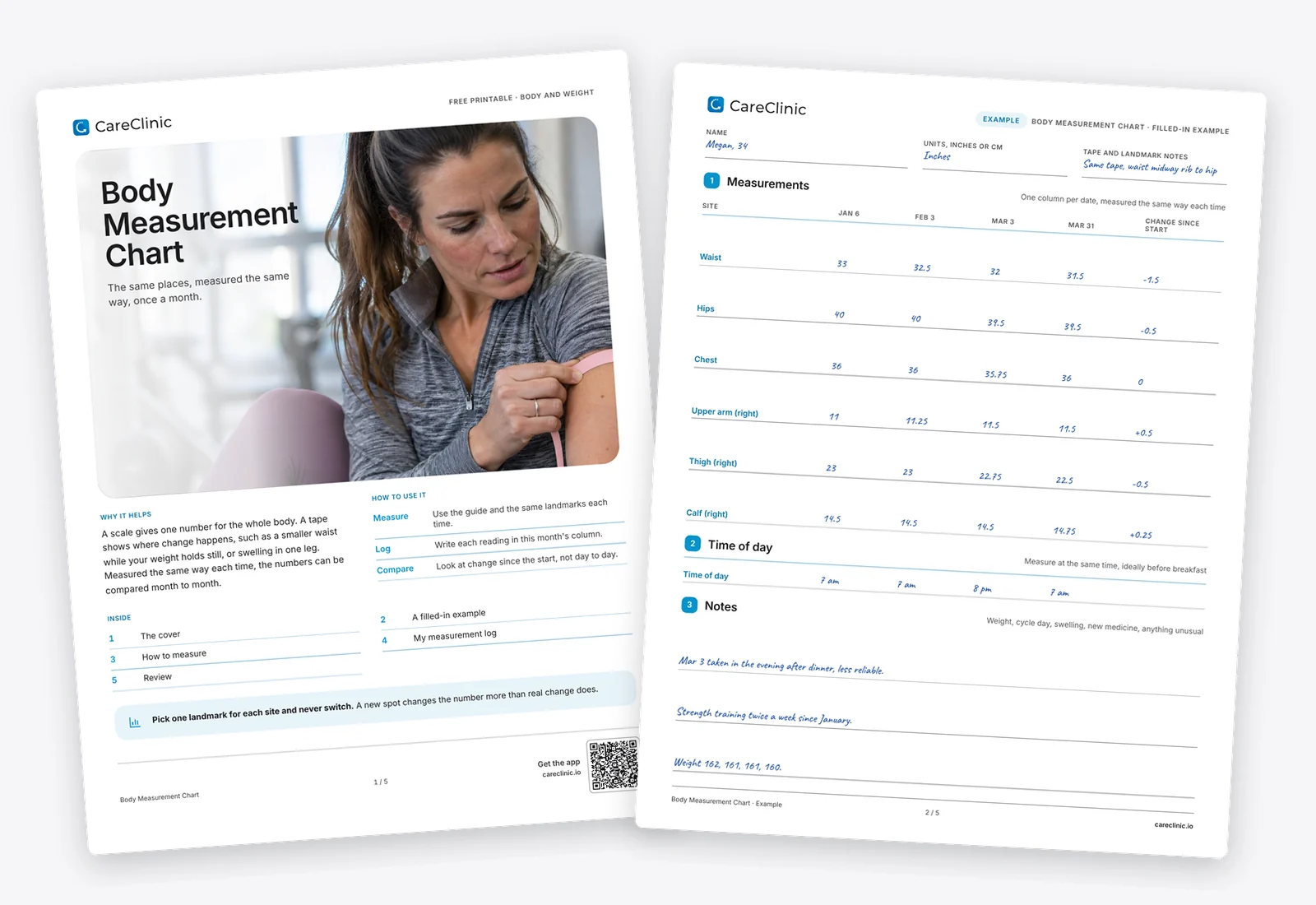
A body measurement chart records the size of the same places on your body, measured the same way, about once a month. It is for anyone tracking change the scale misses, such as strength training, a medicine that affects weight, swelling in one limb, or recovery after an illness.
Page 3 shows where to place the tape for each site and how to keep readings consistent. Then you log the date, the time of day and each number, so every column compares like with like and you can see a trend instead of a single reading.
Download the Body Measurement Chart
- Fill it in on your phone or computer, or print it
- US Letter and A4
- Includes a filled example
How it helps
See where change happens
A smaller waist or a bigger upper arm can show progress while your weight holds still.
Readings you can compare
Fixed landmarks, the same tape and the same time of day keep one month comparable with the next.
Clear notes for your care team
Dated numbers and notes about medicines or swelling are easier to discuss than a feeling that clothes fit differently.
How to use it
- Choose your sites. Waist, hips, chest, upper arm, thigh and calf cover most needs. Add your own on the blank rows.
- Fix the landmarks. Write where the tape goes for each site and which side, so every reading matches.
- Measure once a month. Same day of the month, same time, ideally before breakfast. Measure twice and log the result.
- Review the change. Compare the latest reading with the first, and note what you were doing in between.
What is inside
- Page 1, the coverHow the body measurement chart works and what is inside.
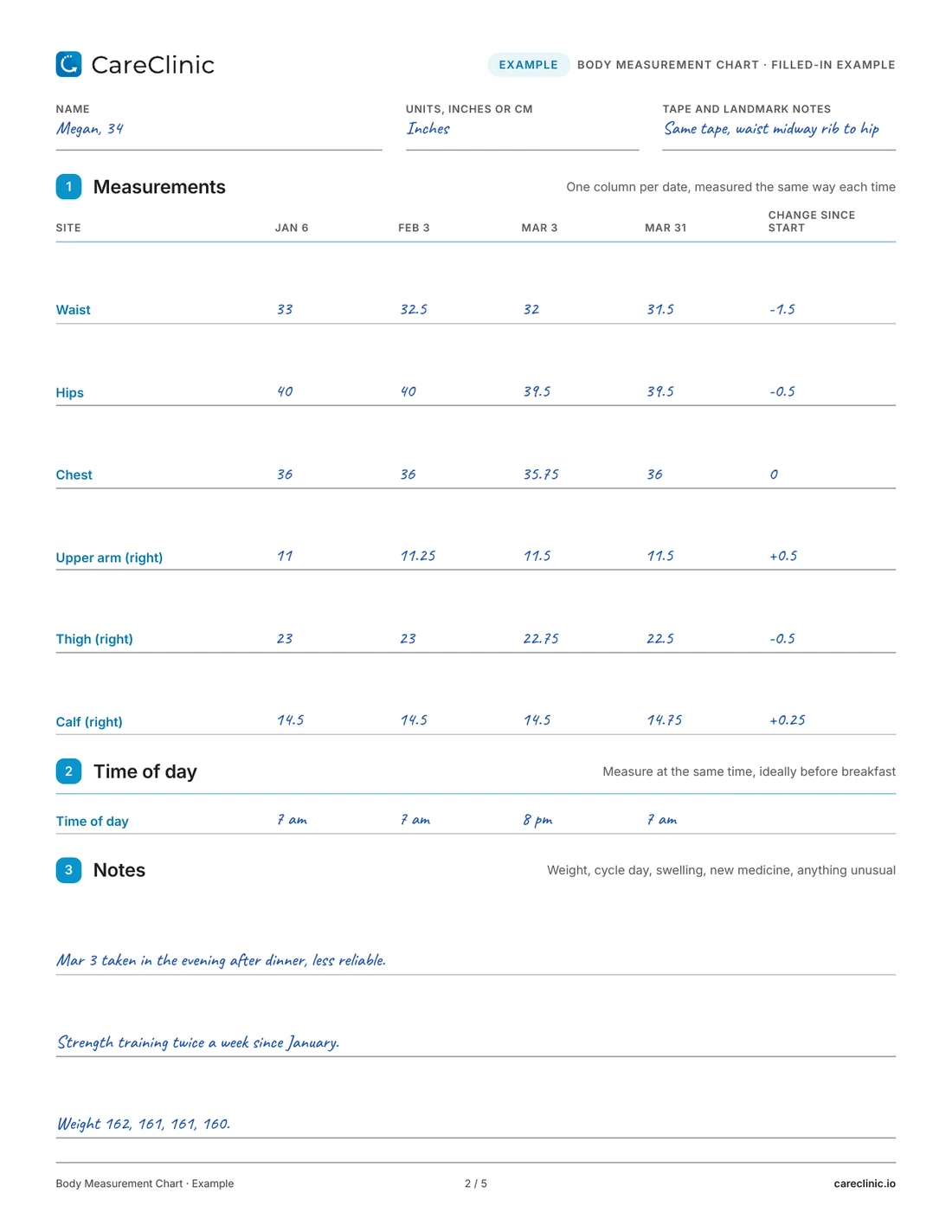
- Page 2, a filled-in exampleMegan's first four readings over three months of strength training.
- Page 3, how to measureRules for consistent readings, where the tape goes for each site and your own landmarks.
- Page 4, my measurement logEight sites, six dates, a change column, time of day and notes.
- Page 5, reviewChange since the first entry, what you were doing and questions for your next appointment.
See a filled example
The example belongs to Megan, 34, who started strength training twice a week in January. Her weight dropped only two pounds, but her waist went from 33 to 31.5 inches and her upper arm from 11 to 11.5 inches over three months. She noted that the March 3 reading was taken in the evening after dinner, so she treats it as less reliable.
 Open the full PDF
How to take body measurements
Use a flexible tape that keeps its length, on bare skin or one thin layer. Keep it level all the way around, snug but not digging in. Read the waist after a normal breath out, with your stomach relaxed.
The WHO protocol places the waist tape midway between the bottom of the last rib you can feel and the upper edge of the hip bone at your side. Use that point and never switch, because a new spot changes the number more than real change does. Hips go over the fullest part of the seat with feet together, the upper arm at the midpoint from shoulder tip to elbow with the muscle loose, and the thigh and calf over their fullest part on the same leg each time.
Why once a month
Tape readings move a little from one try to the next, even when nothing has changed. Measuring daily mostly records that noise. Once a month gives real change time to grow bigger than the wobble.
Food, fluid and time of day all shift the waist. Measuring before breakfast on the same day each month is the easiest way to keep conditions the same. Take each reading twice, and if the two disagree, take a third.
What the numbers cannot tell you
No tape can separate muscle, fat and water, and it gives no reason for a shift. For that reason this body measurement chart leaves out ideal sizes, target lines and good and bad colors. Read the numbers next to your notes on exercise, food, sleep and medicines.
Tips that make it work
- Keep the body measurement chart and the tape together so the same tape is used every time.
- Write your landmarks on page 3 the first time, such as waist midway between rib and hip, right arm.
- Ask someone to help with the chest and upper arm, where it is hard to keep the tape level alone.
- If you also log weight, exercise or medicines in the CareClinic app, note the same dates here so the two line up.
Bringing it to your doctor
Bring your body measurement chart to appointments when you are changing a medicine, managing a condition that affects weight or fluid, or working with a physical therapist. New swelling in one arm or leg, especially with pain, warmth or redness, needs an urgent appointment. If it comes with chest pain or shortness of breath, call 911 or the emergency number where you live. Tell your doctor promptly about rapid weight or size change you cannot explain.
Questions
How do I measure my body for a measurement chart?
Use a flexible tape on bare skin, keep it level and snug, and use the same landmark for each site every time. Measure in the morning before breakfast and take each reading twice.
Where do you measure your waist?
Midway between the bottom of your last rib and the upper edge of your hip bone, at the side of your body. Use that spot every time and read the tape after a normal breath out.
How often should body measurements be taken?
Once a month is enough for most goals. Small day to day changes are often measuring noise, so monthly readings show real trends more clearly.
Can I use a body measurement chart for weight loss?
Yes. Your waist or hips can change while the scale barely moves, especially with strength training. Track both and look at the trend over a few months.
Is this body measurement chart printable free?
Yes. The body measurement chart is a free PDF in US Letter and A4 with a measuring guide, a filled example, a six date log and a review page.
More free worksheets

References
- Waist circumference and waist-hip ratio: report of a WHO expert consultation. World Health Organization. https://www.who.int/publications/i/item/9789241501491
- DVT (deep vein thrombosis). NHS. https://www.nhs.uk/conditions/deep-vein-thrombosis-dvt/