You want a PMDD tracker app that opens fast on your worst days, shows when symptoms build before your period and reminds you before a dose slips. You also want a record your doctor can read in minutes. Here is how Belle and CareClinic help you get there.
Below, we cover what each phase of PMDD asks of a tracker, what your doctor needs to see, and where Belle and CareClinic differ.
What a good PMDD tracking app should do
PMDD has a shape. Symptoms build after ovulation, peak in the days before your period, and ease within a few days of bleeding. So the app you use needs to make that shape visible, month after month.
In practice, that comes down to four things:
- A daily rating you can finish in a minute, even on a hard day.
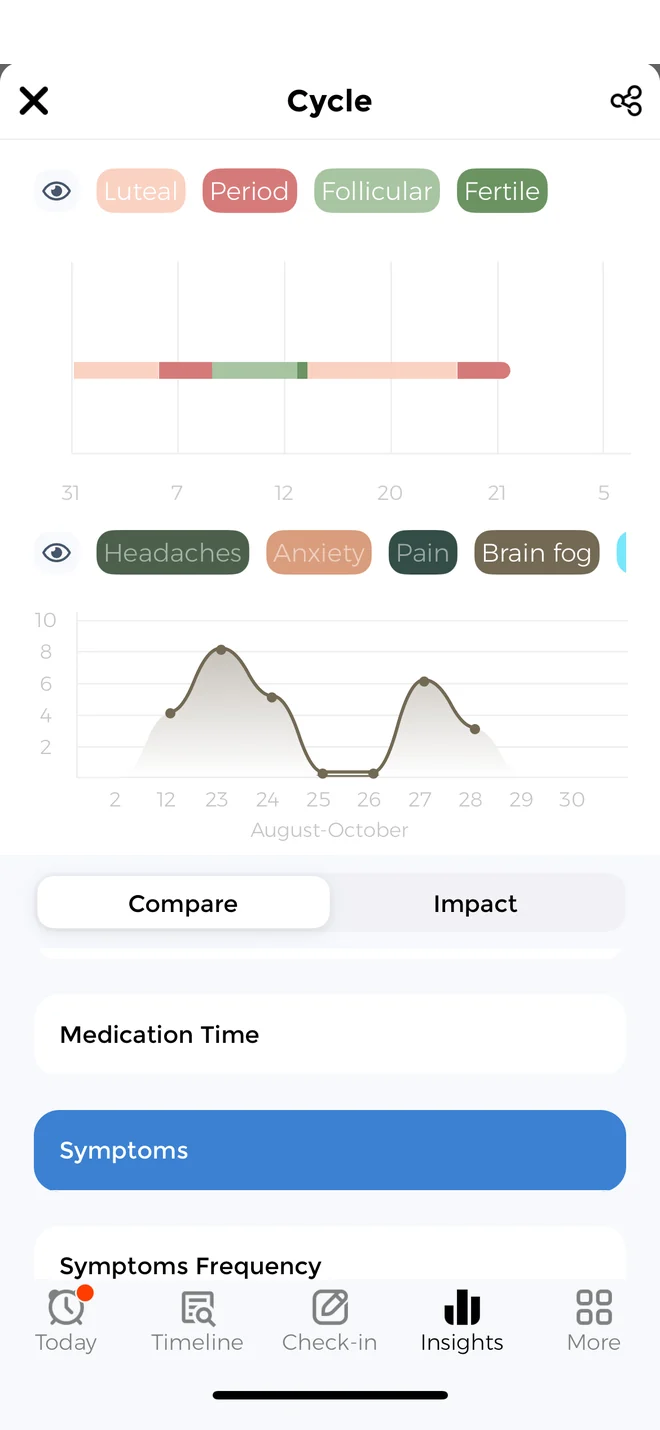
- Symptoms shown by cycle phase, so the luteal rise stands out.
- Treatment logged next to symptoms, such as an SSRI or birth control.
- Reports your doctor can read in a few minutes.
Effort matters most. If a PMDD app is hard to open on your worst day, the record has gaps right where your doctor needs data.
Belle and CareClinic: what each app is for
CareClinic
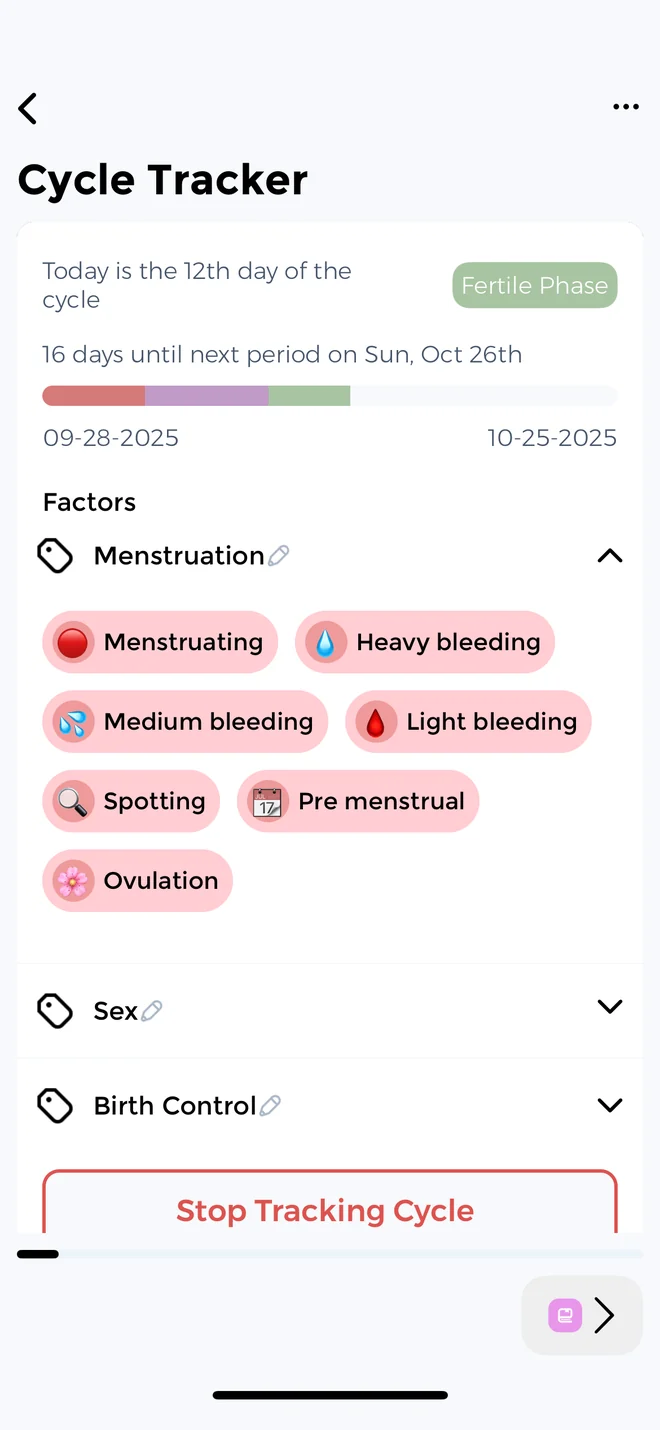
CareClinic is a free symptom tracker app and chronic illness app. For PMDD, you start with two things: the period tracker and daily symptom tracking. The app also comes with a long list of built-in symptoms, and you can add any symptom you want.

You enable only the trackers you need, and the others stay off and out of your way. When your needs change, you can add medications, sleep or a care plan later.
CareClinic starts simple and also handles more complex care when you need it, such as several conditions, caregiving for a dependent or your health records. It suits any age, from teens to older adults and the family members who help them.
Belle Period & PMDD Tracker
Belle, from Belle Health, is a period and symptom tracker centered on PMS and PMDD. It shows your cycle phases and tracks mood, energy, sleep and pain. On its website, Belle Health also offers a PMDD course and self-tests.
Tracking PMDD through each cycle phase
Each phase tells you something different. Here is what to watch for in each one, and what CareClinic records along the way.
Menstrual phase
The menstrual phase starts on the first day of your period. For many people with PMDD, mood begins to lift here, so it is a useful checkpoint.
In CareClinic, you log flow and the symptoms you notice. If cramps or headaches matter to you, you can also mark them on a body map with a severity. Every symptom has a start and end time, so you can see how quickly relief arrives once bleeding starts. That timing is one of the details a doctor checks for PMDD.
Follicular phase
The follicular phase runs from your period to ovulation. Many people feel steadier here, so these days become your baseline.
The same daily ratings you log all month give you that baseline. If energy is a concern, you can also turn on energy tracking and activity cost. Over a few cycles, your energy curve shows how much you can take on in these weeks. Sleep can sync from Apple Health, Health Connect, Fitbit, Garmin or Oura, so there is less to type.
Ovulation
Some people with PMDD notice a short dip around ovulation. For others, however, ovulation marks the start of the shift into luteal symptoms.
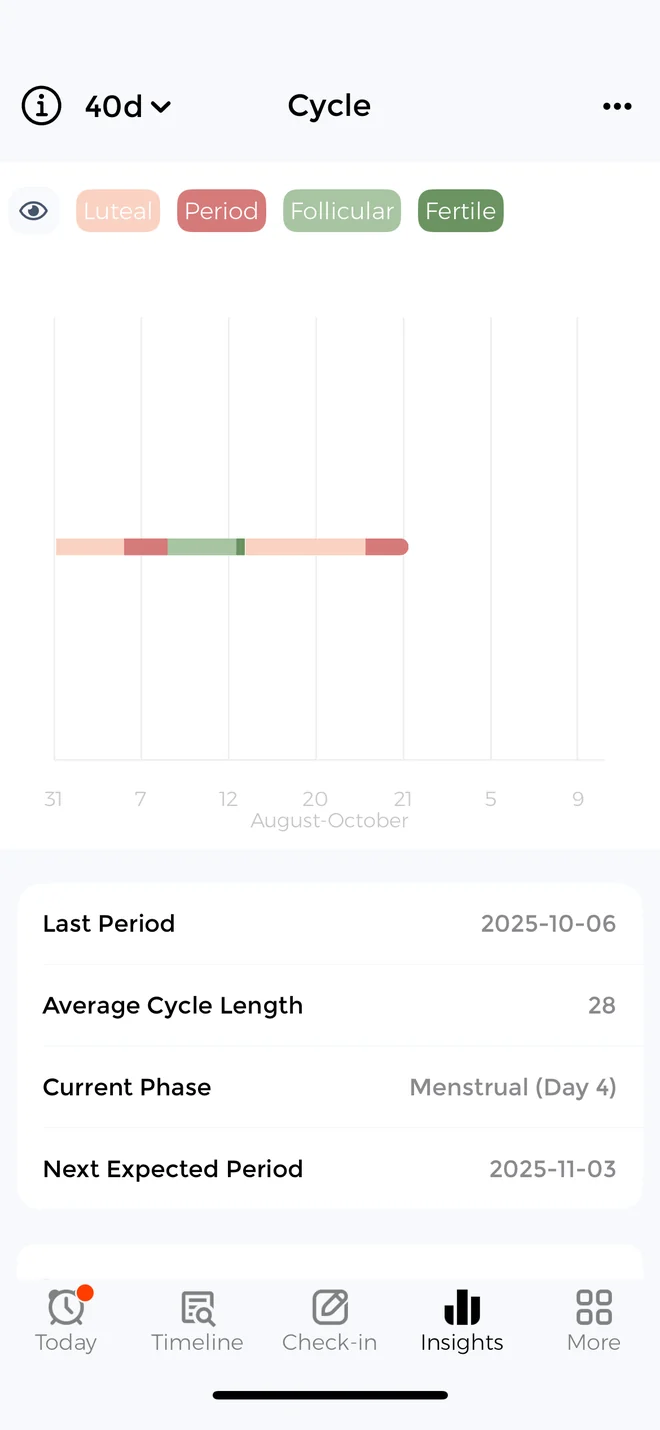
CareClinic predicts ovulation and your next period. That tells you roughly when your luteal phase began, and the luteal phase is the window a PMDD diagnosis looks at. If you want more precision, you can also log cervical mucus and temperature.
Luteal phase
The luteal phase is where PMDD shows itself. Irritability, low mood, anxiety, tearfulness, poor sleep, food cravings, bloating and breast tenderness can build in the week or two before your period.
Belle in the luteal weeks
Belle's store listing says the app helps you feel prepared for difficult days. One App Store reviewer says its phase guidance helps with PMDD.
CareClinic in the luteal weeks
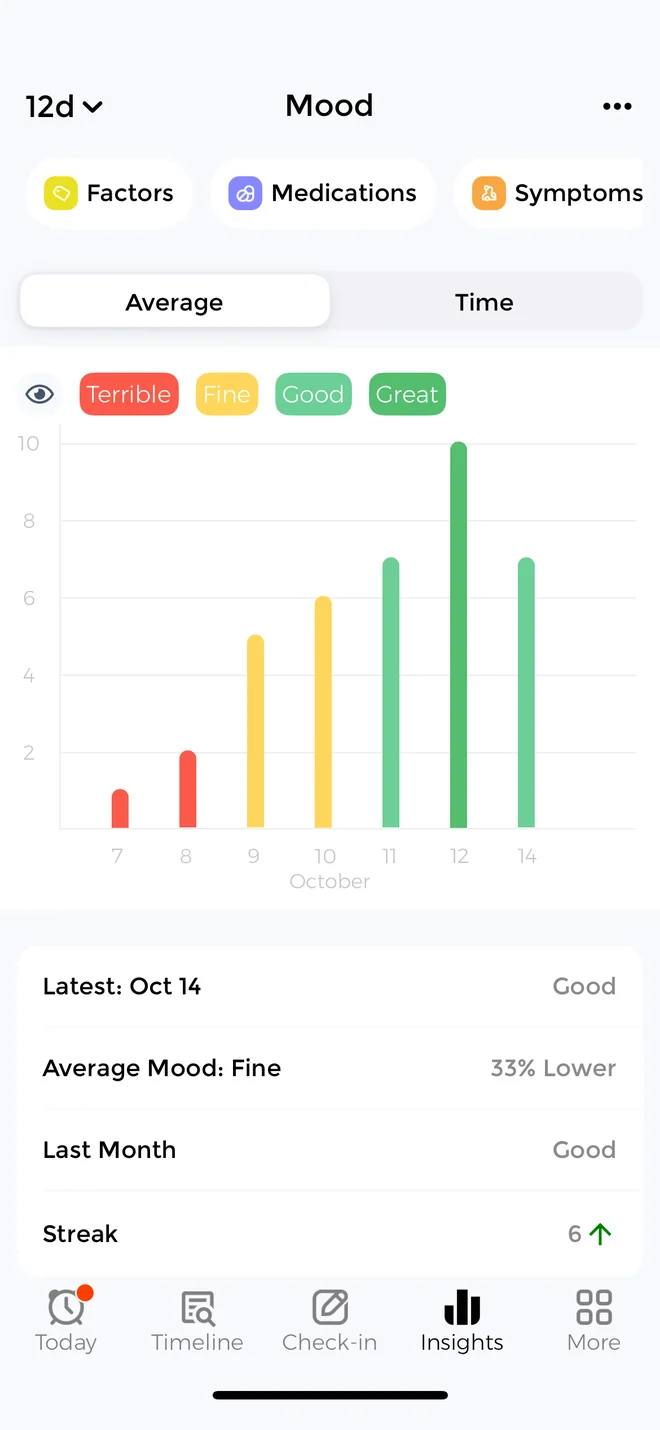
In CareClinic, the main view is symptoms by cycle phase. It puts your luteal days next to your follicular days, so the rise is easy to see.
If you want more detail, the PMS timeline shows which symptom starts first, which one peaks, and how many days each lasts. Your charts can also show links between symptoms and factors you log, such as sleep or caffeine. When you want a heads up, a symptom forecast helps you lighten your schedule before a peak.
Logging SSRIs and birth control
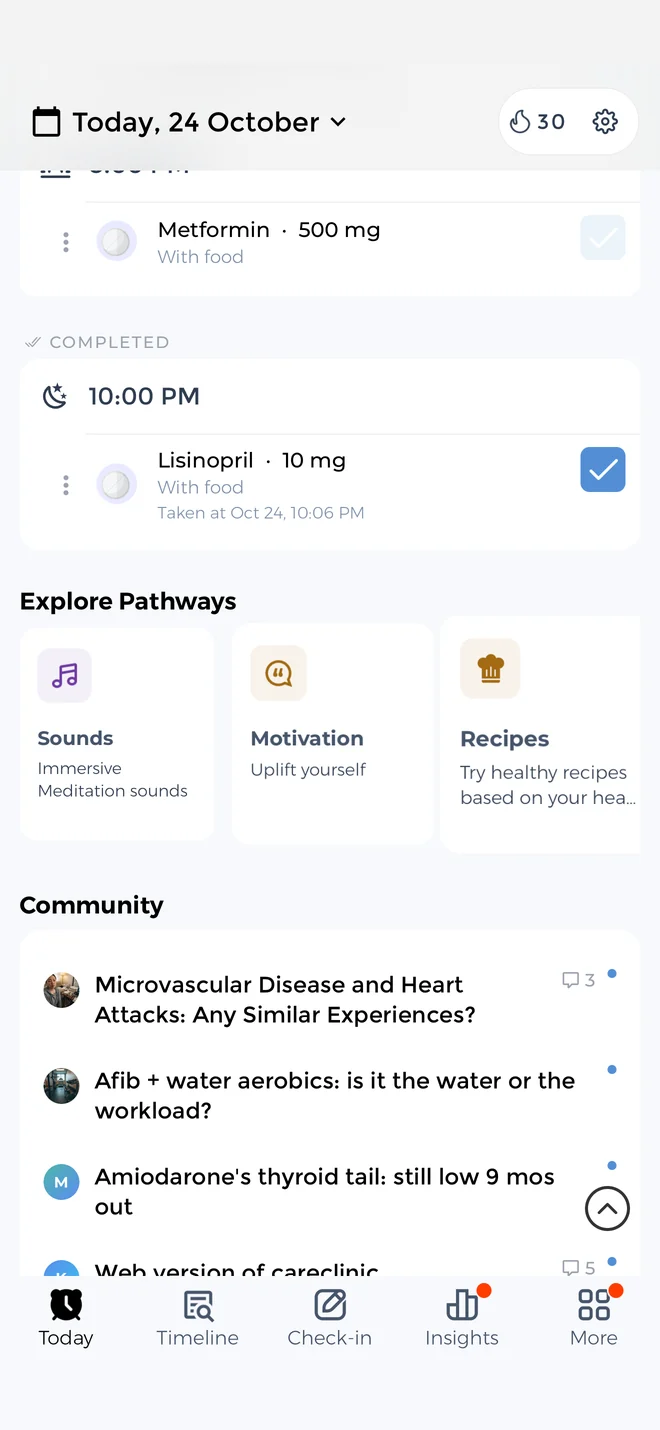
Many people with PMDD take an SSRI every day or only during the luteal phase, and others use hormonal birth control. If you take any of these, you can turn on medication tracking. CareClinic then sends reminders, alerts you before a refill runs out, and keeps a history of taken and missed doses. You can also add a medication by photographing the bottle or label.
Because doses and symptoms sit in one app, you can compare a cycle on treatment with a cycle before it. Belle's public materials do not list medication reminders, so you would need a second app for this.
What your doctor needs to diagnose PMDD
A PMDD diagnosis relies on daily symptom ratings across at least two menstrual cycles. Your doctor wants to see symptoms appear in the luteal phase, ease within a few days of your period, and stay low in the week after it. Many clinicians use a daily form such as the Daily Record of Severity of Problems. So a tracker you open every day gives you that record without paper.
A PDF report for the dates you choose
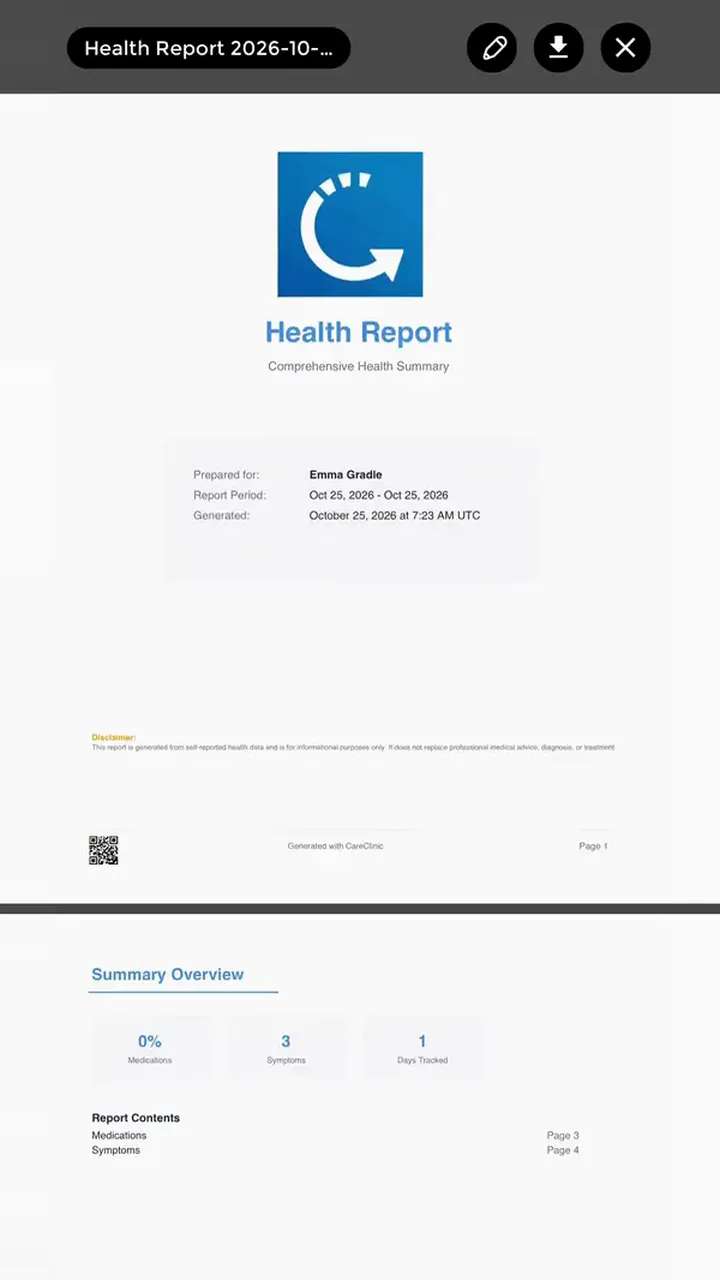
CareClinic builds a PDF doctor report for the date range you pick, such as your last two or three cycles. The report puts symptoms, medications and cycle entries in one document. If a specialist wants the raw daily numbers, you can also export a CSV file.
A health record next to your cycle
CareClinic has a health record for lab results, imaging, immunizations and medical documents. So if your doctor orders blood work, such as a thyroid panel, the results sit next to your cycle data. On iPhone, you can also import hospital records through Apple Health Records.
Getting ready for the appointment
If you want help preparing, Carey, CareClinic's AI health assistant, answers from your own logs and records. Before a visit, Carey prepares a visit summary and suggested questions for your doctor. You can also ask out loud, for example, "How did my sleep change in my last two luteal phases?"
What to bring to a PMDD appointment
- Daily symptom ratings from at least two full cycles.
- Your period start dates and cycle phases.
- Every medication, supplement and birth control method, with start dates.
- Notes on how symptoms affect work, school and relationships.
- Two or three questions you want answered before you leave.
Support for the harder luteal weeks
In CareClinic
CareClinic includes CBT lessons for anxious or negative thoughts and soundscapes for calming down or falling asleep. You can also repeat self-assessments to see how your mood changes over time. If you want more structure, a guided care plan gives you a ready set of things to track and learn, and you can add one at any point.
Carey is there between appointments too. Ask how this cycle compares with the last one, or which days your energy dipped. Carey works fully by voice, which helps when typing feels like too much.
In Belle
Besides the course and self-tests on its website, Belle lists practical support tools in the app for days when symptoms increase. One reviewer describes daily activities that help them process emotions.
A Care Team for the people around you
PMDD affects the people you live with too. In CareClinic, you can add a partner or family member to your Care Team and choose what each person can see. A partner who sees your luteal phase coming can then plan the week with you. If you are a parent helping a teenager track her cycle, you can also manage her profile and track for her.
When PMDD is not the only thing you track
PMDD often sits alongside other conditions. Anxiety, depression, ADHD and migraine can all get worse before a period. This premenstrual flare of an existing condition can look a lot like PMDD on paper, so telling them apart is easier when everything sits in one record.
Belle covers PMS and PMDD. CareClinic supports more than 3,500 conditions, but you add only what applies to you. For example, you can turn on tracking for focus, migraine, anxiety or low mood next to your cycle. Your doctor can then see whether symptoms appear only in the luteal phase or all month, which shapes both diagnosis and treatment. For migraine, automatic weather logging also adds one more factor to compare.
CareClinic vs Belle: PMDD tracker app comparison
Here is how the two apps compare on the features people ask about most.
| Feature | CareClinic | Belle |
|---|---|---|
| Cycle phases | Yes, with period and ovulation predictions | Yes, with phase guidance |
| PMS and PMDD patterns | By cycle phase, plus a PMS timeline | Yes |
| Pain and cramps | Body map, severity and duration | Yes |
| Mood | Yes, plus a journal and self-assessments | Yes |
| Sleep | Logged or synced from wearables | Yes |
| Energy | Yes, plus activity cost | Yes |
| SSRIs, birth control and supplements | Reminders, refill alerts and dose history | Not listed |
| Flare forecast | Yes | Not listed |
| AI assistant | Carey, by text or voice | Not listed |
| Doctor report | PDF, CSV and Carey visit summary | Yes |
| Wearables and health apps | Apple Health and Health Connect, plus Fitbit, Garmin, Dexcom and Oura | Not listed |
| Support tools | CBT lessons, soundscapes, care plans | PMDD course, self-tests, practical tools |
| Sharing | Care Team with set permissions | Selected cycle info with trusted people |
| Conditions beyond PMDD | 3,500+ conditions | Focused on PMS and PMDD |
| Devices | iPhone, iPad, Android, web, Mac, Apple Watch | iPhone and Android |
| Cost | Free to use | Free download, up to $79.99 a year |
We compared the features each app describes in its store listings and on its website at the time of writing. "Not listed" means the feature was not described in Belle's public materials.
Cost, privacy and devices
What Belle costs
You can download Belle for free. At the time of writing, its annual plan costs $79.99 on the App Store, the highest price listed there, and Google Play lists in-app purchases of up to $99.99 per item. You can check current prices on the Belle App Store listing.
What CareClinic costs
CareClinic is free to use, and you can keep using it for free indefinitely.
Privacy
Belle's Google Play listing says data is encrypted in transit and that you can ask for your data to be deleted. CareClinic covers both, encrypting your data in transit with TLS and at rest with AES-256, and letting you delete your account from the app. It is also HIPAA compliant, aligned with GDPR and PIPEDA, and never sells your health data or uses it for advertising or AI training. You can lock the app with Face ID, another biometric lock or a passcode, and decide what each Care Team member can see.
Devices and languages
Belle runs on iPhone and Android. CareClinic runs on iPhone, iPad, Android, web, Mac and Apple Watch. It is also available in multiple languages.
Which one to keep
Our verdict: CareClinic does what a PMDD tracker app needs to do. It shows your luteal pattern, keeps treatment on track and turns your daily notes into a report your doctor can use. You start with your cycle and a few symptoms, and the rest stays off until you need it. It is also free to use.
Belle stays close to PMS and PMDD alone, and Belle Health pairs the app with a PMDD course and self-tests on its website. Its annual plan costs $79.99 on the App Store.
Comparing other apps too? Our CareClinic app comparisons put symptom, mood and chronic illness trackers side by side.
Belle vs CareClinic FAQ
Belle reviews and cost
Is the Belle PMDD app good for tracking PMDD?
Belle focuses only on PMS and PMDD, with cycle phases, symptom logs and reports for your doctor. Its public materials do not list medication reminders, wearable sync or an AI assistant. CareClinic includes those, and it is free to use.
What do Belle app reviews say?
The reviews we read go both ways. One App Store reviewer calls the app "like a mini friend to help me regulate emotions." One Google Play reviewer says the free version had enough features. However, another calls it glitchy and says some features would not load.
What about Belle app Reddit threads?
We based this article on Belle's store listings, website and store reviews, not on Reddit. If you read Reddit threads, treat each post as one person's experience. The most useful test is your own: log every day for one full cycle and see if the record answers your questions.
How much does Belle cost?
At the time of writing, Belle's annual plan costs $79.99 on the App Store. The download is free, and Google Play lists in-app purchases of up to $99.99 per item.
CareClinic, diagnosis and privacy
Is CareClinic a free PMDD tracker app?
Yes. CareClinic is free to use, and you can keep using it for free indefinitely. Start with your cycle and the symptoms you notice, then add medications, sleep or other trackers when you need them.
Can a PMDD symptom tracker app help me get diagnosed?
Yes. Doctors confirm PMDD with daily symptom ratings across at least two cycles, and a tracker you use every day creates that record. CareClinic turns it into a PDF report for the dates you choose. Carey can also prepare a visit summary with questions for your doctor.
Is my PMDD data private in CareClinic?
Yes. CareClinic is HIPAA compliant and aligned with GDPR and PIPEDA. Your data is encrypted in transit and at rest, and it is never sold or used for advertising or AI training. You can add Face ID, a biometric lock or a passcode, and choose what each Care Team member can see.
Can I use Belle and CareClinic together?
Yes. You can keep Belle for its PMDD course and use CareClinic for daily tracking, medications and doctor reports. If you prefer one app, CareClinic keeps your cycle, your treatment and your health record in one place.