
One team is six weeks from enrolling 72 participants and still has no practical way to collect the daily diary. Another runs a supplement program and wants customers to log product use, sleep, energy, and unexpected experiences without answering a fresh survey every week.
A medical-device company may already have a clinical database but no participant app, while a clinic may want structured check-ins between appointments. Each buyer may use a different label, such as ePRO, eDiary, electronic patient diary, PROMs platform, remote data capture, or white-label companion app, but the operational gap is similar.
They need a simple way for people to record repeated information, receive reminders, and stay engaged, while the organization gets longitudinal data it can review, export, or connect to another system. The solution should be proportional to the program rather than forcing every buyer into a large eCOA contract or a custom app build.
Who needs an ePRO, eDiary, or participant app?
Clinical research remains an important use case, but it is not the only one. Any organization that needs people to report health, treatment, product, behaviour, or outcome data repeatedly may have the same underlying requirement.

| Organization | What it may need | Example workflow |
|---|---|---|
| Clinical research teams and boutique CROs | Patient-reported outcomes, symptom diaries, scheduled assessments, reminders, and exports | A 12-week feasibility study with one daily diary and two recurring questionnaires |
| Medical-device and digital health companies | Product-use logs, comfort or tolerability tracking, functional outcomes, photos, and connected measurements | A post-market or pilot program that follows device use and self-reported experience between visits |
| Supplement, nutraceutical, and wellness brands | Routine adherence, product-use tracking, check-ins, lifestyle context, and customer-reported experience | An eight-week program that follows supplement use alongside sleep, energy, mood, nutrition, and symptoms |
| Clinics and care programs | Between-visit tracking, reminders, care plans, patient check-ins, and team visibility | A rehabilitation, mental health, chronic care, pre-operative, or post-operative pathway |
| Patient organizations and research communities | Condition-specific tracking, registries, member toolkits, and longitudinal reports | A community program that helps members record symptoms, treatments, triggers, and questions for appointments |
| Software vendors, EDC providers, and health platforms | A ready participant-facing app, white-label deployment, data exports, or integration support | An existing platform that has administrative tools but no practical daily app for its users |
| Employers, health plans, and population programs | Preventive pathways, engagement, self-reported outcomes, and aggregate program monitoring | A voluntary wellness or condition-support initiative with recurring check-ins and resources |
The same platform can support very different programs, but the wording, consent, claims, review process, and data requirements should match the use case. A regulated clinical trial, a customer wellness program, and a patient support initiative should not be configured or described as though they carry identical responsibilities.
What can CareClinic collect beyond a questionnaire?
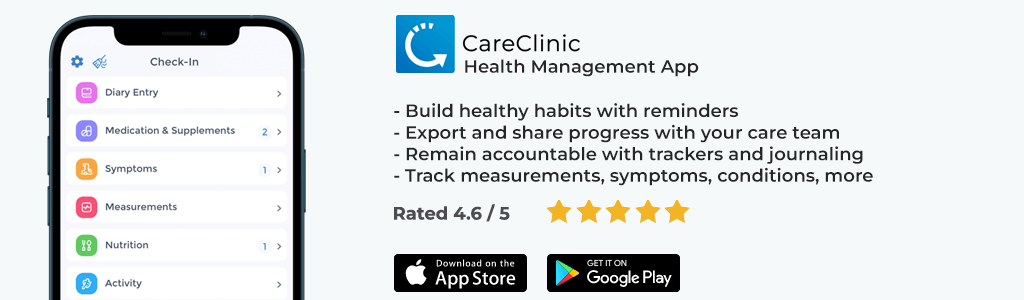
CareClinic is built around repeated health tracking rather than a single form submission. Its modules can be combined to capture structured assessments, daily entries, treatment routines, measurements, lifestyle context, and open-ended observations in one longitudinal record.
- Assessments and questionnaires: Supported clinical assessments, recurring self-assessments, scoring, reminders, and progress over time through the health assessment tracker.
- Symptoms and tolerability: Severity, duration, location, triggers, notes, photos, and patterns through the symptom tracker.
- Medications, supplements, and product routines: Dose, timing, adherence, refill needs, brands, stacks, and reported effects through the supplement tracker and treatment tracker.
- Daily experience: Text, photos, voice notes, prompts, and structured check-ins through the health diary.
- Plans and scheduled actions: Multiple care plans, reminders, goals, treatments, activities, and measurements through CareClinic care plans.
- Connected and contextual data: Activity, sleep, heart rate, body measurements, and other supported sources through health data integrations.
- Reports and data access: Longitudinal timelines, charts, PDF reports, CSV exports, and configurable sharing for downstream review.
Not every program needs every module, and more fields do not automatically produce better data. The app can be narrowed around a defined workflow so people see the trackers and tasks that matter instead of navigating an oversized feature list.
When is a survey tool not enough?
A survey can work well for a one-time intake or a short feedback exercise. The limitations usually appear after the team adds repeat participation, individual schedules, reminders, missed-entry visibility, longitudinal comparisons, role-based access, or a clean handoff to another system.
Consider a supplement company running an eight-week product experience program. A weekly form may collect answers, but the team may soon need to know whether the person actually used the product, which days were missed, what else changed in the routine, whether an unexpected experience was reported, and whether engagement declined after week three.
A small clinical study faces a similar problem with stricter controls. The questionnaire may be simple, but the study still needs to know when it was available, when it was completed, whether late entry was allowed, what the coordinator could see, and how the data will be exported at study close.
| Basic form or survey | Flexible ePRO or participant platform |
|---|---|
| Usually designed around a submission | Designed around a person and a timeline |
| One link or questionnaire at a time | Recurring diaries, assessments, reminders, and tasks |
| Responses often end in a spreadsheet | Longitudinal records, dashboards, reports, and exports |
| Limited context around adherence or routines | Symptoms, treatments, products, habits, measurements, and context in one view |
| Limited reason to return between forms | An app that can support daily use, reminders, education, and progress tracking |
| Branding is usually limited to the form | Standard, configured, or white-label participant experiences |
How is CareClinic different from a traditional ePRO platform?
CareClinic began as a complete personal health app rather than a study-only questionnaire tool. The underlying product already combines assessments, symptoms, treatments, supplements, measurements, check-ins, reminders, care plans, journals, reports, sharing, and supported integrations.
The CareClinic ePRO platform can therefore be scoped as a focused ePRO or electronic diary without limiting the product to that role. The same foundation can support a clinical study, patient support program, post-market follow-up, wellness initiative, product companion, registry, or branded member app.
The distinction also matters after the first questionnaire is complete. A person can continue using the app to follow a routine, record context, review progress, and keep relevant information together, while the organization uses the agreed dashboard, report, export, or integration workflow.
A regulated study may still require study-specific validation, instrument licensing, audit controls, and procedural documentation beyond a normal consumer deployment. A wellness or product program may use a lighter setup, while a white-label or integration-led project may require additional branding, technical, support, and governance work.
What does 500,000+ users worldwide mean for an organization?
CareClinic is used by more than 500,000 people worldwide, with more than 10 million entries logged monthly across the platform. It is available across iOS, Android, and web, supports 12 languages, and is used for symptoms, treatments, supplements, habits, assessments, measurements, records, and everyday health routines.
This number should not be confused with the number of clinical-trial participants or enterprise customers. Its value is product maturity, because the mobile experience, reminders, trackers, exports, and support flows have been shaped by everyday use rather than created for one pilot.
For an organization, that provides a different starting point from commissioning a new study or wellness app with untested daily workflows. It does not remove the need for project-specific configuration or validation, but common tracking and engagement functions already exist in a product used at meaningful scale.
Can CareClinic work for a pilot and scale with the program?
CareClinic can be approached in layers, so a team does not need to begin with the largest deployment. The right level depends on the number of users, the workflow, the required branding, the data destination, and whether the project is exploratory, operational, or regulated.
- Start with CareClinic Teams. This may suit a pilot, small study, clinic program, research group, or internal evaluation that can use the existing app and a focused set of trackers.
- Configure the program. Assessments, schedules, selected modules, templates, roles, review rules, and exports can be scoped around a recurring research, support, wellness, or product workflow.
- Add white-label deployment. A CRO, clinic, device company, software vendor, or brand can explore an organization-specific participant experience with its own branding and onboarding requirements.
- Connect the data layer. An EDC, digital health platform, care system, or analytics environment may need agreed exports, FHIR or API work, identity mapping, and clearly assigned system responsibilities.
The broader CareClinic platform for organizations supports patient engagement, remote tracking, dashboards, and configurable deployment for organizations of different sizes. A first program can remain narrow and expand when there is a clear reason to add users, workflows, branding, exports, or integrations.
How should you compare ePRO price and quality?
The cheapest license is not always the lowest-cost implementation, and the most expensive platform is not automatically the safest or best fit. A useful comparison looks at the total work required to launch, operate, support, and close the program.
- Standard configuration: Which requirements already exist and can be configured without development?
- Commercial minimums: Is the contract sized for the actual number of users, sites, programs, and months?
- Custom development: Which items require engineering, how will they be tested, and who maintains them later?
- Participant support: Who handles onboarding, account recovery, device issues, and questions during the program?
- Data access: Can the team review a sample export, data dictionary, timestamps, and closeout process before signing?
- White-label scope: What changes beyond the logo, and who owns content, support, release, and app-store responsibilities?
- Integration: Is a standard export enough, or does the project require FHIR, API work, identity mapping, or ongoing synchronization?
- Research and regulatory scope: Who is responsible for instrument licensing, validation, audit controls, procedures, training, and jurisdiction-specific requirements?
CareClinic will not be the lowest-cost option for every possible project, and no objective comparison can be made without a scope. Its practical advantage is that organizations can start from a mature, modular app instead of paying to recreate common tracking, reminder, reporting, and engagement functions.
A good proposal should separate standard product capabilities, one-time configuration, recurring fees, third-party costs, and genuinely custom work. That makes it easier to compare price and quality without treating an enterprise suite, a survey tool, and a custom app as equivalent products.
Is CareClinic suitable for international programs?
CareClinic has a worldwide user base and supports multiple languages, so the product is not limited to a United States audience. Program requirements still vary by country and may include local rules for privacy, consent, electronic records, data location, accessibility, instrument licensing, clinical research, and product claims.
For regulated clinical research, teams should assess the project against ICH E6(R3) Good Clinical Practice and the requirements of every relevant jurisdiction. The modern guideline emphasizes proportionate, fit-for-purpose systems and data governance, while local regulations and institutional requirements can add further obligations.
CareClinic explains its current data-storage and privacy approach in the privacy and security knowledge base. An organization should still review the proposed configuration, contracts, data flows, and user population with its own privacy, legal, clinical, and regulatory advisers.
Where can AI help with patient-reported data?
AI becomes more useful after the data-collection workflow is clear and the underlying information is structured. It may help organize participant free text, summarize a longitudinal timeline, identify incomplete or inconsistent records, or help a team find themes across a program.
Those uses are different from changing source responses, filling in missing entries, altering a validated score, or making an independent clinical or safety decision. CareClinic’s larger value is the longitudinal data layer, because repeated, contextual information can support human review and carefully scoped AI-assisted analysis.
The app’s Timeline and Insights tools already bring tracked information into charts, comparisons, patterns, and exportable reports. Organizations can decide which analyses are appropriate for their program and where a qualified person needs to remain in the review loop.
When is CareClinic likely to be the right fit?
CareClinic is most relevant when people need to report or track information repeatedly, not simply complete one form. It is also a stronger fit when the organization values a usable mobile experience, reminders, multiple data types, longitudinal records, reports, team visibility, or a path from a pilot to a configured or branded deployment.
- You need a patient diary, participant diary, ePRO, PROMs workflow, check-in app, or product companion without building the core app from zero.
- You need to combine questionnaires with symptoms, treatments, supplements, lifestyle factors, measurements, photos, notes, or connected data.
- You want to start with a small team or program but preserve the option to add users, workflows, branding, reporting, exports, or integrations later.
- You already have an EDC, CRM, care platform, or analytics system and primarily need a participant-facing data layer.
- You want the participant experience to be based on a product already used by more than 500,000 people worldwide.
CareClinic may not be the complete answer when a project needs randomization, investigational product supply management, a full EDC replacement, specialized hardware provisioning, complex imaging workflows, or a highly specialized endpoint that the current product cannot support. In those cases, CareClinic may serve as one component of the stack, or another platform may be the more appropriate choice.
Could CareClinic fit your study, program, or product?
Start by creating a CareClinic Teams account and outlining who will use the app, what they need to record, how often they will record it, what the team needs to review, and where the data must go. That gives the CareClinic team enough context to separate what is already available from what needs configuration, white-label work, or integration. Start with CareClinic Teams
Related CareClinic guides
- Before You Build the Patient App
- The Device Is Ready. The Patient App Is Not.
- A Reminder Is Not a Patient Support Program
- The Trial Is Remote. The Burden Isn't.
- The Device Launched. The Follow-Up Didn't.
- A Rare Disease Registry Is More Than a Signup Form
- A Patient Diary Is Not Yet Real-World Evidence
Frequently asked questions about ePRO and participant apps
Is CareClinic only for clinical trials?
No, CareClinic is not limited to clinical trials. It can also support care programs, medical-device follow-up, registries, patient organizations, digital health products, supplement and wellness programs, and other projects that need recurring user-reported data.
Can CareClinic be used as an eDiary or electronic patient diary?
Yes, CareClinic can be configured around recurring or event-based entries, reminders, symptoms, treatments, assessments, notes, and reports. The exact workflow should be scoped around the program, particularly when the resulting records will be used in regulated research.
Can a supplement or nutraceutical company use CareClinic?
Yes, a supplement, nutraceutical, or wellness company may use CareClinic as a product companion or structured experience-tracking app. A program can follow product use, adherence, symptoms, mood, sleep, nutrition, activity, and other approved measures, while the company remains responsible for appropriate claims, consent, privacy, and review processes.
Can CareClinic be white labelled or used as an OEM patient app?
CareClinic offers configurable and white-label options for organizations that want a branded participant or customer experience. OEM-style projects may also require integrations, data mapping, support arrangements, release planning, and a clear division of responsibilities between CareClinic and the partner.
Can a small team start now and scale later?
Yes, a team can begin with a focused workflow and add users, trackers, assessments, branding, reporting, or integrations as the program develops. The initial setup should still account for future data structure and ownership needs so growth does not require avoidable rework.
Does CareClinic work outside the United States?
Yes, CareClinic is used worldwide and supports multiple languages across its mobile and web experiences. Each organization should still assess local privacy, research, accessibility, data, and product requirements for the countries included in its program.
Does CareClinic replace an EDC or full eClinical platform?
Not necessarily, and many projects do not need it to do so. CareClinic can provide the participant-facing and longitudinal tracking layer while data is exported or integrated into the research, care, analytics, or operational systems the organization already uses.
Where can I review the current app before speaking with the team?
The CareClinic knowledge base documents the current trackers, reminders, assessments, reports, integrations, care-team functions, accessibility options, and day-to-day app behaviour. Reviewing those materials can help a buyer distinguish existing functionality from project-specific configuration before beginning a commercial discussion.