The device works. The clinical service is defined. The operations dashboard is taking shape. Then somebody asks the question that can quietly add a year to the roadmap:
What are patients supposed to use?
For a smaller health company, the patient app often arrives late in product planning. The team has spent its time on the part that makes the business different: a device, care model, study workflow, coaching program, data platform or clinical service. It has not spent two years building medication reminders, symptom logging, account recovery, push notifications, reports, accessibility settings and mobile release infrastructure.
That is not necessarily a mistake. Those features may be important, but they may not be the company's intellectual property.
In brief: a white-label patient app is usually worth considering when the organization's real product is the care program, device, research workflow or service around the app, rather than the common mobile infrastructure inside it.
The decision is more nuanced than "build or buy." A serious white-label patient app is not a generic app with a new logo pasted on the opening screen. It should have a defined purpose, an agreed data flow, clear ownership, an appropriate feature set and a support model that still works six months after launch.
Table of Contents

- Start with the job the patient needs to do
- Separate your product from the plumbing
- What should a white-label patient app include?
- Four ways to give patients a digital experience
- Who should own a white-label patient app?
- How should a white-label patient app handle privacy?
- A health app can change regulatory scope through its claims
- AI belongs after the workflow is understood
- The white-label scoping checklist
- Where might CareClinic fit in a branded patient app project?
- Related CareClinic guides
- Bring the workflow, not a 100-screen wish list
- Frequently asked questions
Start with the job the patient needs to do
Product discussions often begin with features: chat, AI, wearables, content, dashboards, reminders and questionnaires. A better place to start is the patient's recurring job.
For example:
- A device user records comfort, use time and symptoms each day.
- A trial participant completes a scheduled electronic diary.
- A rehabilitation patient follows exercises and reports pain and function.
- A member of a chronic-care program tracks medication use and measurements.
- A patient-support program asks for short check-ins between scheduled calls.
- A wellness customer follows a routine and records sleep, mood or energy.
Each of these can be delivered through a mobile app, but they do not need the same app. The workflow, language, consent, escalation rules and data destination should follow the program.
This also prevents a common failure: commissioning a "complete patient app" before anybody has decided what a useful Tuesday morning interaction looks like for the person using it.
Separate your product from the plumbing
A useful build-versus-white-label conversation distinguishes the part that creates strategic value from the part that every health app has to operate.
| Your organization may need to own | Common app infrastructure you may not need to rebuild |
|---|---|
| Your device, clinical service, program design or research protocol | Account creation, authentication and password recovery |
| The questions, measures and actions that matter to your use case | Symptom, medication, mood, sleep, activity and measurement tracking |
| Your clinical, operational or customer-support workflow | Reminder scheduling, notifications and recurring check-ins |
| Your interpretation rules and professional responsibilities | Longitudinal timelines, charts, reports and basic exports |
| Your brand, market positioning and relationship with users | Mobile navigation, accessibility, offline handling and release maintenance |
| Your integration contract and data-governance decisions | Common device APIs, secure storage patterns and routine support tooling |
There is no rule that everything in the right-hand column must be licensed. A company with a strong mobile engineering team may prefer to own the full stack. The table is simply a way to ask where custom development produces a real advantage and where it produces another system the team must support.
What should a white-label patient app include?
The phrase is used loosely. At its weakest, white label means a different logo and color palette. At its most useful, it means a maintained product foundation that is configured around another organization's identity and workflow.
A realistic scope can include:
- the app name, icon, launch screen, colors and store presentation;
- which tracking areas are relevant to the program;
- which records or modules appear by default;
- condition- or program-specific onboarding;
- care plans, assessments, reminders and educational material;
- the destination of user-entered and connected data;
- staff access, reports, exports or integration requirements;
- support, account recovery and release responsibilities;
- privacy language, consent and role allocation; and
- the boundaries of any AI-assisted feature.
A useful test: ask the vendor which requests are standard configuration, which are fixed at the app-build level, and which require custom engineering. "Everything is configurable" is usually less reassuring than a clear answer.
CareClinic's own white-label architecture makes this distinction. Tracking areas and some record defaults can be selected for a program, while certain features are controlled at the app-build level and other changes require scoped development. That is more realistic than pretending every screen is an instant on/off switch.
Four ways to give patients a digital experience
| Approach | Often a good fit when | Main trade-off |
|---|---|---|
| Forms and a lightweight portal | The workflow is short, infrequent and mostly one-directional | Recurring engagement, reminders and longitudinal context may remain manual |
| Use an established app under its existing brand | The team wants to validate the workflow before investing in a branded build | The patient relationship is shared with another product identity |
| Configurable white-label health app | The program needs its own brand and patient experience without rebuilding standard tracking infrastructure | The team must work within the product's real configuration boundaries |
| Fully custom patient app | The app experience itself is core IP or the workflow cannot be delivered on an existing foundation | Higher engineering, security, testing, release and maintenance responsibility |
A fifth option is an embedded SDK or set of APIs. That can make sense when the company already has a patient app and only needs a specific capability. It is less helpful when there is no mobile product, onboarding, reminder system or support workflow to embed it into.
White-Label Patient Portal or App
A white-label portal may suit a short or occasional task, such as sharing information or completing a form. A recurring program may need an app when people return to track information, receive reminders, and see records over time. Consider how often patients use the service, what they need to record, and what staff need to review before choosing.
CareClinic's app supports recurring tracking and reports, while a portal may fit a simpler workflow.
Who should own a white-label patient app?
One of the least glamorous decisions can become one of the most expensive: whose developer accounts, app listing, bundle identifiers, signing keys and store relationships will hold the product?
The answer affects control, review access, releases, analytics, support, future transfer and what happens if the commercial relationship ends.
Apple permits eligible apps to be transferred between App Store Connect organizations while remaining available; ratings and reviews can remain with the app, and the Bundle ID stays the same. Transfers still have eligibility requirements and require action by the account holders.
Apple also supports private custom-app distribution to specified organizations through Apple Business Manager when a public App Store listing is not the right model.
These details should be decided in the commercial and implementation scope, not left as an assumption for the final week before submission.
How should a white-label patient app handle privacy?
A branded health app may be operated for a clinic, a device company, a CRO, a wellness brand or directly for consumers. Those relationships matter.
In the United States, HIPAA does not automatically apply to every health app. It may apply when an app developer creates, receives, maintains or transmits protected health information on behalf of a covered entity. Consumer health apps outside HIPAA can still face Federal Trade Commission requirements, including the Health Breach Notification Rule.
The FTC's mobile health app tool advises developers to examine what the app collects, which sources it connects to, where information is sent and which federal rules may apply. Use the FTC mobile health app tool.
HHS similarly explains that the HIPAA relationship depends on whether the app is provided by or on behalf of a covered entity and whether the developer acts as a business associate. Read the HHS guidance on health apps and APIs.
Before launch, the parties should be able to draw the data flow on one page: what enters the app, what stays on the device, what reaches the platform, which organization can access it, what goes to an integration and what is deleted when the relationship ends.
For patients who find this article: a white-label app is an app operated under a clinic, program or company brand. That alone does not say who can see your information or how it is used. The app should explain the organization behind it, its privacy practices, the purpose of data collection and how to ask questions or delete an account.
A health app can change regulatory scope through its claims
The same technical feature can carry different responsibilities depending on how it is intended and marketed.
A tool that helps a person organize and record health information is not automatically treated the same way as software intended to diagnose, prevent, mitigate or treat a disease. FDA's digital health policy navigator starts with the intended use of each software function. Review the FDA intended-use step.
This is why branding and marketing copy belong in the implementation review. A partner cannot assume that placing a new logo on an existing tracker also transfers responsibility for every claim it wants to make.
AI belongs after the workflow is understood
Many requests for a new patient app now include an AI feature before the team has defined the basic workflow.
AI can be helpful for low-risk support tasks: organizing free text, summarizing a longitudinal record for human review, helping a user find the right part of the app, or identifying incomplete data. It should not be used to conceal an unclear care model.
If an AI output influences diagnosis, treatment, prioritization or safety, its intended use, evidence, limitations and human oversight need a more deliberate review. A white-label agreement should state which party defines the logic, validates it, monitors it and is responsible for the resulting action.
The white-label scoping checklist
A productive first meeting should end with fewer assumptions. These are the decisions that usually affect scope most:
| Decision | Questions to settle |
|---|---|
| Audience and purpose | Who uses the app, for what recurring job, and in which countries? |
| Brand and distribution | Whose name, store accounts, domains, support contacts and legal pages appear? |
| Tracking scope | Which symptoms, medications, measurements, habits, diaries or assessments are actually needed? |
| Program content | Who supplies care plans, instructions, questionnaires, translations and instrument licenses? |
| User roles | What can a patient, caregiver, coordinator, clinician or administrator see and do? |
| Data flow | Where is data stored, reviewed, exported or synchronized, and which system is authoritative? |
| Alerts and review | What is merely displayed, what is flagged, and who is responsible for responding? |
| AI | What task does it perform, what data does it use, and where does a person remain in control? |
| Support and releases | Who handles onboarding, password recovery, app reviews, operating-system changes and incidents? |
| Exit and continuity | What happens to users, data, the app listing and integrations if the agreement ends? |
Where might CareClinic fit in a branded patient app project?
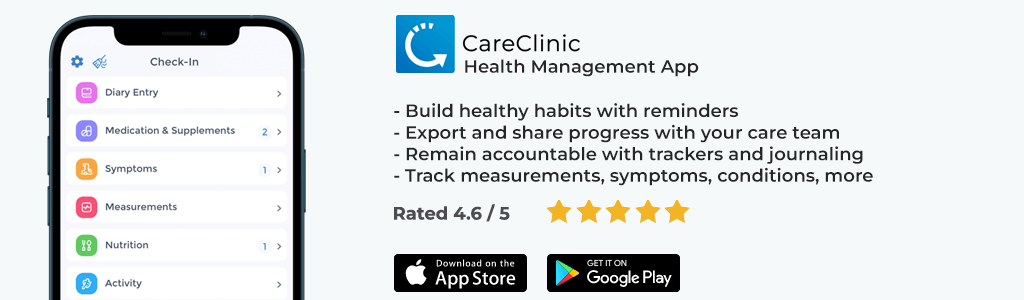
CareClinic is an established longitudinal health-tracking product rather than a blank app template. Its patient experience already covers common tracking needs such as symptoms, medications, measurements, mood, sleep, activity, nutrition, journals, assessments, reminders and reports.
For an OEM or white-label project, that foundation can be scoped around a defined audience and program. A project may include app identity and branding, selected tracking areas, starting defaults, condition or program focus, onboarding, data access, reports and integration work.
Not every requested change is a setting. Some choices are per-user defaults, some are app-level configuration, and some require custom development. The first useful output is therefore a written scope that separates existing product capabilities, configuration, integration and new engineering.
A smaller team can also begin with CareClinic under its existing brand to validate the workflow before deciding whether a dedicated branded app is justified. For research-specific diary requirements, see Electronic Patient Diary Software Beyond Traditional ePRO.
Related CareClinic guides
- The Device Is Ready. The Patient App Is Not.
- A Reminder Is Not a Patient Support Program
- A Patient Diary Is Not Yet Real-World Evidence
Bring the workflow, not a 100-screen wish list
Tell the CareClinic team who will use the app, what they need to record, how often they will return, what your staff needs to review, where the data must go and which parts of the experience need your brand.
Discuss a White-Label Patient App
On the signup page, choose OEM or White Label. Use Patient Reported Outcomes (ePRO) instead when the main requirement is a clinical-trial or research diary. Do not include patient information in the inquiry.
Frequently asked questions
What is a white-label patient app?
A white-label patient app is an existing health or patient-engagement platform configured and released under another organization's brand. The scope may include app identity, selected features, onboarding, content, data access, integrations and support responsibilities.
Is a white-label health app the same as a custom app?
No. A custom app is designed and engineered specifically for one organization. A white-label app starts with an existing maintained product and configures or extends it for the partner. Some white-label projects still include custom development.
Who should consider an OEM patient app?
Common buyers include digital-health startups, medical-device companies, CROs, EDC or research-software vendors, clinics, care programs, patient organizations and wellness companies that need a recurring patient experience but do not want to rebuild common mobile infrastructure.
Can the app use our company name and branding?
A white-label scope can include the app name, icon, colors, launch assets, store presentation and program-specific onboarding. The parties should decide whose store accounts and app identifiers will own the release before development begins.
Can we start with CareClinic and white-label later?
Yes. A smaller team may begin with the existing CareClinic experience to test the workflow, participant burden and staff process. A later branded build can then be based on evidence from actual use rather than assumptions.
Does a white-label app automatically become a medical device?
No. Regulatory status depends on the intended use and functions, not simply on whether the app is custom or white-labeled. Software intended for diagnosis, treatment, mitigation or prevention may require a different assessment from software used to organize and record information.
Does HIPAA apply to every branded health app?
No. HIPAA applicability depends on the organizations and relationships involved, including whether the app developer acts on behalf of a covered entity. Other privacy, consumer-protection and breach-notification rules may still apply when HIPAA does not.
How long does a white-label patient app take to launch?
Timing depends on branding, required features, store-account readiness, integrations, content, languages, privacy review, validation expectations and custom development. A vendor should provide a scope-based plan rather than promise one universal launch date.
Can CareClinic support a white-label ePRO app?
CareClinic accepts both OEM or white-label inquiries and ePRO inquiries. The correct path depends on whether the main requirement is a branded longitudinal patient experience or a protocol-driven clinical-research workflow.
Educational information only. This article is not legal, regulatory, clinical, security or app-store advice. Organizations should assess their intended use, data flows, contracts, jurisdictions and release requirements with the appropriate professional advisers.